In This Article
- The Short Version: What Seed Oils Actually Are
- How Seed Oils Are Made (And Why It Matters)
- How Did These Oils Take Over Everything?
- The Health Concerns: What People Actually Worry About
- What Seed Oils Are NOT
- The Other Side: Why Some Experts Disagree
- So What Do You Actually Do With This Information?
- Frequently Asked Questions
- The Bottom Line
- References
What they are, where they hide, and why so many people are quietly removing them from their kitchens.
I’ll be honest. When I first heard people talking about “seed oils” online, I figured it was another wellness fad. Like the people who swear by celery juice or think microwaves are poisoning them. Another group of internet health people finding something new to panic about.
The thing that finally got me to take it seriously was watching a bunch of Dave Asprey content. The before-and-after pictures of his face are striking. He talks openly about how chronically inflamed he used to be. Red, puffy, swollen-looking. Brain fog so bad he couldn’t focus on his own work. He overhauled his diet, pulled the seed oils out completely, dialed up his omega-3 intake, and his face changed. The puffiness went away. The redness calmed down. The brain fog lifted. Same person, different physiology.
I’d been writing off my own version of that as just “getting older.” Some occasional puffiness in my face, especially in the morning. A persistent low grade hum of inflammation I’d stopped really noticing. Once I started paying attention to what Asprey was describing, I recognized too much of it in myself. So I started reading the actual research. Not the influencer posts. Not the TikTok clips. The published studies, the consumption data, the manufacturing process. I came out the other side thinking this might actually be worth paying attention to.
I’ll tell you what happened to me further down. The short version: it took longer than I expected. Omega-6 fats sit in your tissue. They don’t flush out in a week.4
This article is the explainer I wish someone had given me when I first went down this rabbit hole. No scare tactics, no conspiracy theories, no one trying to sell you a $90 bottle of specialty oil. Just a clear, practical breakdown of what seed oils are, how they took over the food supply, what the real concerns are, and what you can do about it if you decide you care.
The Short Version: What Seed Oils Actually Are
Seed oils are cooking oils extracted from the seeds of plants using industrial processing. That’s it. That’s the core definition.
The word “industrial” is doing a lot of work in that sentence, though. Because these aren’t oils you could make in your kitchen. They require heavy machinery, chemical solvents, high heat, and multiple rounds of refining to produce. The process looks a lot more like a chemical plant than a food kitchen.
The Seed Oils People Are Talking About
- Soybean oil (the single most consumed oil in America)
- Canola oil (also called rapeseed oil on some labels)
- Corn oil
- Sunflower oil
- Safflower oil
- Cottonseed oil
- Grapeseed oil
- Rice bran oil
Notice what’s NOT on that list: olive oil, coconut oil, avocado oil, butter, ghee, lard, tallow. Those are all extracted through simpler mechanical processes (pressing, churning, rendering) and have been part of human diets for hundreds or thousands of years. The seed oils above? Most of them didn’t exist as food products until the early 1900s.
How Seed Oils Are Made (And Why It Matters)
This is the part that changed my perspective. Because when you see what it takes to turn a soybean or a canola seed into a bottle of clear, odorless cooking oil, the word “natural” starts to feel like a stretch.
Here’s the standard process for most industrial seed oils:
Step 1: The seeds are crushed and heated. This breaks down the cell structure to release more oil. Temperatures typically hit around 200°F or higher during this phase.
Step 2: Chemical solvent extraction. The crushed seeds are bathed in hexane, a petroleum derived chemical solvent, to pull out as much oil as possible. Hexane is also used as an industrial degreaser and in the production of glue. The FDA allows trace amounts to remain in the finished product. How much? They don’t specify a limit for cooking oils. That bothered me when I found out.
Step 3: Degumming. The crude oil gets treated with phosphoric acid or citric acid to remove phospholipids and other gummy substances.
Step 4: Neutralization. Sodium hydroxide (lye) is added to remove free fatty acids that would make the oil taste bad.
Step 5: Bleaching. The oil is run through bleaching clay to remove pigments so it comes out looking clear and pale rather than dark and murky. This is purely cosmetic.
Step 6: Deodorizing. The oil is heated to extremely high temperatures (over 450°F) and steam stripped to remove any remaining odor or flavor. This step is what makes all these oils taste like basically nothing.
Compare that to olive oil: you pick the olives, you crush them, you collect the liquid. People have been doing it the same way for literally thousands of years. Or butter: you churn cream. That’s it. Or tallow: you render animal fat slowly over low heat. One ingredient, one step.
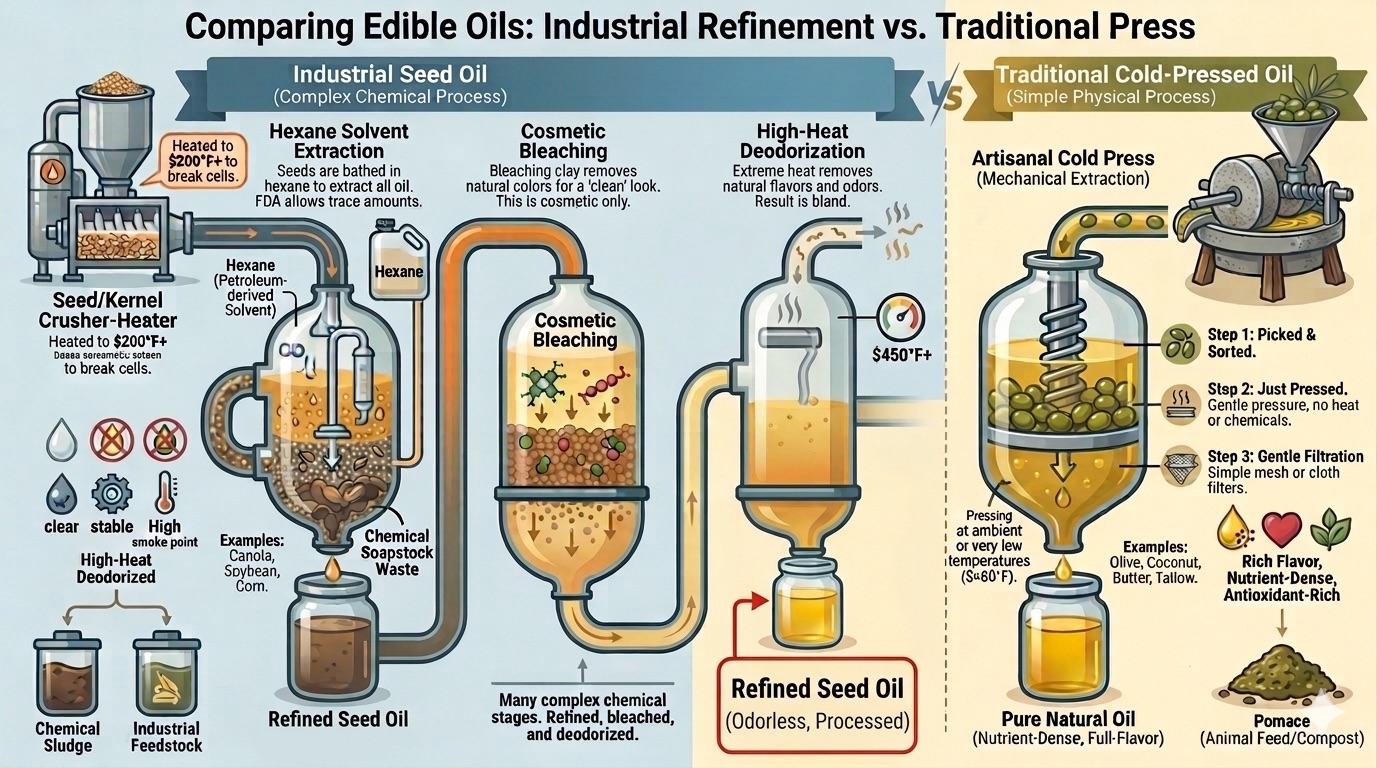
Industrial seed oil refinement vs. traditional cold press methods.
How Did These Oils Take Over Everything?
Here’s the part that’s genuinely fascinating if you’re a history nerd. Seed oils didn’t become America’s primary cooking fat because they’re healthier. They became dominant because of economics, government policy, and one very effective marketing campaign.
A Quick Timeline
1911: Procter & Gamble launches Crisco, the first mass market product made from cottonseed oil. Before this, Americans cooked with lard, butter, and tallow. Crisco was marketed as the “modern, clean” alternative. It was also much cheaper to produce.
1940s-1950s: Soybean production explodes in the U.S. because soybeans are cheap to grow and the government subsidizes them heavily. Soybean oil becomes an extremely cheap byproduct. The food industry needs something to do with all of it.
1961: The American Heart Association officially recommends replacing saturated fats (butter, lard, tallow) with polyunsaturated vegetable oils. This single recommendation changed the entire trajectory of American cooking. Crisco, corn oil, and soybean oil go from cheap industrial products to “heart healthy” choices overnight.
1970s-1990s: The low fat movement kicks into high gear. Fat is the enemy. But food without fat tastes terrible, so manufacturers dump cheap seed oils into everything to compensate. Soybean oil consumption skyrockets.
2000s-present: Seed oils are now in roughly 60% of packaged foods in the U.S. They’re the default frying oil for every major restaurant chain. Americans consume an estimated 80+ grams of soybean oil per day, up from essentially zero a hundred years ago.
The point here isn’t that there’s some grand conspiracy. There isn’t. It’s simpler than that. Seed oils are cheap to produce, the government subsidizes the crops they come from, and a few well timed (but now widely questioned) health recommendations made them the default. Once they became the default, the entire food industry built around them. Changing that is like trying to un pave a highway.
The Health Concerns: What People Actually Worry About
This is where things get complicated, because the science is genuinely unsettled. I’m not a doctor, a nutritionist, or a researcher. What I can do is lay out the main concerns that have people re thinking these oils, and let you draw your own conclusions.
Concern #1: Omega-6 to Omega-3 Ratio
This is the big one. Your body needs both omega-6 and omega-3 fatty acids. Neither one is “bad” on its own. The issue is the ratio.
For most of human history, people consumed omega-6 and omega-3 fats in a ratio somewhere around 1:1 to 4:1. The current estimated ratio in the standard American diet is between 15:1 and 20:1.3 Some researchers have estimated it could be as high as 25:1 in people who eat a lot of processed food.
Seed oils are one of the primary drivers of that shift. Soybean oil alone is roughly 54% omega-6 (linoleic acid). Corn oil is about 58%. Sunflower oil can be over 65%. When these oils are in everything you eat, the omega-6 adds up fast.
Why does the ratio matter? Omega-6 fatty acids are precursors to pro inflammatory compounds in the body. Omega-3s are precursors to anti inflammatory compounds.1,2 Neither inflammation response is inherently “bad.” Your body needs both. But a dramatically lopsided ratio, the thinking goes, could push your body toward a chronically inflamed state. Chronic low grade inflammation is associated with heart disease, type 2 diabetes, obesity, and a bunch of other conditions nobody wants.
Concern #2: Oxidation and Instability
Polyunsaturated fats (which make up the majority of most seed oils) are chemically unstable. They have multiple double bonds in their molecular structure, and those bonds are vulnerable to breaking down when exposed to heat, light, or air. When they break down, they oxidize.5,8 Oxidized oils produce compounds like aldehydes and lipid peroxides, which are not things you want floating around in your bloodstream.
This matters because seed oils are used for deep frying, pan frying, baking, and high heat cooking, situations where oxidation is most likely to occur. Restaurants reuse fryer oil for days.6 Home cooks heat these oils to smoking and beyond without thinking about it. Every time that happens, the oil degrades a little more.
Saturated fats (butter, coconut oil, tallow) and monounsaturated fats (olive oil, avocado oil) are much more chemically stable. They have fewer vulnerable double bonds, so they hold up better under heat. That’s basic chemistry, not opinion.7
Concern #3: Processing Residues
Remember the hexane extraction we talked about earlier? The deodorizing at 450°F? The bleaching clay? Each step in that process has the potential to leave trace residues or create byproducts that wouldn’t exist in a minimally processed oil.
The high temperature deodorizing step is particularly interesting. Research has shown it can create small amounts of trans fats in the finished oil, even in oils that are labeled “0g trans fat.” Current labeling rules allow manufacturers to round down to zero if a serving contains less than 0.5 grams. If you’re cooking with these oils daily, those trace amounts add up over weeks and months.
Concern #4: They’re Everywhere, So Exposure Is Constant
Maybe the most practical concern of all. Even if each individual exposure to seed oils is small, the cumulative effect is enormous because they’re in virtually everything.
Your morning coffee creamer. The bread for your toast. The salad dressing at lunch. The cooking oil for dinner. The snack crackers you grab at 3pm. The restaurant meal on Friday night. Every single one of those could contain soybean, canola, or sunflower oil. When one ingredient shows up in that many meals across that many days, it becomes a significant portion of your total fat intake whether you’re aware of it or not.
I wrote a full room by room breakdown of every common food that contains seed oils if you want to see just how pervasive they are. The list is longer than most people expect.
What Seed Oils Are NOT
In the interest of being fair, let me push back on some of the more extreme claims you’ll see online. Because the seed oil conversation has a fringe element that doesn’t help anybody.
Seed oils are not “poison.” If they were, half the country would be in the hospital right now. Most Americans consume these oils multiple times a day and have been doing so for decades. Calling them poison is inflammatory and unserious.
Seed oils are not the sole cause of obesity, heart disease, or any other condition. Diet is complicated. Health is complicated. Anyone selling you a narrative where one ingredient is the villain and eliminating it solves everything is oversimplifying to the point of dishonesty.
A single meal containing seed oils will not hurt you. If you eat fries at a restaurant once a week, you’re going to be fine. The concern is about chronic, daily, high volume consumption over years and decades. Not the occasional exposure.
Not everyone who avoids seed oils is a conspiracy theorist. Some people just prefer to eat less processed food in general. Avoiding seed oils is one way to do that. It doesn’t mean you think the government is trying to poison you.
The Other Side: Why Some Experts Disagree
I’d be doing you a disservice if I didn’t mention that plenty of registered dietitians, cardiologists, and nutrition researchers think the anti seed oil movement is overblown. Their arguments, in brief:
The AHA still recommends them. The American Heart Association continues to recommend polyunsaturated vegetable oils as replacements for saturated fat. They point to studies showing that this swap is associated with lower LDL cholesterol.
Randomized controlled trials are mixed. Some intervention studies show benefits from replacing saturated fat with seed oils. Others show no benefit, or mixed results. The famous Minnesota Coronary Experiment and Sydney Diet Heart Study both had results that complicated the “seed oils are better” narrative, but they also had methodological issues that critics point out. The data, in both directions, is messy.
Dose and context matter. Using a tablespoon of canola oil to sauté vegetables at home is a very different situation than drinking a milkshake that contains soybean oil as filler, or eating fried chicken from a restaurant that reuses fryer oil for a week straight. Lumping all seed oil exposure into one category might be misleading.
So What Do You Actually Do With This Information?
If you’ve read this far and you’re thinking “okay, I want to at least cut back,” here’s the practical playbook. It’s simpler than most people make it.
Start With Your Cooking Oil
This is the single highest impact change you can make. If you’re currently cooking with canola oil, vegetable oil, or corn oil, swap it out. Extra virgin olive oil for low and medium heat cooking. Avocado oil for high heat. Butter or ghee for anything that benefits from the flavor. That one change affects every meal you make at home.
Personally, I keep algae oil in my kitchen for high heat cooking. It has the highest smoke point of any cooking oil, a completely neutral taste, and a fatty acid profile that’s mostly monounsaturated. Not many people know about it yet, but I think it’s going to become a lot more popular in the next few years.
Learn to Read Labels
This is step two and it’s the one that takes the most effort upfront. Flip products over. Read the ingredient list. Look for soybean oil, canola oil, sunflower oil, corn oil, cottonseed oil, safflower oil, or the phrase “vegetable oil.” Once you start looking, you’ll find them in places you never expected. Bread. Coffee creamer. Protein bars. “Healthy” granola. The list goes on.
I put together a full kitchen audit guide that goes category by category through every common product that contains seed oils, with specific brand names and clean alternatives for each one.
Replace Your Condiments
Condiments are the second biggest daily source of seed oils for most families. Your mayo, salad dressings, ketchup, pasta sauce, and cooking sprays are almost certainly made with soybean or canola oil. The good news is that clean alternatives exist for every single one of these. We tested a bunch of them and put together a brand by brand guide to seed oil free condiments that covers mayo, ketchup, mustard, dressings, pasta sauce, and more.
Don’t Be Weird About It
Seriously. This is important. Don’t become the person who can’t eat at a restaurant, won’t go to a friend’s dinner party, or lectures strangers about their grocery cart. Your daily habits matter way more than occasional exposures. If you’ve cleaned up your home kitchen, that covers probably 80% of your total fat intake. The remaining 20% from restaurants and social situations is not going to undo all of that. Perfectionism is the enemy of sustainability when it comes to dietary changes.
What I Actually Did (And How Long It Took)
I owe you the personal version of this since I made a vague promise about it earlier.
The whole switch was simpler than I expected. I just replaced things over time. When the canola oil ran out, I bought avocado oil instead. When the salad dressing bottle was empty, I started making my own with EVOO and lemon. When I needed something for searing steaks or pan-frying chicken thighs, I bought a tub of beef tallow.
That’s basically the whole methodology. Find what you were using the seed oil for and pick the right replacement for that purpose. There isn’t one alternative that does everything well. Avocado oil and EVOO for salad dressings and finishing oils. Avocado oil and beef tallow for higher heat cooking. Butter and ghee for eggs and most pan cooking. That covers maybe 95% of the situations where seed oils used to be the default in my kitchen.
The harder part was getting the omega-6 fats already in my system to clear out. That took longer than I expected. Not weeks. Months. The puffiness in my face came down gradually. The mid-afternoon brain fog I’d been treating with more coffee started lifting. My skin got a little less reactive. None of it was dramatic on any single day. But somewhere around the four or five month mark I caught a photo of myself and noticed I just looked different. Less swollen. The kind of thing nobody else would point out, but you can tell when it’s your own face.
The other thing I noticed: when I did eat seed oils after months of avoiding them, like getting fries at an airport, I’d feel it the next day. Slight puffiness, kind of foggy. Whether that’s real biological response or me paying more attention because I’d been avoiding it, I don’t know. But it’s been consistent enough that I trust the signal.
If you’re starting from scratch, this is what I’d buy first:
A good extra virgin olive oil and a bottle of avocado oil. The EVOO does the flavor work. Avocado oil is the neutral one when you don’t want olive flavor competing with the dish.
A jar of grass-fed beef tallow and the same avocado oil. Tallow handles real high heat (steaks, hash browns, anything that needs a hard sear). Avocado oil is the neutral fallback for medium-high cooking.
Real butter. Ghee if you want a slightly higher smoke point and a richer, slightly nutty flavor. That’s the whole list.
Butter or lard, depending on what you’re baking. Lard makes pie crust that nothing else can match. Butter handles cookies, cakes, anything you want to taste like butter.
That’s it. Six items, total. Replace the seed oils as they run out. Don’t throw working bottles away in a panic. Give your tissues time to turn over. The slow path actually works better than the dramatic-overnight-overhaul approach because you can sustain it without thinking about it.
Frequently Asked Questions
They’re processed the same way and have similar omega-6 profiles, though canola has a slightly better ratio than soybean. In practical terms, most people who avoid one also avoid the other. Neither is something I choose to cook with at home.
These skip the hexane extraction step, which is a genuine improvement. But the oil itself still has the same fatty acid composition, which means the omega-6 and oxidation concerns remain. Cold pressed canola oil is still canola oil. It’s just extracted more gently.
No. This is a myth that circulates on social media. Seed oils are legal and widely used in Europe, Asia, and everywhere else. Some countries do use more olive oil (Mediterranean countries) or coconut oil (Southeast Asia) as their primary cooking fat, but that’s cultural preference, not regulation. No government has banned seed oils.
Extra virgin olive oil is mostly monounsaturated fat (oleic acid), which is much more stable than the polyunsaturated fats in seed oils. It also contains polyphenols and antioxidants that have been studied extensively. And it’s produced by a simple mechanical pressing process rather than chemical extraction. It’s not perfect (no food is), but its track record across thousands of years of human consumption is pretty hard to argue with.
Swap your cooking oil. If you’re using vegetable oil or canola oil at home, replace it with extra virgin olive oil or avocado oil. This one change affects every meal you cook and removes the single largest controllable source of seed oils from your diet.
No. Absolutely not. You ate what was available, affordable, and recommended by the mainstream nutrition establishment. That’s what any reasonable person would do. The information is changing and your choices can change with it. Looking backward doesn’t help. Just start making different choices going forward.
The Bottom Line
Seed oils are industrially processed cooking fats that went from nonexistent to ubiquitous in about a hundred years. They’re cheap, they’re everywhere, and the health debate around them is real but unresolved. The concerns about omega-6 ratios, oxidation, and chronic inflammation are worth taking seriously. The claims that they’re literal poison are overblown.
My personal approach is pretty simple: I cook with olive oil, avocado oil, butter, ghee, and occasionally algae oil when I have a rippin’ hot pan and need to sear a steak. When I fry things, I go with beef tallow, coconut oil, and occasionally duck fat for the tastiest fries you’ll ever eat. I read labels on everything I buy. I’ve replaced the worst offenders in my kitchen. And I don’t stress about the occasional restaurant meal or social situation where seed oils are involved. That balance works for my family. Maybe it works for yours too.
The single best thing you can do is educate yourself, decide where your comfort level is, and make changes at whatever pace feels sustainable. Don’t let perfect be the enemy of good. And definitely don’t let internet strangers bully you into feeling bad about a bottle of canola oil that’s been in your pantry since 2023. Just use it up and buy something different next time.
Ready to Clean Up Your Kitchen?
Start with our Best Seed Oil Free Condiments guide for brand by brand picks you can swap in this week. Then check our Foods With Seed Oils to Avoid for a full kitchen audit, shelf by shelf. If snacking is your weak spot, we’ve got a seed oil free snacks guide too. And for a deep look at which cooking fats are actually worth using, see our cooking oils guide and our breakdown of heart healthy cooking oils.
Related reading: Best Seed Oil Free Condiments · Foods With Seed Oils to Avoid · Best Seed Oil Free Snacks · Best Seed Oil Free Cooking Oils and Fats · Tallow vs Lard · Heart Healthy Cooking Oils · Best Water Filters for Home · Why I Avoid Seed Oils · Seed Oil Free Restaurants Guide · Is There a Healthy Vegetable Oil?
References
- Simopoulos AP. The importance of the ratio of omega-6/omega-3 essential fatty acids. Biomedicine & Pharmacotherapy. 2002;56(8):365-379. PubMed
- Simopoulos AP. Evolutionary aspects of diet, the omega-6/omega-3 ratio and genetic variation: nutritional implications for chronic diseases. Biomedicine & Pharmacotherapy. 2006;60(9):502-507. PubMed
- Blasbalg TL, Hibbeln JR, Ramsden CE, Majchrzak SF, Rawlings RR. Changes in consumption of omega-3 and omega-6 fatty acids in the United States during the 20th century. American Journal of Clinical Nutrition. 2011;93(5):950-962. PubMed
- Guyenet SJ, Carlson SE. Increase in adipose tissue linoleic acid of US adults in the last half century. Advances in Nutrition. 2015;6(6):660-664. PubMed
- Grootveld M, Atherton MD, Sheerin DH, et al. In vivo absorption, metabolism, and urinary excretion of alpha,beta unsaturated aldehydes in experimental animals. Relevance to the development of cardiovascular diseases by the dietary ingestion of thermally stressed polyunsaturate rich culinary oils. Journal of Clinical Investigation. 1998;101(6):1210-1218. PubMed
- Moumtaz S, Percival BC, Parmar D, Grootveld KL, Jansson P, Grootveld M. Toxic aldehyde generation in and food uptake from culinary oils during frying practices: peroxidative resistance of a monounsaturate rich algae oil. Scientific Reports. 2019;9:4125. PubMed
- Grootveld M. Evidence based challenges to the continued recommendation and use of peroxidatively susceptible polyunsaturated fatty acid rich culinary oils for high temperature frying practises. Frontiers in Nutrition. 2022;8:711640. PubMed
- Haywood RM, Claxson AW, Hawkes GE, et al. Detection of aldehydes and their conjugated hydroperoxydiene precursors in thermally stressed culinary oils and fats: investigations using high resolution proton NMR spectroscopy. Free Radical Research. 1995;22(5):441-482. PubMed
there is nothing for me to earn on it. Other posts on this site do contain Amazon
affiliate links, and they are disclosed as such where they appear.