Tallow vs Lard: Which Fat Is Actually Better for Cooking?
Two animal fats, two very different personalities. Here’s what matters and what doesn’t.
That sent me down a rabbit hole. Tallow led to lard, which led to leaf lard, which led to… pasture-raised leaf lard from pigs that eat acorns in Spain. I know. I know how that sounds. But here we are.
After two years of cooking with both fats pretty much daily, I have a clear picture of which one I grab for what. They’re genuinely different. Not interchangeable. And both deserve a spot in your kitchen for different reasons. Let me walk you through it.
What Are Tallow and Lard, Exactly?
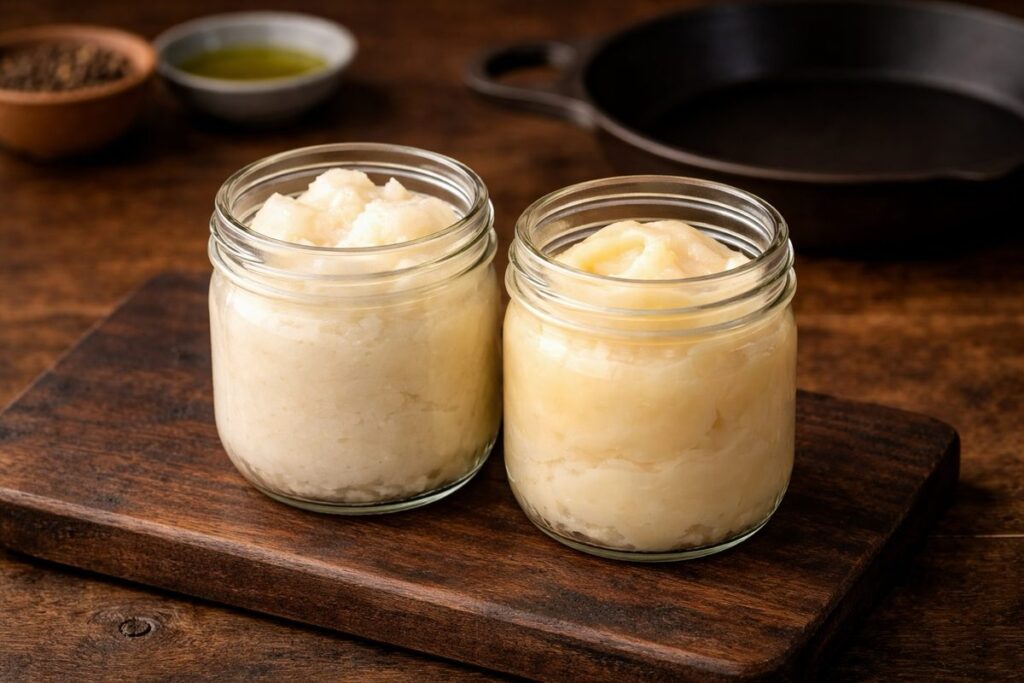
Tallow = rendered beef fat. You take the raw suet (that hard white fat packed around a cow’s kidneys and loins), chop it up, melt it down low and slow, strain out the crunchy bits, and what’s left is this creamy pale fat that firms up at room temp. Mild beefy smell. Waxy texture when it’s cool. Melts smooth in a hot pan.
Lard = rendered pork fat. Same idea, different animal. Take pork fat, melt it, strain it. You get a soft white fat that’s smoother than tallow and way more neutral in flavor. Good lard barely tastes like anything.
Here’s the thing most people don’t know: there are grades of lard. The fancy one is called leaf lard. It comes from the fat around the pig’s kidneys and loin area specifically. Almost zero pork taste. Silky smooth. Bakers have fought over this stuff for literally centuries because it makes pie crust that’s unfairly good. The regular stuff (sometimes called back fat lard) has more flavor to it. Still good, just different.
Tallow doesn’t have grades the same way, but the sourcing changes everything. Grass-fed/grass-finished beef makes tallow with a genuinely different fat profile than feedlot beef. More on that below. It actually matters.
Head to Head: Tallow vs Lard
I made this table because I kept looking up the same numbers over and over. Now they’re all in one place.
| Category | Beef Tallow | Pork Lard |
|---|---|---|
| Source | Rendered beef suet | Rendered pork fat |
| Smoke Point | ~400°F (204°C) higher | ~370°F (188°C) |
| Saturated Fat | ~50% | ~37% |
| Monounsaturated Fat | ~42% (oleic acid) | ~46% (oleic acid) higher |
| Polyunsaturated Fat | ~4% | ~17% |
| Flavor | Mild beefy, savory | Neutral to slightly porky (leaf lard = very neutral) |
| Texture (cold) | Firm, waxy | Soft, creamy |
| Best For | Frying, roasting, searing | Baking, pie crusts, frying, sautéing |
| Oxidative Stability | Very high better | High (but more PUFA = slightly less stable) |
| Calories (1 tbsp) | ~115 | ~115 |
| Vitamin D | Barely any | Up to 1,100 IU/tbsp (pasture-raised only) way higher |
| Shelf Life | 12+ months (pantry) | 6-12 months (fridge is better) |
| Dietary | Keto, Paleo, Whole30, Carnivore | Keto, Paleo, Whole30, Carnivore |
So what’s the takeaway? Tallow takes the heat tolerance and stability rounds. Lard takes monounsaturated fat content and, if it’s pasture-raised, vitamin D by a landslide. There’s no overall winner. They just do different things. Which is why I keep both.
What to Cook With Each
Numbers and nutrition profiles are great but the real question is what do I actually reach for when I’m standing in front of the stove. After two years of using both daily, here’s how it shakes out in practice.
When I Grab Tallow
Hot pan situations. That’s the short answer. The 400°F smoke point means I can get a cast iron absolutely screaming without the fat turning bitter or setting off the smoke detector (again). And the beefy undertone? It’s actually a feature with most savory cooking. Adds depth without being obnoxious about it.
When I Grab Lard
Baking, always. Also eggs, refried beans, stir fry, basic weeknight stuff where I don’t want every dish tasting like a steakhouse. Lard just disappears into the background and lets the food be the star. Exactly what you want from a cooking fat 80% of the time.
| Cooking Method | Tallow | Lard | My Notes |
|---|---|---|---|
| Deep frying | ✓ Best | ● Good | Tallow at 350-375°F is rock solid. Can reuse it 3-5 times easy. |
| French fries | ✓ Best | ● Good | The McDonald’s combo. Once you try tallow fries you can’t go back. |
| Searing steak | ✓ Best | ● Fine | Beef on beef. The flavors just work together. |
| Roasting veggies | ✓ Best | ✓ Great | Honestly both are amazing here. Tallow gives a slightly richer crust. |
| Pie crust | ✗ No | ✓ Best | Leaf lard. Game over. Flakiest crust you’ll ever pull out of an oven. |
| Biscuits / pastry | ✗ No | ✓ Best | That soft texture creates layers that butter can only dream about. |
| Sautéing | ✓ Great | ✓ Great | Both solid. Pick whichever flavor profile fits the dish. |
| Eggs | ● OK | ✓ Great | Lard’s neutral flavor lets eggs taste like eggs. Tallow adds richness some people love. |
| Fried chicken | ✓ Great | ✓ Great | Southern grandmas used lard. Both make insane crust though. |
| Refried beans | ● Fine | ✓ Best | Traditional recipe. Lard refried beans are a completely different food. |
| Flour tortillas | ✗ No | ✓ Best | Non-negotiable. Flour tortillas without lard are just sad flat bread. |
The cheat sheet: Tallow = frying and searing fat. Lard = baking and all-purpose fat. There’s overlap in the middle for things like roasting and general cooking, but they each own their lane.
The Health Conversation
OK so. The nutrition world is kind of imploding right now and tallow and lard are smack in the middle of it. Grab a snack (preferably one fried in tallow).
What We Were Told for 50 Years
Animal fats = bad. Vegetable oils = good. Crisco literally ran ad campaigns saying their hydrogenated vegetable shortening was healthier than grandma’s lard. That was the deal for like five decades. Margarine over butter. Canola over drippings. The American Heart Association slapped their little heart-check on everything except the stuff humans had been cooking with for thousands of years.
So what happened? Everyone switched. And then obesity tripled. Heart disease? Still here. I’m not saying correlation equals causation, but man, that’s an uncomfortable set of facts sitting next to each other.
What I Found When I Actually Looked at the Numbers
Here’s the thing that made me do a double take. Lard? The fat your grandmother cooked with that everybody acts like is a heart attack in a jar? It’s mostly monounsaturated fat. 46% oleic acid. The exact same fatty acid people high-five olive oil for having. Only 37% saturated. When someone calls lard “a saturated fat” they are factually wrong and I will die on this hill.
Then there’s the tallow situation. Yeah, it’s about 50% saturated fat. Scary number if you don’t look closer. But a huge chunk of that is stearic acid. Stearic acid is this weird outlier that study after study shows doesn’t raise LDL cholesterol the way palmitic acid does. It’s basically cholesterol-neutral. So “tallow is half saturated fat” is technically true but practically meaningless unless you know which saturated fats we’re talking about. Nobody ever asks that follow-up question though.
Then the 2026 Dietary Guidelines Dropped
I almost spit out my coffee. The USDA, the same agency that spent 30 years telling us to cut saturated fat, put out new guidelines in January 2026 that recommended butter and tallow alongside olive oil. Protein got bumped up as a priority. Ultra-processed foods got called out hard. I had to read it twice.
Does that mean tallow is a health food now? No. Let’s not be silly about it. But the federal government quietly admitting “hey maybe we were wrong about animal fats being poison” after three decades is… something. The science moved. The guidelines finally followed. Slowly, and without apologizing, but they moved.
Where I Actually Land on This
I’ll be straight with you: this isn’t settled. A big JAMA study tracked 200,000+ people and found plant-based oils correlated with lower mortality. That’s not nothing. You can’t just pretend that data doesn’t exist because it doesn’t fit the narrative you like.
At the same time, stearic acid keeps coming up neutral in controlled studies. And the oxidative stability thing is just chemistry. You heat up a PUFA-heavy oil and those double bonds start snapping, throwing off aldehydes and lipid peroxides and other stuff you definitely don’t want in your food. Tallow and lard don’t have that problem because their fats are mostly saturated and monounsaturated. Fewer molecular weak spots. Less breakdown. Less sketchy byproducts.
So here’s what I actually do: tallow or lard for anything hot. Olive oil and algae oil for cold stuff and lower temps. Soybean oil, corn oil, generic “vegetable oil”? Not in my house. But I also think the people on Twitter screaming that a drizzle of sunflower oil on a salad will destroy your mitochondria need to calm down. Dose matters. Application matters. Nuance is not dead, it’s just hiding.
Grass-fed Beef Tallow: Why It Actually Matters
“Grass-fed” gets slapped on everything now and half the time it’s marketing fluff. But with tallow? The sourcing actually changes what’s in the fat. Like, measurably. Lab-test-it-and-get-different-numbers different.
The CLA thing is real. Conjugated linoleic acid. Grass-fed tallow has 2 to 5 times more of it than feedlot tallow. Animal studies show anti-inflammatory effects and better insulin sensitivity. Human research hasn’t fully caught up yet, but there’s enough signal there that I think it’s worth paying attention to. Not worth building a religion around, but worth paying attention to.
Then there’s the fat-soluble vitamin situation. Grass-fed tallow carries more A, D, E, and K2. K2 is the sleeper nutrient that nobody was talking about five years ago. The theory (and growing evidence) is that it helps shuttle calcium into your bones and teeth instead of letting it park in your arteries. Still developing science. But interesting enough that I seek it out.
Omega ratio is better too. Not because tallow is secretly an omega-3 superfood (it isn’t, at all), but because grass-fed has less omega-6 in it. And when every other thing in the modern American diet is slamming you with omega-6, “less” is doing some heavy lifting.
Oh, and the stearic acid content runs higher in grass-fed. Since that’s the saturated fat that doesn’t seem to mess with cholesterol, more of it in the mix is a nice bonus.
Pasture-Raised Lard: The Underrated One
Tallow is the main character right now. TikTok loves it. Carnivore diet bros won’t stop posting about it. And meanwhile lard is just sitting there, quietly having a better nutritional profile in some ways, and nobody cares. Lard needs a publicist.
The Vitamin D Thing Is Wild
I cannot get over this stat. Lard from pigs that actually lived outside, in the sun, on pasture: up to 1,100 IU of vitamin D per tablespoon. Lard from pigs raised in a concrete barn with no windows: basically zero. Exact same species. Completely different product. All because one pig got to stand in sunlight and the other didn’t.
Here’s why that matters. Something like 40% of Americans are vitamin D deficient. Daily recommendation is 600 to 800 IU. A single tablespoon of the good lard and you’re set. A cooking fat. Covering your vitamin D for the day. This is the same ingredient the government spent 50 years telling us would kill us. Wild.
Choline (the Nutrient Nobody Talks About)
Your liver needs choline. Your brain needs choline. Something like 90% of Americans aren’t getting enough. And lard is a legit source. Pasture-raised lard has meaningfully more than the factory farm stuff, with some estimates putting it around 400 mg per cup. For reference, the daily adequate intake is 550 mg for men. So it adds up, especially when you’re cooking with it regularly anyway.
The Acorn-Finished Rabbit Hole
This is the part where I lose all pretense of being a normal person and go full food obsessive. I don’t care. It’s too interesting.
So in Spain and Portugal there are these Ibérico pigs that roam around oak forests eating acorns for months. That acorn diet basically transforms their fat. The oleic acid content shoots up to levels that compete with olive oil. The texture goes silky. There’s this faint nutty sweetness. It’s lard, technically, but it’s playing a completely different game.
Fatworks has an Ibérico lard from Dehesa-raised pigs. Pricey. I bought a jar anyway because I have no self-control when it comes to weird fats. Made a pie crust with it. I sat there staring at the pie for a while. It was like butter’s more interesting older sibling had shown up to Thanksgiving.
There are also Mangalitsa pigs, this curly-haired Hungarian breed that some US farms are now finishing on acorns. Super niche. Growing slowly. Similar concept, similar results in the lard quality.
To be clear: you don’t need fancy acorn lard for Tuesday night dinner. Regular pasture-raised lard is great. But if you bake a lot and you haven’t tried the Ibérico stuff at least once, you owe it to yourself. You’ll get it immediately.
How Do They Stack Up Against Seed Oils?
You knew this section was coming. Can’t talk about cooking fats in 2026 without getting into the seed oil thing. It got really loud this year, especially after those new dietary guidelines came out.
The Stability Issue (This Is the Big One)
Here’s the deal with soybean oil, corn oil, sunflower oil, canola. They’re packed with polyunsaturated fatty acids, PUFAs. Every PUFA molecule has these double bonds in its chain. Think of each double bond as a little structural weakness. Add heat and those weak spots start breaking apart.
What is PUFA? PUFA stands for polyunsaturated fatty acid. These are fat molecules with multiple double bonds in their carbon chain, which makes them chemically unstable when heated. The more double bonds, the faster the oil breaks down into harmful byproducts like aldehydes. Tallow and lard are mostly saturated and monounsaturated fat, which is why they hold up so much better under heat. Worth noting: PUFAs are not nutritionally “bad.” The American Heart Association points to evidence that dietary polyunsaturated fat can improve cholesterol markers. The concern with seed oils is specifically about what happens when you cook with them at high heat, repeatedly.
When that happens you get aldehydes. Lipid peroxides. A whole cocktail of byproducts with names you’d rather not Google. The more double bonds in the oil, the faster it falls apart. Linolenic acid is the worst. Then linoleic. Oleic acid holds up much better, which is why olive oil is more heat-stable than soybean oil even though they’re both liquid at room temp.
Now compare that to tallow and lard. Their fat is mostly saturated and monounsaturated. Way fewer double bonds. Way fewer weak points. I deep fry with tallow, let it cool, strain it through cheesecloth, stick the jar in the pantry, and use it again next week. Tastes fine. Holds up fine. (We wrote a whole guide on the healthiest oils for frying if you want the full comparison.) Try doing that with canola oil five times in a row. By round three it smells like a tire fire and tastes like sadness.
There’s published research backing this up too. One study found palm oil (saturated fat heavy) barely changed its fatty acid composition after 40 hours of continuous frying at 360°F. Sunflower oil degraded significantly over the same test. Another paper in the International Journal of Food Properties confirmed the obvious: PUFA-heavy oils produce the most oxidative breakdown products when you fry with them. Not exactly shocking once you understand the chemistry, but nice to have in print.
OK But What About Cholesterol
Gotta be honest here. PUFAs do lower LDL cholesterol compared to saturated fats. That’s been documented a bunch of times and I’m not going to pretend the data doesn’t exist just because it’s inconvenient for my argument.
But. “Lower LDL” and “better health outcomes” are not the same sentence. Particle size matters. Oxidized LDL is the actually dangerous type. And we keep coming back to this: not all saturated fats do the same thing. Stearic acid, the main one in tallow, doesn’t appear to raise LDL at all. Palmitic acid does. Saying “saturated fat raises cholesterol” without specifying which saturated fat is like saying “all mushrooms are poisonous.” Technically they’re in the same category. Practically, that’s useless information.
What I Actually Do
Soybean oil, corn oil, generic “vegetable oil” (which is just soybean oil in a trench coat), none of that is in my kitchen and hasn’t been for years. Better options exist at literally every price point. Hot cooking gets tallow or lard. Lower temps and salad dressings get good California EVOO or algae oil.
That said? I think the seed oil panic crowd goes too far sometimes. If you eat a salad dressing at a restaurant that was made with a little canola oil, you’re going to be fine. You’re not going to spontaneously combust. A Popeyes deep fryer reheating the same soybean oil for the 40th time is a very different scenario than cold-pressed sunflower oil drizzled on a tomato. Scale and context matter. Let’s not lose our minds here.
Once you’ve sorted out your cooking fats, the next biggest source of seed oils is packaged snacks and condiments. We put together guides on seed oil free snacks and seed oil free condiments with specific brand recommendations if you want to keep going.
Best Brands to Buy
Tallow
Fatworks Organic Grass-Fed Beef Tallow

Grass-fed + Grass-finished
This is where I’d start. Fatworks was early to the rendered animal fat game before it was trendy, and their quality has stayed consistent. Organic, grass-fed and finished, sourced from small US family farms. No additives, no preservatives, no hydrogenation. Glass jar. Clean mild flavor. I’ve gone through probably 15 jars of this stuff at this point.
Pros: Organic, truly grass-finished, clean flavor, glass jar, Whole30 approved.
Cons: 14 oz disappears fast when you fry with it. The price per ounce stings if you’re going through jars weekly.
Epic Provisions Beef Tallow

Grass-fed
If you want to grab tallow off a shelf today without ordering online, Epic is probably your best shot. Whole Foods, Sprouts, most natural grocery stores carry it. Grass-fed (not always grass-finished, heads up), pasture-raised cattle. Consistent quality. Not the fanciest option but totally solid for everyday use.
Pros: Easy to find in stores, consistent quality, Non-GMO verified.
Cons: 11 oz jar is small. May not be grass-finished. Not organic.
Try Fatworks Tallow on Amazon (Epic no longer available on Amazon)
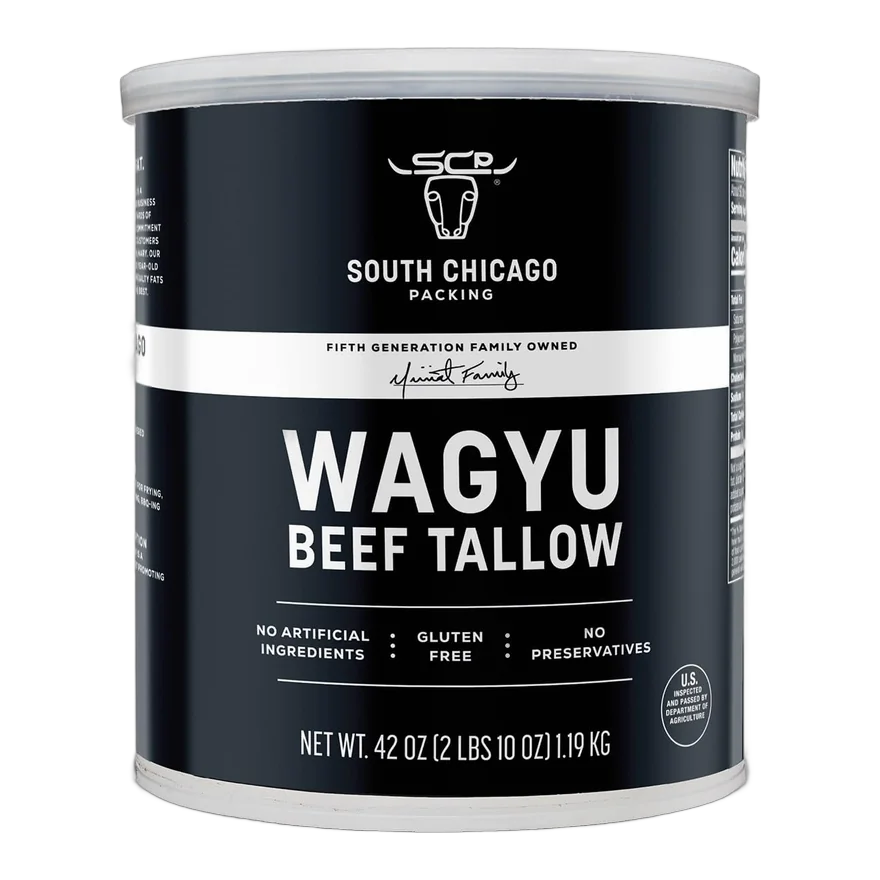
South Chicago Packing Wagyu Beef Tallow

Wagyu
Here’s the thing nobody tells you about tallow: if you want to actually deep fry with it (and you should, at least once), those little 14 oz jars get expensive real fast. South Chicago sells a 42 oz tub that makes frying practical. The wagyu fat has a higher monounsaturated content and a richer flavor. This is what I pull out when I’m doing a big batch of fries or fried chicken for company.
Pros: Practical size for frying, wagyu fat profile, good value per ounce.
Cons: Not organic. Not grass-finished (wagyu cattle are grain-finished). Plastic tub.
Lard
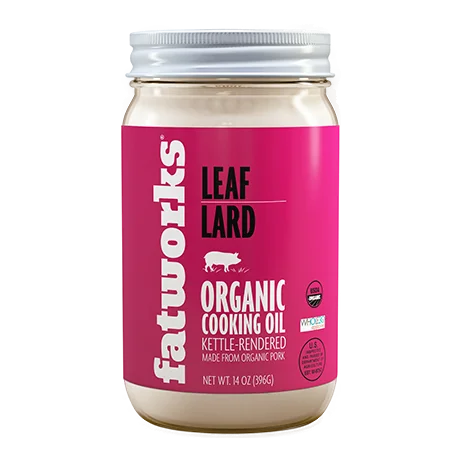
Fatworks Pasture-Raised Leaf Lard

Pasture-Raised | Leaf Lard
The gold standard. Leaf lard from pasture-raised pigs on small US family farms. This is the one bakers lose their minds over. Almost zero pork flavor. Clean, delicate, makes pie crust that’s unfairly flaky. But don’t sleep on it for frying either. The smoke point handles most cooking just fine. I keep one jar for baking and one for cooking because I go through it.
Pros: Leaf lard (highest grade), pasture-raised, barely any pork taste, incredible for baking.
Cons: You’ll blow through 14 oz faster than you expect. The gallon jug exists for a reason.
Fatworks Pasture-Raised Pure Pork Lard

Pasture-Raised
This is your daily driver lard. Back fat and belly fat from pasture-raised pigs. Slightly more flavor than the leaf lard but still pretty mild. Eggs, refried beans, stir fry, fried chicken, whatever. If you want one lard that does everything well (except maybe delicate pastry), this is the one. Good price-to-quality balance.
Pros: Versatile everyday fat, pasture-raised, good price per ounce.
Cons: A bit more porky than leaf lard. Wouldn’t use it in a delicate fruit pie.
Epic Provisions Pork Lard

Non-GMO
Same deal as their tallow: it’s everywhere, it’s consistent, and it’s a fine starting point. Not pasture-raised, not leaf lard, so you’re not getting the vitamin D benefits or the baking magic. But if you’ve never cooked with lard before and want to dip your toes in without committing $15 to a jar of leaf lard, Epic is a reasonable first buy.
Pros: Widely available, affordable, Non-GMO verified, decent all-around lard.
Cons: Not pasture-raised, not leaf lard. Entry-level product.
My Kitchen Setup
What I Actually Keep on Hand
I run both. Always. Tallow and lard serve different roles and I don’t want to pick one over the other. Along with ghee, avocado oil, olive oil, and algae oil, they cover every cooking situation I run into.
Tallow: French fries (the whole reason I got into this), searing steaks, roasting potatoes, roasting any root vegetable really. Anything where I want serious heat and savory flavor.
Leaf lard: Pie crusts, biscuits, flour tortillas. Anything baked where flaky layers are the goal.
Regular lard: Morning eggs, refried beans, fried chicken, weeknight stir fry. The everyday fat.
If you can only buy one: Savory cooks who don’t bake much, get tallow. Bakers who want one fat that handles everything, get lard. Everyone else, buy both. A jar of each costs maybe $25 total and they last months.
FAQ
Honestly, it depends what you’re optimizing for. Tallow handles higher heat better and has less polyunsaturated fat (which means less oxidation when frying). Lard is higher in monounsaturated fat, the same stuff in olive oil, and if it’s from outdoor pigs the vitamin D content is absurd. I don’t think either one “wins.” They’re both miles ahead of processed seed oils. Use the one that fits what you’re cooking.
Savory cooking? Go for it. They work pretty interchangeably for frying, roasting, sautéing. Baking though? No. Do not put tallow in a pie crust. It’s too firm, too beefy, and the result will be… not great. Leaf lard or butter for anything baked. Trust me on this one.
Sort of? It’s more like a background savory richness than an actual “I’m eating a burger” flavor. In fries and roasted vegetables it’s perfect. With eggs or fish, some people find it too present. Depends on your palate. If you want a completely neutral cooking fat, leaf lard is what you’re looking for.
Because raising pigs outdoors on actual pasture is expensive. They need land, they grow slower, the operations are smaller. But you’re getting a fundamentally different product. The vitamin D alone tells the story: conventional indoor lard has essentially zero, pasture-raised can hit 1,100 IU per tablespoon. If you’re using it for baking (smaller amounts per recipe), the price is pretty reasonable per use. For frying where you’d burn through a jar quickly, conventional Epic lard works fine.
This is low-key one of the best things about tallow. Let it cool down, pour it through cheesecloth or a fine mesh strainer into a mason jar. Stick it in the pantry. I get 3 to 5 frying sessions out of one batch before the flavor starts turning. Lard can go 2 to 3 rounds. Neither one falls apart like seed oils do because there’s so much less PUFA to oxidize.
Yeah I get asked this a lot. The short version: much of tallow’s saturated fat is stearic acid, and stearic acid keeps showing up as cholesterol-neutral in studies. The 2026 USDA guidelines also backed off the blanket “avoid saturated fat” language and focused more on cutting ultra-processed foods. All that said, if your doctor told you to limit saturated fat specifically, listen to your doctor. Not me. Not this article. Your doctor.
Tallow is easy. Pantry. Cool, dark spot. Lasts a year, probably longer. Lard I put in the fridge just to be safe, where it’ll keep 6 to 12 months easy. If you’re going through a jar in a few weeks (which, you might), counter is fine for lard too. Both freeze without any issues if you want to buy in bulk.
Oh absolutely. It’s embarrassingly easy and way cheaper than buying jars. Go to your butcher, ask for beef suet or pork fat. Half the time they’ll give it to you for next to nothing, sometimes literally free. Chop it up, throw it in a pot or slow cooker on low for a few hours, strain through cheesecloth, jar it. That’s the whole process. I’ll do a proper step-by-step guide on rendering at home soon.
Related reading: Best Seed Oil Free Cooking Oils and Fats · What Are Seed Oils? · Foods With Seed Oils to Avoid · Best Seed Oil Free Condiments · Best Seed Oil Free Snacks · Heart Healthy Cooking Oil