You can clean up your home kitchen in a weekend. Restaurants are harder. Here’s what actually works without turning dinner into an interrogation.
In This Article
Six months into my whole “clean up the kitchen” project, I had a moment at a restaurant that completely deflated me. I’d been so careful at home. New oils, reading every label, tossing stuff out. Felt pretty good about it. Then my wife and I went to a nice Italian place downtown and I ordered fried calamari without even thinking.
Soybean oil. That calamari was swimming in soybean oil. The bread basket? Baked with canola. The house vinaigrette on my salad? Sunflower oil with some herbs floating in it. My wife’s pasta got sauteed in whatever unlabeled “vegetable oil” was sitting next to the stove. I did the mental math later and figured that one dinner probably canceled out a week of being careful at home.
So I spent that night doing what I always do when something bugs me: reading everything I could find about which restaurants cook with actual good fats. Spoiler. Barely any of them. Certainly not the places where you and I eat on a random weeknight.
Good news, though. It’s not all hopeless. You won’t eat a perfectly seed oil free meal at most restaurants. But you can cut your exposure by a lot if you understand how restaurant kitchens work and you know what to order. That’s this article. Practical moves, not paranoia. I don’t want you dreading every dinner out.
The Restaurant Reality
I’m going to be blunt because I think it helps. Nearly every restaurant you walk into in the US is cooking with seed oils. It’s not malicious. It’s math. Seed oils are dirt cheap, flavor neutral, and they come in 35-pound jugs that commercial kitchens rip through like nothing.
I asked a buddy who manages a mid range grill in Charlotte about this. He showed me the invoice. A gallon of soybean oil: $3.50. Gallon of avocado oil: $28. Olive oil: somewhere in between, depends on the quality. His kitchen rips through 15 to 20 gallons a week. Do that math and you see why nobody in the restaurant business is racing to switch.
And fryers aren’t even the half of it. Watch an open kitchen sometime. Every burger, every chicken breast, every veggie order. The line cook grabs a squeeze bottle and squirts oil on the flat top. That bottle? Canola. Maybe a soy/canola mix. Salad dressings come from bulk containers. Soybean oil with vinegar and seasoning stirred in. The bread from whatever bakery supplier they use? Baked with “vegetable oil.” Even that “grilled” fish got a coat of oil before it hit the grate. The stuff is absolutely everywhere.
None of this is meant to scare you off from restaurants. I’m telling you so you walk in with your eyes open instead of thinking that grilled chicken entrée is somehow clean. A completely seed oil free restaurant meal at a normal American spot? Not really a thing. What IS a thing: doing way less damage than the person who just blindly orders whatever.
Chain Restaurant Breakdown: America’s Biggest Chains
I spent way too long researching this. Called some corporate numbers, read allergen guides, dug through nutrition PDFs, and checked every chain’s website for frying oil information. I looked at the 25 biggest restaurant chains in America. Here’s what I found.
I’m color coding this because it makes the bad news easier to swallow. Green means they’re using animal fats or at least something reasonable. Orange means it’s a mixed bag. Red means it’s the standard seed oil situation.
The Ones Actually Doing It Right
| Restaurant | Frying Oil | Grill/Flat Top | Notes |
|---|---|---|---|
| Outback Steakhouse | Beef tallow | Butter | The OG. Outback has been frying in beef tallow since they opened in 1988. Bloomin’ Onion? Tallow. Fries? Tallow. Wings, Sydney ‘Shrooms? All tallow. Steaks get finished in butter. I genuinely don’t understand why every steakhouse doesn’t copy this. |
| Steak ‘n Shake | 100% beef tallow | 100% Wisconsin butter | This one blew my mind. Early 2025, they ripped out the vegetable oil and went full tallow. Every fryer. Fries, onion rings, chicken tenders. March 2026 they dropped tallow tater tots. Burgers cook in real Wisconsin butter from a family farm. Not a single seed oil left in the building. |
| Popeyes | Beef tallow blend | N/A | Not pure tallow like the other two. They blend it with vegetable oils. But tallow is pulling weight in that fryer and you can taste it. Ever wonder why Popeyes chicken hits different from KFC? This is literally the reason. |
Three chains. Out of the entire US restaurant landscape, three major nationwide chains are frying in animal fat. Outback has been doing it quietly for almost 40 years. Steak ‘n Shake made a big public pivot. And Popeyes has been blending tallow into their fryers since day one. That’s your short list.
The Peanut Oil Tier (Better, Not Great)
| Restaurant | Frying Oil | Notes |
|---|---|---|
| Chick fil A | Refined peanut oil | All the chicken goes in 100% refined peanut oil. So far so good. Then you find out the waffle fries are cooked in canola. Why, Chick fil A? You were so close. Peanut oil sits at 32% PUFA, which isn’t great but it’s miles ahead of soybean’s 58%. |
| Five Guys | 100% peanut oil | Peanut oil for the fries, and the burgers just cook on a flat top without much added oil at all. Honestly? If you need a fast food burger and there’s a Five Guys nearby, that’s about as good as it gets. |
Peanut oil is a genuine step up from soybean or canola. It’s still 32% PUFA, so I’m not going to call it a health food. But it holds up better under heat, and both of these chains are at least consistent about using it. If Chick fil A would ditch the canola for their waffle fries, they’d be a solid green.
The Seed Oil Standard (Most of the Industry)
| Restaurant | Frying Oil | Notes |
|---|---|---|
| McDonald’s | Canola/corn/soybean blend | This is the one that kills me. McDonald’s used beef tallow until 1990 and the fries were legendary. Now? Canola, corn, soybean, hydrogenated soybean oil. They throw in “natural beef flavor” like that makes up for it. It does not. |
| Burger King | Soybean/canola blend | Vegetable oil blend with hydrogenated soybean. Nothing special here, just the default fast food seed oil playbook. |
| Wendy’s | Soybean/cottonseed blend | They mix soybean, canola, and cottonseed together. Fries, chicken, nuggets, if it touches the fryer it touches that blend. |
| Taco Bell | Canola oil | Made the switch to canola back in 2006. Chalupas, empanadas, anything that gets fried. Oh, and the rice? Cooked in soybean oil. You basically can’t dodge it here no matter what you order. |
| Sonic Drive In | Soybean/canola blend | Soy fryer shortening for every fried thing on the menu. Even the buns get hit with liquid margarine, which is also soy. Tots, fries, onion rings, corn dogs. The whole operation runs on it. |
| LongHorn Steakhouse | Soybean oil | Soybean in the fryers, canola on the grill. Here’s what makes me mad: Outback and LongHorn are both owned by Darden. Same parent company. Outback fries in tallow. LongHorn didn’t get the memo. |
| Olive Garden | Soybean/corn/canola blend | You’d think a place with “olive” in the name would cook with olive oil. Nope. Seed oil blends handle the frying and most of the cooking. They save the olive oil for drizzling on top at the end. Marketing, not cooking. |
| Applebee’s | Soybean oil | Refined soybean oil, everything, every dish. About what you’d expect from a place that microwaves half the menu. I’m being harsh but I’m not wrong. |
| KFC | Low linolenic soybean oil | They ditched the partially hydrogenated stuff in 2007 and switched to a “low linolenic” soybean variety. Sounds fancy. It’s still soybean oil. Colonel Sanders would be confused. |
| Panera Bread | Soybean oil | Panera loves marketing themselves as the “clean” fast casual option. Then you look at the ingredient list and it’s soybean oil in the fryer, sunflower and canola in the soups, palm oil in the pastries. Clean eating, dirty fats. |
| Chipotle | Rice bran oil | At least it’s not soybean, I’ll give them that. Rice bran oil clocks in around 35% PUFA with a rough omega-6 ratio. Not great, not the worst. Better than Taco Bell by a long shot, worse than Five Guys. |
| In N Out | Sunflower oil | They dumped cottonseed for sunflower oil around 2017. Non-GMO and expeller pressed, which sounds nice. But sunflower oil is 66% PUFA. The saving grace? Their burgers cook on a dry griddle with no oil at all. |
| Arby’s | Corn/soy/canola blend | The usual seed oil cocktail. Curly fries, mozzarella sticks, chicken tenders, all swimming in it. Nothing to see here. |
| Dunkin’ | Palm/soy/cottonseed blend | Your morning donut gets fried in a palm, soy, and cottonseed oil blend at 375 degrees. Hash browns too. If you’re just there for black coffee, you’re fine. Anything from the food menu? Nope. |
| IHOP | Soybean oil | Soybean oil in the fryers and a liquid margarine blend on the griddle. Think about that for a second. Your pancakes, the thing IHOP is famous for, get a coat of margarine on a flat top before the batter even hits. Brutal. |
| Cracker Barrel | Soybean oil | Looks like grandma’s kitchen. Cooks nothing like grandma’s kitchen. Soybean oil in the fryers, margarine on some griddle stuff, real butter in a few gravies. Grandma would not approve. |
| Waffle House | Canola oil | Canola in the fryers, liquid margarine on that famous flat top. Hash browns, waffles, eggs, every single thing that touches the griddle gets the margarine treatment. I still love Waffle House. I’m just honest about what I’m eating there. |
| Subway | Soybean oil | Here’s the thing about Subway. They don’t really fry anything. But soybean oil is baked into every single bread variety they make. Italian, 9-Grain Wheat, all of them. The sauces are soybean oil based too. You can’t escape it because the oil IS the bread. |
| Panda Express | Soybean oil | Possibly the worst offender on this entire list. Every wok entree gets blasted with soybean oil at screaming high heat. Orange chicken, kung pao, broccoli beef, chow mein, fried rice. The volume of oil going through those woks is insane. |
| Pizza Hut | Soybean/cottonseed oil | Soybean oil in the dough, hydrogenated cottonseed oil mixed in. That crispy pan pizza bottom? It gets that way because it sits in a pool of soybean oil while it bakes. Pizza chains are basically seed oil delivery systems pretending to be Italian. |
| Dairy Queen | Soybean oil | Fries, chicken strips, onion rings, all soybean oil. The Blizzards are a different story (dairy and sugar, not oil). But anything from the hot food side of the menu? Straight soybean. |
| Jack in the Box | Canola/soybean blend | They use a canola blend with “high oleic” canola and soybean oil. High oleic is marginally better than regular canola, sure. But you’re still eating a seed oil blend on your tacos, fries, and egg rolls. Marginally better is still bad. |
| Starbucks | Canola oil (transitioning) | Right now it’s canola in the egg bites, sandwiches, and pastries. But they made noise in 2025 about swapping to avocado oil. If they actually pull it off across the whole menu, that would be massive for a chain this size. I’m watching. Not holding my breath. |
| Domino’s | Soybean/canola oil | Soybean and canola baked right into the dough. Pan pizza pans get a spray of soybean oil. That “garlic butter” on the crust? Soybean oil in disguise. Even a cheese pizza isn’t clean here. |
Count that up. Out of 25 major nationwide chains, three fry in animal fat, two use peanut oil, one is making noise about switching to avocado oil, and the other nineteen are running some version of soybean, canola, corn, or cottonseed oil through their kitchens. That’s the reality of eating out in America right now.
The one that honestly makes me the angriest? LongHorn Steakhouse. Outback and LongHorn are both owned by Darden Restaurants. Same parent company. Outback has been frying in beef tallow since 1988. LongHorn is over there using soybean oil. Same corporate boardroom, completely different cooking philosophy. Make it make sense.
The Bright Spot: Steak ‘n Shake’s Tallow Turnaround
I need to give Steak ‘n Shake their own section because what happened there is genuinely wild. January 2025, the CEO announced they were ripping out every drop of vegetable oil and replacing it with beef tallow. Not some of it. All of it. By the end of February, all 436 locations had made the switch. Fries. Onion rings. Chicken tenders. And in March 2026 they dropped beef tallow tater tots.
But they didn’t stop at the fryer. Remember the “buttery blend” they used on the griddle? That was seed oil wearing a butter costume. Gone. Replaced with 100% Grade A Wisconsin butter from a family farm. Real butter. Steaks and burgers now cook in the stuff.
So you’ve got a nationwide fast food chain, 436 locations, with literally zero seed oils anywhere in the kitchen. And the food tastes noticeably better. If Steak ‘n Shake can pull this off at that scale, then every restaurant claiming “we can’t afford to switch” is just telling on themselves. They could. They just don’t want to eat the cost. Steak ‘n Shake decided the food mattered more than the margin, and I will drive out of my way to give them money for that.
The Seed Oil Free Restaurant Movement
While the big chains mostly drag their feet, something cool is happening at the local level. Small independent restaurants all over the country are going seed oil free and putting it right on their menu. There’s a site called Local Fats (localfats.com) that lists over 5,800 restaurants in 29 countries cooking without seed oils. Another one, Seed Oil Free Restaurants (seedoilfreerestaurants.com), does the same thing. I check both whenever I’m traveling somewhere new.
A few places that stood out to me when I was researching this:
- James Provisions in Hurst, TX. They list their cooking fats right on the website: olive oil, butter, ghee, coconut oil, bacon fat, duck fat, beef tallow. That’s it. No seed oils, period.
- Just BE Kitchen in Denver was one of the first spots to get “Seed Oil Free Certified.” Coconut, palm fruit, and olive oils are all they use.
- Farm to table spots in general skew heavily toward butter, olive oil, and animal fats. Not a guarantee, but your odds are way better at a place that actually cares about sourcing.
If there’s one near you, go eat there. I’m serious. Vote with your wallet. Every tallow burger you buy instead of a soybean oil one tells the industry something. And honestly, the food just tastes better when it’s cooked in real fat. There’s a reason older folks still talk about how good McDonald’s fries used to be. That was the tallow.
Smart Ordering Strategies
You can’t control what oil sits next to the stove in someone else’s kitchen. But you absolutely can pick menu items that keep you away from the worst of it.
Order grilled or roasted, not fried
This is your biggest weapon and it’s stupidly simple. Grilled chicken touches a grate that got a quick swipe of oil. That’s a tiny amount. Fried chicken? That thing sat submerged in a pool of soybean oil for the full cook time. We’re talking totally different quantities of fat absorption. I started defaulting to “grilled” for everything about a year ago and it’s become automatic now. When you can’t figure out what to order, just pick whatever says grilled or roasted on the menu.
Ask for butter instead of oil
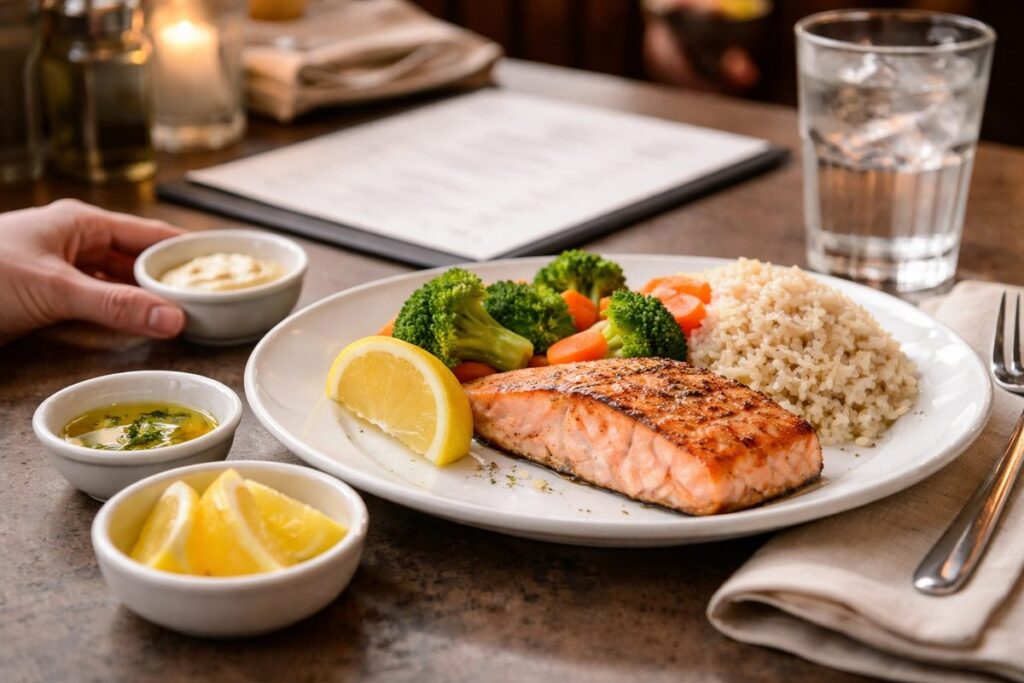
Butter exists in every restaurant kitchen on earth. First time I asked a server “can they use butter instead of oil for the salmon?” I was bracing for pushback. Nothing. She jotted it down, the kitchen did it, the salmon came out better than it would have in canola. I’ve done this maybe 40 or 50 times now at different places. Only got turned down twice, both times at fast casual spots where everything comes pre prepped. Sit down restaurants almost never have a problem with it.
Skip the dressing, dress it yourself
Dressings are the sneakiest source on the whole menu. That “house vinaigrette” sounds fancy but it’s probably 80% soybean oil with vinegar and some dried herbs tossed in. My move: “Can I get olive oil and vinegar on the side?” Every restaurant above the fast casual tier has olive oil somewhere in the kitchen. If they somehow don’t have it, grab lemon wedges. Lemon juice, salt, maybe some pepper over a salad. I was skeptical the first time. Now I actually prefer it to most bottled dressings.
Steak and baked potato is your friend
My go to panic order. If I’m at a new restaurant and nothing on the menu is obviously safe, steak and baked potato. The steak sears on a hot surface and the marbling does most of the work. Barely any added oil needed. Baked potato uses zero. Slap some butter and sour cream on the potato, call it done. I’ve fallen back on this exact combo at probably two dozen restaurants when I couldn’t figure out a better move.
Sashimi over rolls
Sushi joints are sneakily decent options if you know what to avoid. Sashimi is just raw fish, sliced. Zero oil touches it. Nigiri is the same deal. Where it gets messy: rolls with spicy mayo (seed oil), tempura anything (deep fried in seed oil), and those fancy drizzle sauces on top (seed oil base, always). My sushi order these days is sashimi, nigiri, soy sauce, wasabi. Maybe edamame if I’m hungry. It’s boiled. No oil involved.
Be strategic about sides
French fries are basically seed oil sponges with some potato flavor. Skip them. I know, I know. They’re good. But a basket of fries absorbs more soybean oil in one sitting than you’d consume at home in a week of cooking. Get a side salad, steamed veggies, baked potato, rice. Even the bread basket with butter is a better bet. Sure, the bread probably has a little soybean oil baked in. But “a little oil in bread” and “an entire serving of fries that sat in a fryer bath” are in completely different universes.
Best and Worst Cuisines for Seed Oil Avoidance
I didn’t figure this out until embarrassingly late. The type of restaurant you pick matters almost as much as what you order once you’re there. French food without butter isn’t French food. Italian food without olive oil doesn’t taste Italian. Those cuisines never swapped to seed oils because the traditional fat IS the flavor. Other cuisines, especially Americanized versions, quietly replaced lard and ghee with cheap vegetable oil years ago and nobody really noticed.
| Cuisine | Traditional Fats | Seed Oil Risk | Notes |
|---|---|---|---|
| French | Butter, duck fat, olive oil | Low | Traditional French cooking relies heavily on butter and animal fats. Higher end French restaurants are your best bet. |
| Italian | Olive oil, butter | Low Medium | Good Italian places use olive oil. Chain Italian restaurants (Olive Garden) use soybean blends. Quality matters here. |
| Japanese | Sesame oil (small amounts) | Low Medium | Sashimi, sushi, and grilled dishes are naturally low oil. Tempura is the exception (deep fried in vegetable oil). |
| Mediterranean/Greek | Olive oil | Low | Olive oil is central to the cuisine. Grilled meats, salads, and dips use olive oil as the default. |
| Mexican | Lard, tallow (traditional) | Medium | Authentic Mexican uses lard. Americanized Mexican restaurants switched to vegetable oil. Ask about the beans and tortillas. |
| Indian | Ghee (traditional) | Medium | Traditional Indian cooking uses ghee. Many restaurants have switched to vegetable oil for cost reasons. Ask if ghee is available. |
| Chinese (Americanized) | Soybean oil | High | Wok cooking uses large amounts of oil at high heat. Almost always soybean or canola at US Chinese restaurants. |
| Fast Food (all types) | Soybean/canola blends | Very High | Everything fried, every sauce, every bun. Seed oil is the foundation of the entire operation. |
The pattern should be jumping out at you. If a cuisine was built on olive oil, butter, or animal fat, and the restaurant takes those traditions seriously, you’re probably fine. French bistro? Great pick. Real Italian spot with an actual Italian chef? Go for it. Americanized Chinese takeout? That wok is getting blasted with canola or soybean oil at rocket high temperatures. Not all restaurants within a cuisine are equal, obviously. But this framework narrows your options fast.
How to Ask Without Being Annoying
I’ve played both roles here. I’ve been the guy grilling the server about cooking oils while my friends stare at the ceiling. I’ve also been the friend at the table watching someone else do that and silently wishing it would stop. Both perspectives taught me something.
Two years of trial and error (heavy on the error, at first) taught me the formula. Short questions. Specific requests. And for the love of god, don’t explain the biochemistry behind your request.
Good: “What oil does the kitchen use for the saute?” This is a direct question that takes three seconds to relay to the kitchen. The server will either know or will check.
Bad: “I’m trying to avoid seed oils because of the omega-6 to omega-3 ratio and the inflammatory cascade they trigger through the NF kb pathway…” Nobody needs to hear this at a restaurant. You’re not educating the server. You’re holding up the table.
Good: “Could they cook my fish in butter instead of oil?” Specific, actionable, easy for the kitchen to accommodate.
Bad: “Can you make sure nothing on my plate was cooked in any kind of vegetable oil, seed oil, or processed fat?” This is effectively asking the kitchen to guarantee something they can’t guarantee. The bread already has oil in it. The seasoning blend might have it. The marinade probably does. All or nothing requests put the server in an impossible position.
Pick your battles. The protein and how it’s cooked. That’s what matters. Let the bread roll go. A trace of canola baked into flour is not the thing that’s going to wreck your health. But becoming the person nobody wants to eat dinner with? That might actually wreck something more important.
When to Just Let It Go
This might be the most important section in this article.
I spent about three months being insufferable about seed oils at restaurants. I’d quiz servers, send things back, bring my own salad dressing in a little glass jar (yes, I actually did that once). My wife finally sat me down and said, in not so many words, that I was ruining dinner for everyone.
She was right. And once she spelled it out, the math hit me: there’s no good reason to obsess over restaurant meals.
Here’s why she was right. Most adults eat 80, maybe 85 percent of their meals at home. If you’ve already cleaned up your kitchen (and if you’re reading this article, you probably have or you’re about to), then your baseline seed oil intake is already way down. That 15 to 20 percent from restaurants? It’s not zero. But it’s also not the main driver anymore. Meanwhile, I was stressing over every single meal out, making my wife and our friends uncomfortable, basically turning dinner into a science experiment nobody signed up for. That stress? Cortisol? Also inflammatory. Nobody writes about the health cost of being insufferable at dinner, but I’m here to tell you it’s real.
Situations where I don’t even try:
- Someone else’s house. If your mother in law cooked dinner with Crisco, you eat the dinner and say thank you. Period.
- Work events. The catered lunch at an all hands meeting is not the hill to die on. Eat what’s there, make better choices at home later.
- Travel. You’re in a new city trying the local food. Half the point of travel is eating stuff you wouldn’t normally eat. Order what looks good.
- Special occasions. Birthday dinners, anniversaries, holidays. Enjoy the meal. One night of seed oil isn’t undoing months of good choices at home.
Every person I know who’s kept this up for more than a year treats it as a sliding scale. Not a switch. Zero seed oil is impossible unless you become a hermit. Dramatically less seed oil while still having dinner with friends, going on dates, traveling? Totally doable. And that’s more than enough.
Frequently Asked Questions
Are there any fast food chains that don’t use seed oils?
Actually, yes. Steak ‘n Shake switched to 100% beef tallow for all frying and real butter for the grill in early 2025. Zero seed oils in the kitchen. Outback Steakhouse has been frying in beef tallow since 1988. Popeyes uses a tallow blend. Five Guys and Chick fil A both use peanut oil, which beats soybean by a mile but still sits at 32% PUFA. And Starbucks announced plans to swap canola for avocado oil, though that’s still in progress. If I absolutely have to hit a drive through? Steak ‘n Shake. That’s my pick now.
Can I call ahead and ask what oil a restaurant uses?
I do this all the time. Called a Thai place near my house at 2:30 on a Tuesday once. Got the owner on the line. He told me they use soybean for the wok and peanut for deep frying. Took 30 seconds. That’s the sweet spot for calling: between 2 and 4pm, the dead zone between services. Small independent spots are way more likely to give you an actual answer. Chains will point you to their website allergen page, which sometimes mentions frying oil but usually glosses over the rest.
Is it rude to bring my own salad dressing?
Yeah. A little bit. I did it exactly once. Pulled out a little glass jar of olive oil dressing at a nice Italian place. My wife looked at me like I’d just pulled out a harmonica and started playing it at the table. We don’t talk about that night. Just ask for olive oil and vinegar on the side. Every restaurant has it. It’s normal. Nobody at the table has to know you’re doing anything unusual. Save the little jar for picnics or something.
What if the restaurant says they use olive oil but it’s probably a blend?
This happens more than people think. I ordered at a place that had “sauteed in olive oil” right on the menu. Food came out tasting completely flat. No pepper, no bite. That wasn’t olive oil. That was canola with a splash of olive for the label. Real olive oil has a punch to it. If the food tastes bland and greasy, someone in that kitchen is using a blend. Higher end spots are more trustworthy here. Casual dining? I assume it’s a blend until the taste proves me wrong.
Do steakhouses use seed oils?
Steakhouses are probably my favorite type of restaurant for this exact reason. The steak itself barely needs added oil. It’s fat. It renders. Most decent steakhouses finish with a butter pat on top. The trap is the sides. Mashed potatoes at chain steakhouses? There’s almost certainly vegetable oil mixed in. Creamed spinach? Seed oil base at a lot of places. Onion rings, fries, obviously deep fried. My move every single time: steak, baked potato with butter, and whatever green vegetable they’ve got that isn’t fried. Leave the blooming onion for someone else’s table.
Should I avoid eating out entirely?
No. And I say that emphatically. A guy in a Reddit thread I follow said he stopped going to restaurants entirely because of seed oils. Hadn’t eaten out in eight months. His girlfriend had left. He ate alone every night. That’s not health. That’s a problem wearing a health costume. The whole point of this article is that you CAN eat out and make reasonable choices while you’re there. Your home kitchen handles the heavy lifting. Restaurants are where you do your best and then enjoy the meal. One or two dinners out a week with some seed oil exposure will not cancel 19 home cooked meals in butter and olive oil. Eat with your friends. Go on dates. Live your life.
Are food delivery apps any better?
Nope. Same kitchens, same oils, same squeeze bottles of canola. Only difference is you’re eating it on your couch in sweatpants. Delivery might actually be worse because that “special instructions” box on DoorDash? In my experience, it gets completely ignored about half the time. I once wrote “please cook in butter” and the food came absolutely drenched in what was clearly canola. One trick that does work: order a grilled protein from the restaurant and make your own sides at home. Grilled chicken from DoorDash plus a homemade salad with olive oil. That hybrid move is legit one of the smarter plays for delivery night.