In This Article
I cook with tallow and lard all the time, and with avocado oil. The tallow in my order history is South Chicago Packing’s, bought in 2023 and again in 2025, and I have also bought tallow from local ranchers at farmers markets. Cast iron, stainless steel and ceramic nonstick are the pans I cook in. No PTFE.
So the question comes up: can the tub of tallow also keep the skillet slick? Yes, with two caveats most tallow posts skip. One is chemistry. The other is that Lodge, who make my pans, tell you not to. And my own habit, since you should know it: I season mostly with vegetable oil, because it is the better fat for seasoning. Tallow is what I cook with. The method below works with either fat, and it is written as instructions, not as a diary.
What seasoning is
Seasoning is not a layer of grease. It is fat that has been heated until it turned into something else.
Lodge describe it as oil baked onto the pan through polymerisation, going from a liquid to a hard, slick surface bonded to the iron.1 Heat and oxygen break open the double bonds in a fat’s unsaturated fatty acids. The broken ends link to each other and to the iron. Do that enough times and you have a thin skin, closer to varnish than to oil, that food does not grab. Once you know that, the usual rules stop being folklore.
Thin coats, because a thick coat cannot cure all the way through. The outside hardens, the inside stays soft, and you get a tacky pan. Rub the fat on, then wipe it off as if you regret it. The pan should look dry, not shiny.2
Unsaturated fat cures faster, because the double bonds are where the linking happens. An oil full of them, like flaxseed, is what painters call a drying oil. That chemistry is why the flaxseed method took over the internet in 2010.2
And tallow is mostly saturated. By the USDA’s numbers beef tallow is about 50 g saturated fat, 42 g monounsaturated and only 4 g polyunsaturated per 100 g.3 Fewer double bonds, fewer places to link. Tallow will build seasoning, but slower than flaxseed or grapeseed, so expect more coats and more cooking. The tallow vs lard post has the full fat table.
What Lodge does, and what Lodge says
Two things to know before you choose a fat.
A new Lodge pan arrives seasoned at the foundry with a Kosher certified, soy based vegetable oil, sprayed thin and baked at high heat.1 Soybean oil, in other words. That is the surface on a pan straight out of the box.
And Lodge’s own oil guide says to season with a neutral oil with a high smoke point. It then says in so many words that they do not recommend beef tallow, lard or ghee for seasoning because the fat can go rancid, though all three are fine to cook with.4
I am not going to hide that. Here is the context. Rancidity is a problem for fat that is sitting on a pan as fat. A thick smear of tallow left in a cupboard for a month will smell. A coat thin enough to look dry, baked at 450 to 500 F until it has polymerised, is no longer tallow in any useful sense. People seasoned iron with lard and tallow for a couple of centuries before soybean oil existed. Keep it thin, bake it properly, cook in the pan often, and the worry mostly goes away. If you would rather follow the manufacturer, they have told you what to use.
Smoke points, honestly
Every guide quotes a smoke point and tells you to bake above it. For tallow the figures online run from about 375 F to 480 F and none of the ones I found came from a lab, so I am not going to print one. The frying oils post explains why the number is a weak guide anyway. For seasoning it barely matters: Lodge’s oven method runs at 450 to 500 F, past every figure anyone quotes for tallow.1 You want the smoke. A little haze from the oven means the fat is breaking down and linking up. Open a window.
The oven method
Lodge’s temperatures, plus the thin coat rule. Same for a new pan, a dull pan or one you have just stripped.
- Wash it in warm water with a little dish soap and a stiff brush. Dry it with a cloth, then set it on a low burner for a few minutes until every trace of water is gone. Water under the fat is how rust ends up under the seasoning.
- Leave it hand hot. A warm pan takes a thinner coat than a cold one.
- Rub on a very thin coat of tallow, inside, outside and handle, with a lint free cloth or a paper towel. Half a teaspoon covers a 10 inch skillet.
- Wipe it all off, or as near as you can. What stays in the pores of the iron is the coat. If the pan glistens or the fat runs when you tilt it, that is too much.1
- Bake it upside down at 450 to 500 F on the middle rack, with foil on the rack below for drips. One hour.
- Turn the oven off and let the pan cool inside it. Lodge say this helps the coat adhere.
- Repeat. The flaxseed method called for six coats.2 With a saturated fat like tallow I would plan on three or four on a bare pan, then let cooking do the rest. Each coat is thin, so this is an afternoon, not a project.
A properly seasoned pan is dark, somewhere between matte and satin, and dry to the touch.
South Chicago Packing 100% Wagyu Beef Tallow (the fat for the job)
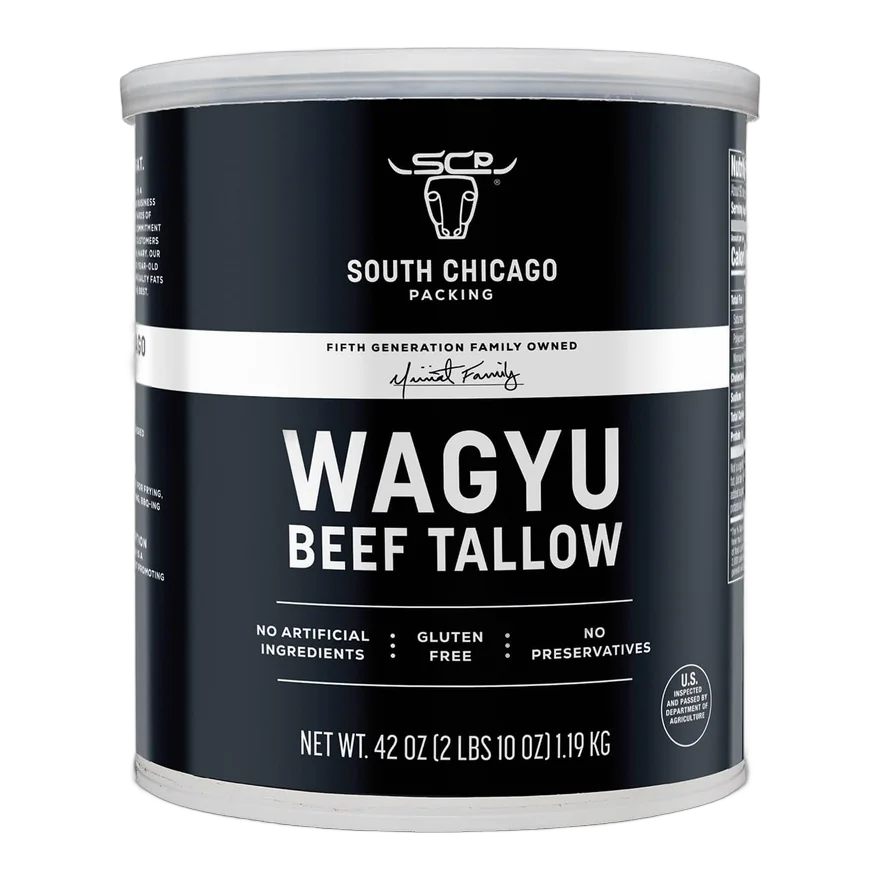
Firm at room temperature, so it goes onto a warm pan like a wax rub rather than a pour, which makes the thin coat easier to get right. Nothing in the tub but rendered beef fat.
Purchase signal: Ordered twice, 2023 and 2025.
Price: $29.69 for the 42 oz tub on October 1, 2026.
Keeping it up after cooking
The oven builds the base. Cooking builds the rest, and two minutes after each use keeps the pan from sliding backwards.
While the pan is still warm, scrape out anything stuck. Wash it in warm water, with a little dish soap if you like, and a brush or a chainmail scrubber on anything baked on.5 Dry it with a cloth and then on the burner for a minute. Do not let it air dry and do not put it in the dishwasher; Lodge say the dishwasher strips the seasoning and brings on rust.5 Then rub in a thin smear of tallow while it is warm, wipe it out again, and put it away.
That last wipe is a tiny seasoning every night, and it is why a pan used daily beats one that gets the oven twice a year and sits in between.
Lodge Pre-Seasoned Cast Iron Skillet, 10.25 inch (a bare pan to start on)
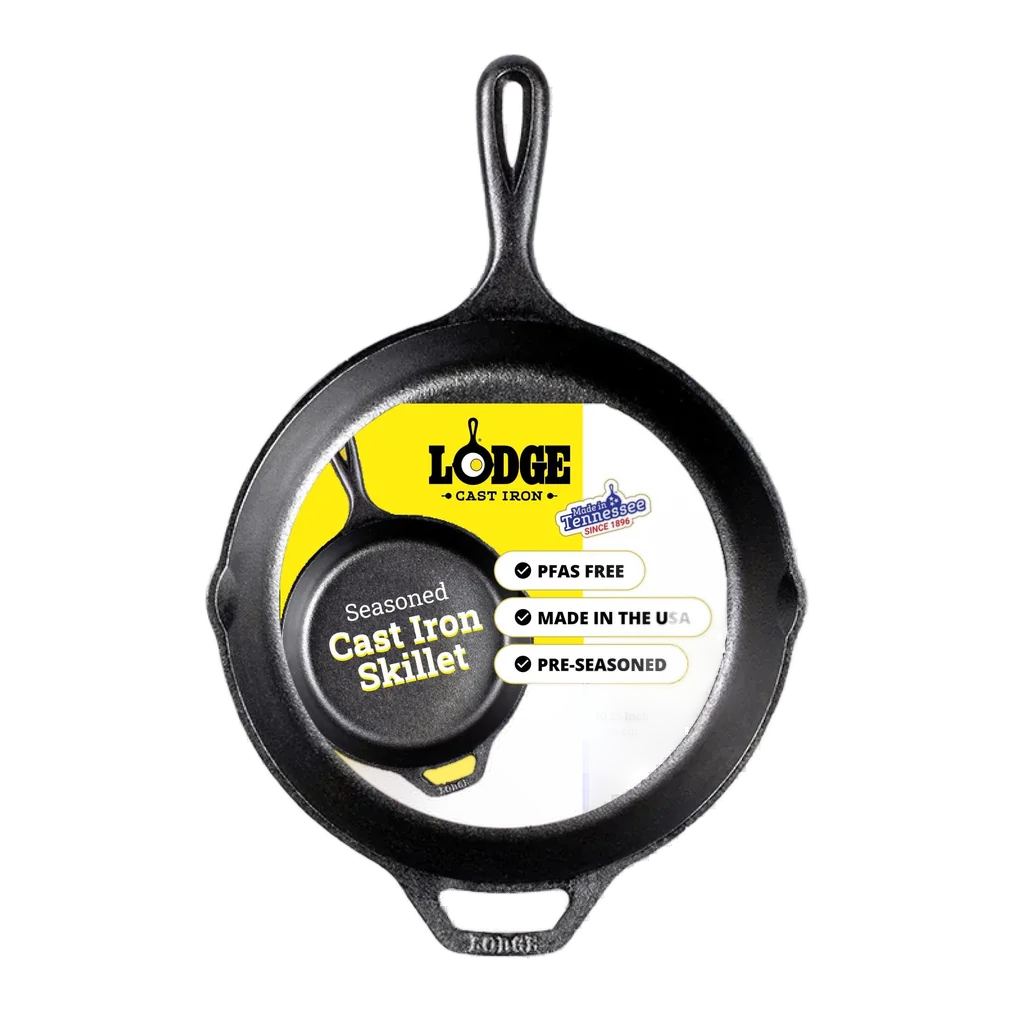
Plain cast iron made in Tennessee, no coating of any kind. It arrives seasoned with soybean oil at the foundry; if that bothers you, strip it and build your own layers with tallow using the method above.
Picked for: Uncoated, cheap, and the pan most seasoning guides are written around.
Price: $22.91 when I looked on October 1, 2026, down from a list price of $24.90.
Sticky pan, rusty pan, flaking pan
Sticky or gummy. Too much fat, every time. Lodge call it a sign of excess oil built up on the pan.6 Put it back in the oven upside down at 450 to 500 F for an hour so the soft layer finishes curing. If it is thick and tacky, scrub the worst off with a chainmail pad first.
Rust. Orange spots mean water sat on bare iron. Scour them off with steel wool or a rust eraser, wash with warm soapy water, dry it completely on a low burner, then run the full oven method. Lodge’s version is the same hour at 450 to 500 F, upside down, cool in the oven, and another hour if it comes out tacky.7 Rust is not the end of a pan. It is a Saturday.
Flaking. Seasoning that lifts off in flakes was built too thick or from a very hard, brittle oil. Flaxseed is the usual suspect: it cures into the hardest surface of any kitchen fat, and the hardest surface is the one that chips. Plenty of people who did the six coats ended up with black flakes in their eggs. Lodge’s answer is to cook in the pan more, or wash, dry, oil lightly and bake again.6 A slower, softer seasoning from a saturated fat is less prone to this. It is the one place tallow’s slowness works for you.
Stripping. When the surface is a patchwork of flakes and bald iron, start over. An oven self clean cycle, a lye bath, or steel wool and patience all get you back to grey metal. Then begin at coat one.
Lodge Chainmail Scrubbing Pad (for stuck food and sticky patches)
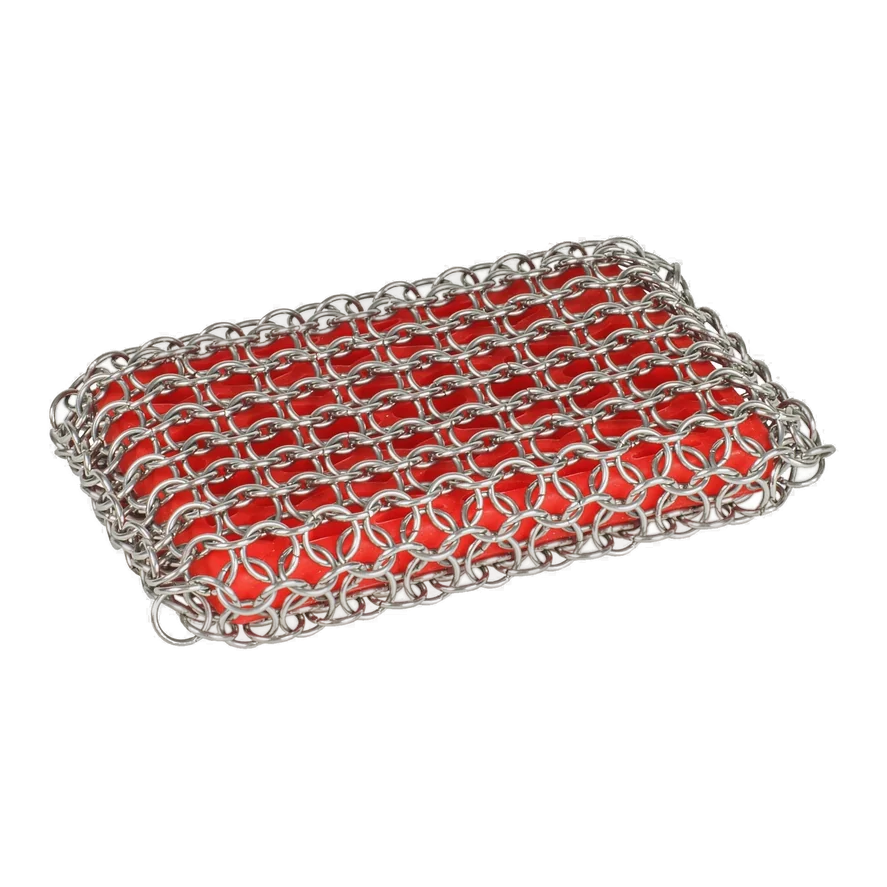
Stainless steel rings over a silicone core. Chainmail lifts burnt food and gummy excess fat without cutting into cured seasoning the way steel wool does. Any plain chainmail pad does the same job for less.
Picked for: The one cleaning tool that matches how seasoning behaves.
Price: $24.90, October 1, 2026. Unbranded pads on the same page run $5 to $15.
Two myths
You cannot use soap. You can. The warning dates from when household soap was made with lye strong enough to eat seasoning. Dish soap today is a detergent, and cured seasoning is a polymer, not grease. Lodge’s own myth page says soap is not necessary but mild dish soap is fine.8 What seasoning will not survive is a night soaking in the sink, and that is a water problem.
You cannot cook anything acidic. A long simmer of tomato sauce in a new pan will eat into the seasoning and the sauce will taste of metal. A quick deglaze with wine in a well seasoned pan is nothing. Lodge put it as large amounts of acidic food over long cooks degrade seasoning, small amounts are fine, and you can always re-season.8
Does iron get into the food?
Yes, and it has been measured. In 1986 Brittin and Nossaman cooked twenty foods in iron and non-iron utensils, three times each. Ninety percent of the foods had significantly more iron after cooking in iron. How much depended on the acidity and moisture of the food and how long it cooked, and different skillets gave different amounts, which the authors put down to how much the pans had been used before.9 That last detail is seasoning at work: a well cured pan has less bare iron touching the food.
A 2003 systematic review found three randomised trials of iron cooking pots in developing countries and reported some evidence that food from the pots raised haemoglobin in people who were anaemic or iron deficient, with the effect depending on whether people kept using the pots, their age, and whether malaria and hookworm were in the picture.10 That is a finding about those settings, not a reason to treat your skillet as a supplement.
It cuts the other way too. If you have hemochromatosis, where the body stores too much iron, Kaiser Permanente’s care instructions say plainly not to use iron cookware because food absorbs some of the iron.11 That is one for your doctor, not a blog.
Quick questions
Can you season cast iron with beef tallow?
Yes. Thin coats, 450 to 500 F for an hour, upside down, repeated. It builds more slowly than flaxseed or grapeseed because it is mostly saturated fat. Lodge advise against it over rancidity; a properly baked thin coat is no longer raw fat.
Why is my pan sticky after seasoning?
Too much fat. Wipe harder next time, and bake the sticky pan upside down at 450 to 500 F for another hour.
How often should I season?
A thin wipe of fat after every wash, and the oven when the pan goes dull, patchy or rusty. A pan used daily may never need the oven again.
What oil does Lodge season with?
A soy based vegetable oil, sprayed thin and baked at the foundry. If you want a surface built from animal fat, strip the pan and build it yourself.
The bottom line
Seasoning is fat turned into a hard polymer by heat and bonded to the iron. Thin coats cure; thick coats go gummy. Flaxseed cures fastest and hardest, which is also why it flakes. Tallow is slow and forgiving, and it is what pans were seasoned with before there was a soybean industry. Lodge season with soybean oil and would rather you did too; the choice is yours. Half a teaspoon, wipe it off, 450 to 500 F for an hour, repeat, then cook in it. The cookware post covers the pans themselves, and the cooking fats post covers what else goes in them.
References
- Lodge Cast Iron. How to season cast iron cookware. lodgecastiron.com
- Canter S. Chemistry of cast iron seasoning: a science-based how-to. 2010 Jan. sherylcanter.com
- U.S. Department of Agriculture, Agricultural Research Service. FoodData Central, SR Legacy: Fat, beef tallow (FDC 171400). FoodData Central
- Lodge Cast Iron. What oils should you use for cast iron cooking and seasoning? lodgecastiron.com
- Lodge Cast Iron. How to clean cast iron. lodgecastiron.com
- Lodge Cast Iron. How to fix common cast iron concerns. lodgecastiron.com
- Lodge Cast Iron. How to restore and season a rusty cast iron skillet. lodgecastiron.com
- Lodge Cast Iron. 10 myths about cast iron cookware, busted. lodgecastiron.com
- Brittin HC, Nossaman CE. Iron content of food cooked in iron utensils. J Am Diet Assoc. 1986 Jul;86(7):897-901. PubMed
- Geerligs PD, Brabin BJ, Omari AA. Food prepared in iron cooking pots as an intervention for reducing iron deficiency anaemia in developing countries: a systematic review. J Hum Nutr Diet. 2003 Aug;16(4):275-81. PubMed
- Kaiser Permanente. Hemochromatosis: care instructions. kaiserpermanente.org
I earn a small commission if you purchase through these links, at no
additional cost to you. I only recommend products I’ve personally used or
researched thoroughly. This helps support the work behind Better Living
Every Day.