In This Article
Late in 2025 a headline went round saying a cup of tea from a plastic kettle holds three billion plastic particles. I went and read the study behind it. The study is real, the kettles were ordinary supermarket ones, and the plastic it found is confirmed. The three billion is another matter, because the paper and the press release that launched the headline do not agree on the number. They are a factor of a thousand apart.
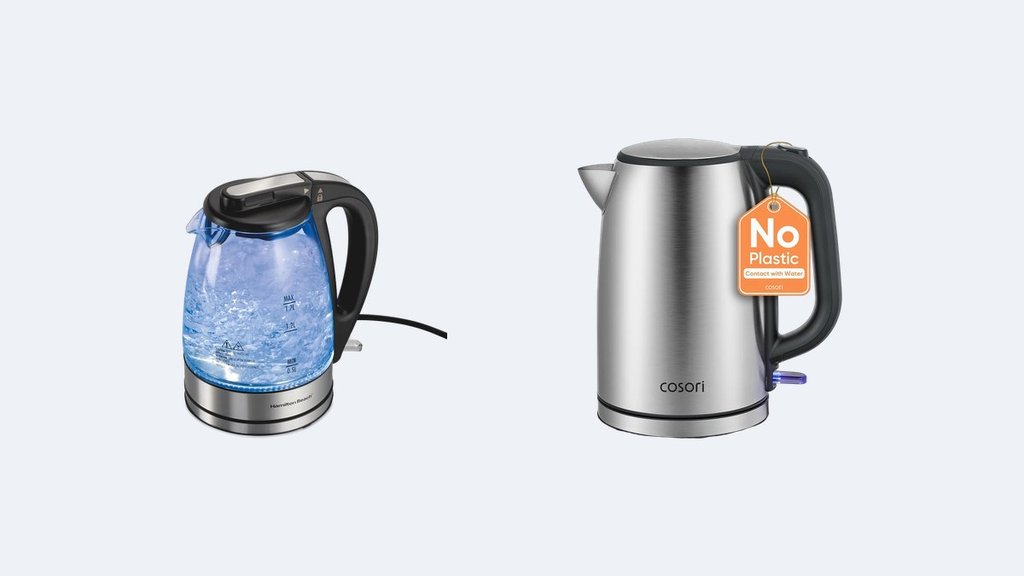
My own kettle is glass. It is a Hamilton Beach 1.7 liter, bought in April 2024, and it does tea, pourover and French press coffee. I cannot tell you I bought glass because of any of this. The study came out a year and a half after the kettle did. So this post is the study first, then what glass and steel put in contact with your water, then two kettles.
What the plastic kettle study measured
The work came from the University of Queensland and was published in npj Emerging Contaminants on November 30, 2025.1 The team bought eight new kettles from two Australian supermarket chains, five of one brand and three of another. All eight were polypropylene, the plastic most kettles are made of, and all held 1.7 liters. They filled each one with 1.1 liters of ultrapure lab water, boiled it, and did that 150 times, testing the water along the way.
They measured the plastic two ways. Keep them apart, because only one of them is solid.
The first way was by weight. They burned what came out of the water and read the chemical signature, which tells you for certain that it is polypropylene and how much there is. The first boil released 0.011 micrograms of nanoplastic and 0.032 micrograms of microplastic for every square centimeter of kettle wall. By the tenth boil that had fallen to about 0.003 and 0.013. After 150 boils it was 0.0004 and 0.002, and the paper puts the drop in nanoplastic at 96 percent.
Those numbers are hard to picture, so here is my arithmetic from the paper’s own figures. The wetted wall was 472 square centimeters. That makes about 20 micrograms of polypropylene in the first kettleful, and about 1 microgram in the 150th. A microgram is a millionth of a gram.
The second way was by counting particles with two light scattering instruments. This is where the billions come from, and the paper is plain about the limit. It describes these counted nanoparticles as “not chemically identified or confirmed as plastics”. The instruments see specks. They cannot say what a speck is made of.
Per liter or per milliliter?
The university’s press release says the first boil in a new kettle released “almost 12 million nanoparticles per millilitre”, which it works out to “almost 3 billion particles in an average 250ml cup of tea”.2 That is the line every headline copied.
The paper’s text gives the same digits with a different unit. It says the new kettles released 1.18 × 10⁷ particles per liter by one instrument. That is 11.8 million per liter. A cup would then hold about 3 million particles, where the press release has 3 billion. The paper’s blank sample, plain lab water boiled in glass, is also given per liter, at 1.24 million.
I do not know which unit is right. One of the two documents is out by a factor of a thousand, and I am not in a position to say which. There is a second gap inside the paper too. The other instrument, pointed at the same water, counted 10,768 particles per liter, a thousand times fewer again, and the authors say themselves that the two instruments disagree sharply.
So the particle count for one cup is somewhere between a few thousand and a few billion, depending on which instrument and which document you believe. I would not hang anything on it. The weight figures are the solid part: real polypropylene, in small amounts, most of it in the first few boils.
What made the plastic kettles shed less
Age, mostly. The bulk of the plastic came off in the first boils and the rate kept falling after that. The authors’ reading is that manufacturing leaves loose particles on the inside wall and boiling washes them off. They say discarding the first few boils of a new kettle cuts what you swallow, and that a quick rinse does not do the same job. Some kettle manuals already tell you to do this. Plenty of people skip it.
The other thing was hard water, which I did not expect. When they swapped the lab water for Brisbane tap water, at a hardness of 125 parts per million, the first boil released roughly a third of the nanoplastic. Under the microscope the tap water kettles had mineral deposits on the wall, and the authors think that crust acts as a barrier. The microplastic results in tap water showed no clear trend, so call it half a finding.
It does mean purer water is harder on a plastic kettle. The water I drink and cook with comes out of a reverse osmosis system, which is about as soft as water gets, so in a plastic kettle it would be the worst case. In a glass kettle it does not come up.
Heat is what does the damage. An earlier Trinity College Dublin study on polypropylene baby bottles found up to 16.2 million microplastic particles per liter, and reported that sterilizing the bottles and filling them with hotter water both pushed the number up.4 A kettle is the same plastic taken to a full boil, every day.
Glass: what touches the water
No glass kettle was in the Queensland study. The authors only suggest, at the end, that designs with “more glass or stainless-steel components” could release less. That is a sensible guess and it has not been tested.
What you can do is read what the water touches. On my Hamilton Beach, the listing says the walls are borosilicate glass and the heating plate at the bottom is stainless steel. That covers nearly all of the surface the water sits against while it boils.
It does not cover everything. The kettle has a mesh filter at the spout and a lid, and neither the listing nor Hamilton Beach’s own page says what the lid or the filter frame is made of.5 The listing does call the kettle BPA free, and that is a claim nobody needs to make about glass and steel, so I would assume some plastic up there. Steam reaches a lid. Boiling water mostly does not.
There is also a joint. Any glass kettle has to seal the glass to the base plate, and that seal is usually silicone. I found no study that measured what a kettle seal releases.
So a glass kettle still has some plastic on it. It just keeps nearly all of it out of the boiling water. I already stay away from Teflon pans for the same sort of reason, and a glass kettle fits that habit at no extra cost.
Hamilton Beach 1.7 Liter Glass Electric Kettle (the one I own)

1500 watts, shuts itself off at the boil, and will not run dry. You can see the water level and the scale through the side, which is the practical argument for glass. The lid material is not published.
Purchase signal: Bought April 2024. It does tea, pourover and French press coffee.
Price: $29.99 on October 8, 2026, against a list price of $34.95.
Stainless steel, and the nickel question
A steel kettle can go one step further than glass, because the lid and the spout filter can be steel too. Check the listing for it. Some steel kettles still have a plastic water window set into the side or a plastic lid lining, and the word “stainless” in the name only describes the outside.
The question people ask about steel is nickel. The one kettle study I found is Danish and was published in 2000. Food regulators boiled water in 26 electric kettles then on sale and found that 10 of them released more than 50 micrograms of nickel per liter. They had set that level with nickel allergy in mind, as the point below which a flare of eczema was unlikely. Lead and chromium were not released in any amount that mattered. The regulators went to the makers, the designs were changed, and in a second round of 10 kettles two still failed and were taken off the market.6
That survey is 25 years old and I found no newer one. What I take from it is narrow. Nickel release depended on how a kettle was built, it could be designed out, and the people it mattered to were those with a nickel allergy. If that is you, glass settles it.
For a steel kettle with no plastic in the water path, this is the one I would look at.
Cosori Stainless Steel Electric Kettle, 1.7 L (steel all the way to the lid)
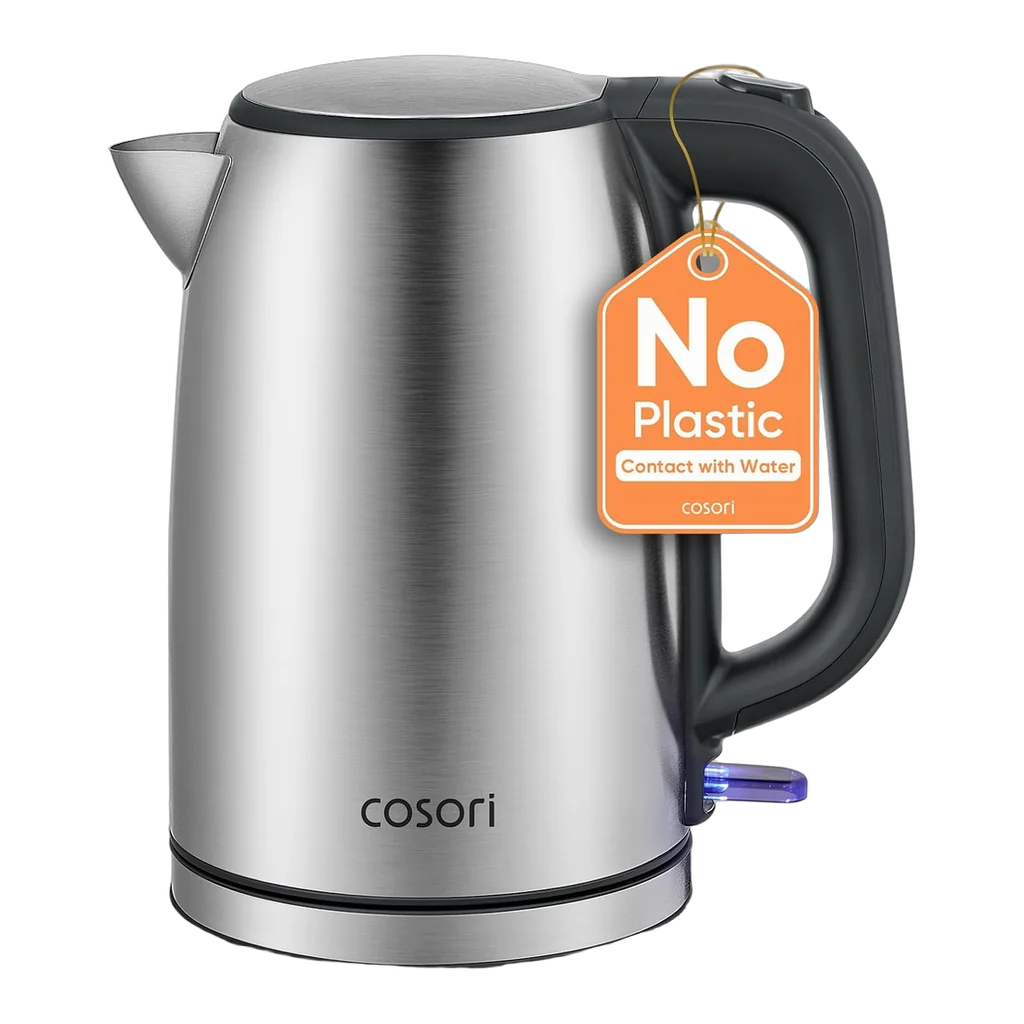
Cosori’s listing says the interior, the spout, the inner lid and the filter are all 304 stainless steel, and that the fill marks are stamped inside so there is no plastic window. Auto shutoff is by Strix.
Picked for: a maker that states in writing that no plastic touches the water, at about six dollars more than the glass one.
Price: $35.99 when checked on October 8, 2026.
The three materials
| Kettle body | What it has going for it | Where it is weak |
|---|---|---|
| Plastic (polypropylene) | Cheapest, light, cool to the touch | Sheds confirmed polypropylene into boiling water, most when new, more in soft water |
| Glass | Water sits on glass and a steel plate, and you can see scale build up | Lid and filter are often plastic, there is a seal at the base, and glass breaks |
| Stainless steel | Can be steel throughout, lid and filter included | Old survey found nickel release from some designs. Some models hide a plastic window or lid lining |
If you are keeping your plastic kettle
You do not have to throw it out. The study’s own numbers say a kettle that has been boiled 150 times is shedding a small fraction of what it did new.
If you buy a new plastic one, boil it full and pour the water away several times before you drink from it. A rinse is not enough. And if your kettle is old, scratched and flaking inside, that is a reason to replace it whatever it is made of.
Quick questions
Do plastic kettles release microplastics?
Yes. The 2025 Queensland study confirmed polypropylene in water boiled in new plastic kettles, about 20 micrograms in the first boil by my arithmetic, falling by 96 percent for nanoplastic over 150 boils.
Is it really 3 billion particles per cup?
That figure is from the press release, which gives 12 million particles per milliliter. The paper’s text gives 11.8 million per liter, a thousand times less. The counted particles were also not confirmed as plastic.
Is a glass kettle plastic free?
Usually not completely. The walls and plate are glass and steel, but the lid, the spout filter and the base seal are often plastic or silicone. Far less plastic sits in the boiling water.
Is stainless steel or glass better for a kettle?
Steel can be plastic free all the way through and does not break. Glass removes the nickel question and lets you see inside. Either is a step away from plastic.
The bottom line
The plastic kettle study found real polypropylene in boiled water, in microgram amounts that fall fast as the kettle ages. The billions in the headline rest on a unit that the paper and the press release do not agree on, and on particles nobody confirmed as plastic. If you want the question gone, a $30 glass kettle or a $36 steel one takes the plastic out of the boil. For the rest of the kitchen, the cookware guide and the plastic free tools list pick up where this stops.
References
- Shi K, Okoffo ED, Fu H, et al. Release of nanoplastic from polypropylene kettles. npj Emerg Contam. 2025 Nov 30;1:16. Nature
- The University of Queensland. Australians are drinking plastic particles in their tea, UQ research finds. News release, 1 December 2025. UQ News
- World Health Organization. WHO calls for more research into microplastics and a crackdown on plastic pollution. News release, 22 August 2019. WHO
- Li D, Shi Y, Yang L, et al. Microplastic release from the degradation of polypropylene feeding bottles during infant formula preparation. Nat Food. 2020 Nov;1(11):746-754. PubMed
- Hamilton Beach. 1.7 Liter Glass Kettle, model 40865, product page. Accessed 2026-10-08. Hamilton Beach
- Berg T, Petersen A, Pedersen GA, et al. The release of nickel and other trace elements from electric kettles and coffee machines. Food Addit Contam. 2000 Mar;17(3):189-96. PubMed
I earn a small commission if you purchase through these links, at no
additional cost to you. I only recommend products I’ve personally used or
researched thoroughly. This helps support the work behind Better Living
Every Day.