In This Article
I usually buy whole beans and grind them. When I am being lazy, I buy it preground.
It goes into a Krups machine I bought fairly recently, with a reusable stainless steel filter cup in place of paper, and the cup works excellently with it. The machine has an iced coffee function and a water tank at the back, so refills are easy. I make iced coffee on it often. It is fast and it is good.
I still buy Peet’s. For the fancier coffee I often order online, and some of that comes from Amazon.
I also hold a few opinions. Light roast has the most caffeine. I enjoy dark roast too. I am not fond of Sumatra. And single origin is key, because there is less chance of toxins.
Those are the kind of beliefs that tend to go unchecked for years, so here they are against the research, after the health numbers that get quoted most.
The number everyone quotes
In 2017 a team published an umbrella review in the BMJ, which is a review of reviews: they gathered the existing meta-analyses on coffee and health and looked at the whole pile at once.1
Across a long list of outcomes, the largest reductions in risk sat at three to four cups a day, and the authors concluded that coffee at usual intakes is more likely to benefit health than harm it.
Almost all of it is observational. Researchers followed people who chose how much coffee to drink and compared them, and the authors end the paper by asking for randomised trials to work out whether any of it is causal. Coffee drinking travels with other things, including not being too ill to want it. People in the early stages of a serious illness often go off coffee, which moves them into the low consumption group and takes their outcomes with them.
The same review found harm signals too, and they cluster in one place. In pregnancy, higher coffee consumption was associated with low birth weight, with preterm birth in the first and second trimesters, and with pregnancy loss. It also found an association with fracture risk in women, though not in men.
Does light roast have more caffeine?
Mostly, with a catch about how you measure.
A 2024 study in Scientific Reports brewed 30 combinations of bean, roast and brew time and measured the caffeine in each cup. With the same weight of coffee and the same brewing, the dark roasts generally came out lower than the light and medium roasts.2
The catch is that roasting changes more than one thing. Darker batches gave lower extraction yields in this study, so less of the bean ended up in the cup. Yet when the researchers compared cups at the same extraction yield, the dark roasts had more caffeine. The authors describe competing effects inside the bean, and under identical brewing the lighter roasts came out ahead.
The same team measured darker beans as less dense. So if you measure with a scoop rather than a scale, a scoop of dark roast holds fewer grams, which should widen the gap further in favour of light.
One wrinkle. A 2021 study from Jordan found the peak at medium roast, with caffeine rising through the lighter roasts and dropping at dark.3 So light over dark is a fair rule. Light over medium is less settled.
Dark roast gets a point back in the next section.
Single origin, and the mould toxin in coffee
The toxin that comes up with coffee is ochratoxin A, made by Aspergillus and Penicillium moulds.
A paper from Nestlé’s research centre traced where it gets in. The main risk step is drying the coffee cherries, particularly the dry process in humid tropical weather, and the review says good drying, grading, transport and storage keep it down.4
Roasting knocks a lot of it out. A Spanish study tested green beans from six countries and found the highest levels in dry processed Robusta from Vietnam. Roasting those beans cut the toxin by about two thirds on average, though unevenly from batch to batch, and brewing in an auto drip machine took out roughly another 15 percent.5 An Italian study found the reduction grows with how hard the beans are roasted, and passed 90 percent at the roast levels used for espresso.6 That is the point dark roast earns back.
The European Union caps ochratoxin A in roasted coffee at 3 micrograms per kilogram, a lower limit that has applied since 1 January 2023.7 The United States has no federal numeric limit. The FDA tested more than 3,700 food samples between 2008 and 2022, found 96.5 percent below the level its methods could quantify, and saw its highest results in green coffee beans, dried fruit, grain products and spices.8
A 2022 meta-analysis of studies from 2010 onward detected ochratoxin A in about 58 percent of the coffee products tested worldwide. When the authors estimated the risk for adult coffee drinkers, only Panama and the Philippines fell below the safety margin they used.9
Now single origin. There does not seem to be a study that compares single origin coffee with blends on mould toxins. What the research does point at is processing and storage, and a single origin bag usually names the country and often the processing method, where a blend usually tells you neither. That is a reasonable way to read a label. It is not evidence that single origin coffee is cleaner, and the processing method printed on the bag is closer to what the research looked at than the word “single” is.
Major Dickason’s, the Peet’s in my order history, is a blend.
Sumatra is a different matter. I am not fond of it, and the research has nothing to say about that.
The filter cup
Coffee beans contain oils called cafestol and kahweol, about 1 percent of the bean by weight, and they raise total and LDL cholesterol. Hot water pulls them out. A paper filter holds them back, which is why paper filtered coffee does not move cholesterol while French press, Scandinavian boiled and Turkish coffee do.10
A 1993 analysis from Health and Welfare Canada measured the total coffee oil, which is what carries the cafestol, in a 150 ml cup. Coffee through filter paper carried under 7 mg. Coffee through a metal screen carried about 50 mg. Boiled coffee and espresso ran from 60 to 160 mg.11
The American Heart Association’s 2026 scientific statement on caffeine puts it in one line: unfiltered coffee raises LDL cholesterol.12
A stainless cup is a metal filter, so it probably behaves more like that screen than like paper. Nobody has measured this particular cup. The cup still does its job well. It is a trade, though, and if LDL is a number you keep an eye on, a paper filter is the cheapest fix on this page.
MCT and butter go into my coffee in phases, and that has its own post. The mushroom energy drinks I bought repeatedly are a different thing again, covered separately.
The picks
Peet’s Coffee Major Dickason’s Blend, Dark Roast, Whole Bean
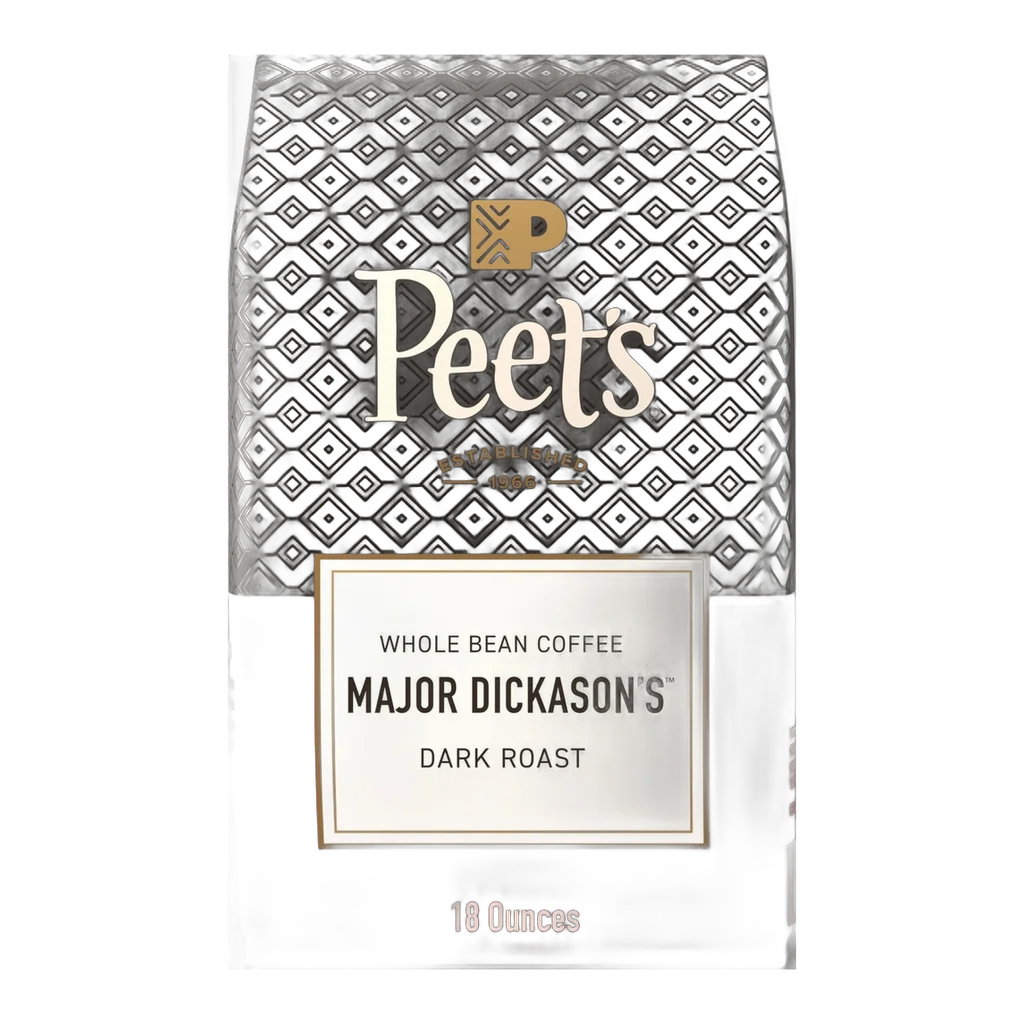
The Peet’s in my order history, carded as the whole bean bag because beans are what I usually buy. A dark roast and a blend, not a single origin, and Peet’s is still a brand I buy.
Purchase signal: Multiple · 2022 to 2023 on Amazon, and still buying Peet’s
Price: Around $16.02 for 18 oz.
Quick questions
Does light roast have more caffeine than dark roast?
Brewed the same way from the same weight of coffee, lighter roasts generally came out higher in a 2024 study. Measured by the scoop, the gap should widen, because dark beans are less dense. Medium roast may be the true peak.
Does roasting destroy mycotoxins in coffee?
It reduces ochratoxin A a lot but not to zero: about two thirds on average in one study, and more than 90 percent at espresso roasts in another. Brewing removes a little more.
Is single origin coffee lower in mould toxins?
No study seems to have compared the two. Processing and storage are what the research points at, and a single origin label is more likely to tell you about those.
Is a metal coffee filter bad for cholesterol?
A metal filter lets through far more of the oils that raise LDL cholesterol than paper does. Paper filtered coffee does not raise cholesterol. If that number matters to you, use paper.
How much coffee is optimal?
The umbrella review puts the largest risk reductions at three to four cups a day. That is an association across observational studies rather than a prescription, and it is not advice for anyone who is pregnant.
The bottom line
Light roast over dark holds up, with medium roast as the wrinkle. Dark roast takes more of the mould toxin out, and roasting and brewing both cut it. Single origin is a sensible way to know more about how the coffee was handled, but nobody has shown it is cleaner. The metal filter cup is the one part of the routine with a direct cholesterol finding behind it, and paper is the easy switch if that matters to you.
References
- Poole R, Kennedy OJ, Roderick P, Fallowfield JA, et al. Coffee consumption and health: umbrella review of meta-analyses of multiple health outcomes. BMJ. 2017 Nov 22;359:j5024. PubMed
- Lindsey ZR, Williams JR, Burgess JS, Moore NT, Splichal PM. Caffeine content in filter coffee brews as a function of degree of roast and extraction yield. Sci Rep. 2024 Nov 25;14(1):29126. PubMed
- Awwad S, Issa R, Alnsour L, Albals D, Al-Momani I. Quantification of Caffeine and Chlorogenic Acid in Green and Roasted Coffee Samples Using HPLC-DAD and Evaluation of the Effect of Degree of Roasting on Their Levels. Molecules. 2021 Dec 11;26(24):7502. PubMed
- Bucheli P, Taniwaki MH. Research on the origin, and on the impact of post-harvest handling and manufacturing on the presence of ochratoxin A in coffee. Food Addit Contam. 2002 Jul;19(7):655-65. PubMed
- Pérez De Obanos A, González-Peñas E, López De Cerain A. Influence of roasting and brew preparation on the ochratoxin A content in coffee infusion. Food Addit Contam. 2005 May;22(5):463-71. PubMed
- Romani S, Pinnavaia GG, Dalla Rosa M. Influence of roasting levels on ochratoxin A content in coffee. J Agric Food Chem. 2003 Aug 13;51(17):5168-71. PubMed
- European Commission. Commission Regulation (EU) 2022/1370 amending Regulation (EC) No 1881/2006 as regards maximum levels of ochratoxin A in certain foodstuffs. Applies from 1 January 2023; carried into Regulation (EU) 2023/915. EUR-Lex
- Miller TJ, Adeuya A, Robin LP. U.S. FDA Regulatory Monitoring of Ochratoxin A in Human Foods: 2008-2022. Food Saf (Tokyo). 2026 Jun 26;14(2):48-57. PubMed
- Fakhri Y, Mahdavi V, Ranaei V, Pilevar Z, Sarafraz M, Mahmudiono T, Khaneghah AM. Ochratoxin A in coffee and coffee-based products: a global systematic review, meta-analysis, and probabilistic risk assessment. Rev Environ Health. 2024;39(2):211-220. PubMed
- Urgert R, Katan MB. The cholesterol-raising factor from coffee beans. Annu Rev Nutr. 1997;17:305-24. PubMed
- Ratnayake WM, Hollywood R, O’Grady E, Stavric B. Lipid content and composition of coffee brews prepared by different methods. Food Chem Toxicol. 1993 Apr;31(4):263-9. PubMed
- Marcus GM, Hu FB, van Dam RM, Cornelis MC, Dewland TA, Kang J, Larsson SC, Page RL 2nd, Parekh N. Caffeine and Cardiovascular Disease: A Scientific Statement From the American Heart Association. Circulation. 2026 Sep;154(9):e345-e355. PubMed
Not medical advice. If you are pregnant or trying to be, the evidence on coffee points differently and is worth discussing with whoever is looking after you. If you are managing your cholesterol, the filter question is worth raising with your doctor.
I earn a small commission if you purchase through these links, at no
additional cost to you. I only recommend products I’ve personally used or
researched thoroughly. This helps support the work behind Better Living
Every Day.