In This Article
Pick up almost any potassium supplement in a US shop and the front of the bottle says 99 mg. Every brand. Same odd number, over and over, like they all copied each other’s homework.
Meanwhile the Daily Value printed on food labels is 4,700 mg.1 Do that division and the standard potassium pill comes out at about two percent of a day. It might be the strangest product in the shop: a supplement designed to be almost nothing.
You would assume there is a safety limit behind it. There isn’t, and what is actually there is a better story.
There is no 99 mg cap
Search this and you will be told, confidently and everywhere, that the FDA caps potassium supplements at 99 mg. That rule does not exist.
What does exist is a labeling policy from another era, pointed at another kind of product entirely. 21 CFR 201.306 sets out the FDA’s position on coated tablets of potassium chloride and other potassium salts that supply 100 mg or more of potassium per tablet.2 Keep selling them, it says, as long as the label carries a particular warning.
The warning concerns reports of nonspecific small-bowel lesions, described in the regulation as stenosis with or without ulceration, associated with coated potassium tablets. It says those lesions caused obstruction, haemorrhage and perforation, that surgery was frequently required, and that deaths occurred.
Which sounds like an excellent reason for a cap, right up until you read the next bit of the same paragraph:
So the same regulation that raises the alarm also says the link was never firmly established and the events were rare. And read what it is actually about: a physical format. A coated tablet parks against the gut wall and dissolves in one spot. That is the hazard being described, not potassium itself at 100 mg.
Supplement companies read all that, worked out they would rather not print the words intestinal perforation on a vitamin bottle, and stopped at 99. Not a limit. A flinch, sixty years old, that nobody has gone back to check.
The number on the bottle is not the number you think
This part applies to whatever potassium product you happen to be holding.
Potassium bicarbonate is a compound, and potassium is only part of it by weight. About 39%. Puregen, the brand I bought once in 2025, sells a capsule that says 1020 mg on the front in large friendly numerals. That capsule delivers somewhere near 400 mg of actual potassium. If you think I am doing suspicious arithmetic, a rival seller puts “39% K” directly in its product title.
Four hundred milligrams is four of those 99 mg pills. It is also still under a tenth of a day.
Where potassium actually comes from
The reason the supplement aisle looks absurd here is that it was never the plan.
A baked potato has more potassium than eight of the 99 mg pills. So does a decent serving of beans, or a couple of bananas, or spinach, or salmon, or yoghurt. Getting to the Daily Value from food is entirely ordinary if you eat that way, and essentially impossible from a supplement shelf that has capped itself at two percent per pill.
Most people in a Western diet fall somewhere below the target. That is a real pattern and it is also not the same thing as a deficiency, which is a clinical state that usually comes from illness, vomiting, or a medication rather than from eating badly.
The part where I stop being casual
Everything above is a story about a label. This next bit is not.
Potassium is one of the few minerals where more is genuinely dangerous for some people, and what goes wrong is your heart rhythm. Clearing the excess is a kidney job, so when kidney function drops, so does the ceiling. On top of that, several extremely common drugs push blood potassium up on their own: ACE inhibitors, angiotensin receptor blockers, potassium-sparing diuretics. And almost nobody counts the salt substitute in the cupboard, which is usually potassium chloride.
Stack a couple of those and add a supplement that quietly delivers 400 mg a capsule, and you are in territory where the failure mode is a heart rhythm problem, not an upset stomach.
For the record, I am not on any of those drugs. If you are, this section matters more than everything else on the page.
I get blood panels done regularly and go over them with a nutritionist. Potassium is one of the eight values on a standard basic metabolic panel,3 so if you want to know where your own level sits, that is where the answer lives. The front of a supplement bottle cannot tell you.
So what is the bicarbonate for
Fair question, and the honest answer is that people buy it for several different reasons and only some of them are about potassium.
It is used as a leavening agent in baking, which is why the same product is sold in one-pound bags next to the sodium bicarbonate. It is used in winemaking to reduce acidity. It is used by gardeners. And it is used as an electrolyte, where the bicarbonate part is doing something distinct from the potassium part, because bicarbonate is a buffer.
That is a lot of jobs for one white powder, and it is worth knowing which one you are buying it for.
The picks
Puregen Labs Potassium Bicarbonate, 1020 mg
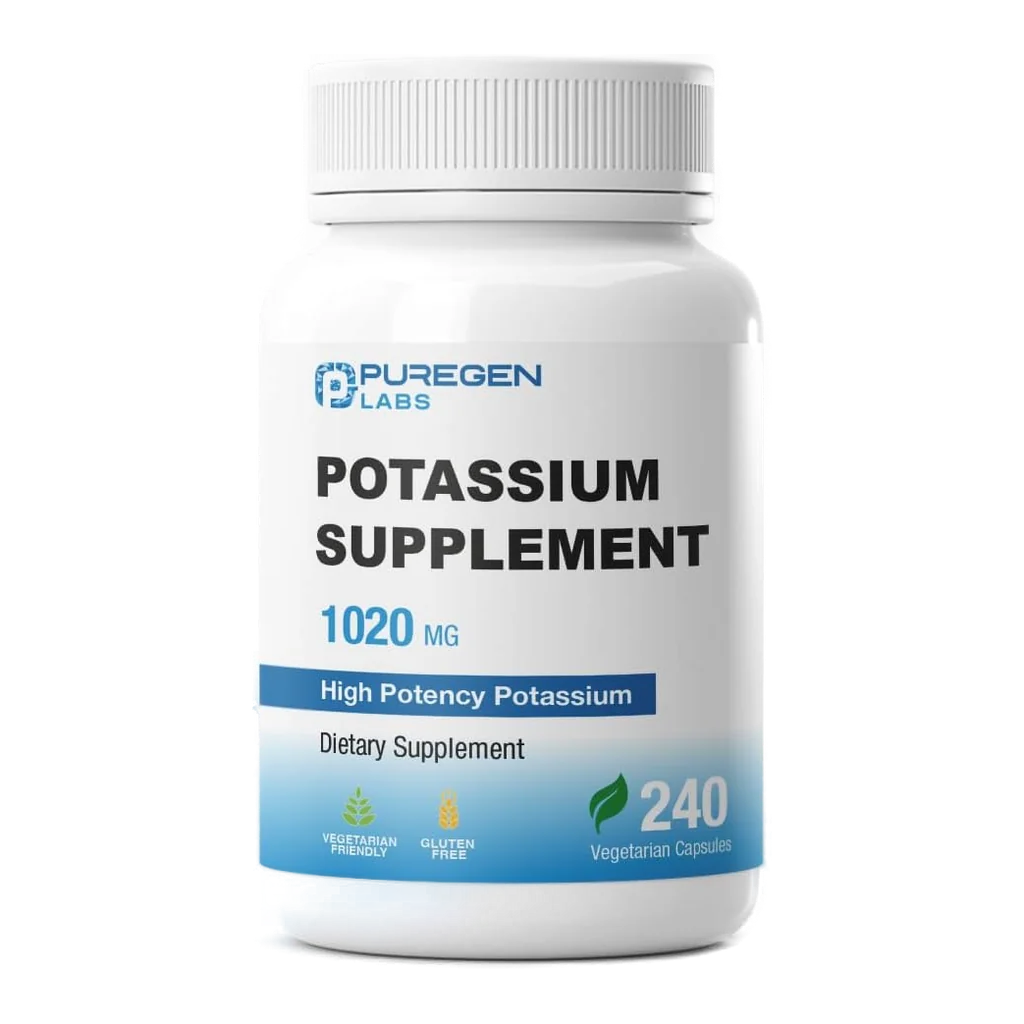
The brand I bought, once, in 2025, and my record does not say which bottle size. Capsules rather than a bag of powder, which is the difference between a supplement and a baking ingredient in practice. Remember the arithmetic: 1020 mg of potassium bicarbonate is about 400 mg of potassium, which is a real dose and not a token one, and that cuts both ways.
Purchase signal: Once · 2025
Price: Around $22.45.
Quick questions
Is 99 mg of potassium useless?
As a way of meeting your daily needs, effectively yes, at two percent of the Daily Value. That does not make the products fraudulent, it makes the reason for the number worth knowing.
Why does the label say 4,700 mg is the Daily Value?
That is the reference figure in the federal labeling regulation, used to calculate the percentages on nutrition and supplement panels.
Can I just take eight of the 99 mg pills?
You could, and I am not going to tell you to. Read the section above about medications and kidney function first, because that question has a different answer depending on who is asking it.
Is potassium bicarbonate better than potassium chloride?
Different compound, different secondary effect. Bicarbonate is a buffer, chloride is not. Neither is a general upgrade over the other and the choice depends on what you were trying to do.
Should I be worried about the small-bowel warning?
The regulation itself says the incidence was low and causality was never definitely established, and it is specifically about coated tablets. It is history worth knowing rather than a reason for alarm.
The bottom line
The 99 mg number is not a safety limit, it is a sixty year old piece of regulatory caution about coated tablets that the supplement industry decided to stay well clear of. The Daily Value is 4,700 mg. Food closes that gap easily and the supplement aisle structurally cannot. And potassium is one of the few minerals where the sensible advice really is to leave the dosing to your doctor if you are on anything that touches your kidneys or your blood pressure.
References
- U.S. Food and Drug Administration. Nutrition labeling of food: reference daily intakes. 21 CFR 101.9. eCFR
- U.S. Food and Drug Administration. Potassium salt preparations intended for oral ingestion by man. 21 CFR 201.306. eCFR
- MedlinePlus, U.S. National Library of Medicine. Basic Metabolic Panel (BMP). MedlinePlus
This is not medical advice and potassium is not a supplement to experiment with. If you take an ACE inhibitor, an ARB, a potassium-sparing diuretic, or have any kidney impairment, talk to your doctor before adding any potassium product.
I earn a small commission if you purchase through these links, at no
additional cost to you. I only recommend products I’ve personally used or
researched thoroughly. This helps support the work behind Better Living
Every Day.