In This Article
There are not many products I have bought continuously for more than a decade. My water filter is one. MCT oil is another, a bottle of it has been in this kitchen since the first Obama administration, give or take, and it goes into my coffee as part of a fasting routine I have already written up. Not every morning, though. I run this in phases: heavy stretches where it is in the cup daily, then months where the bottle just sits there. Ten years of buying something does not mean ten years of using it without a gap, and I would rather say so.
That post covers the how. This one is the ingredient itself, because MCT oil sits in a strange spot: it is one of the most overhyped products in the wellness aisle, and it is also something I genuinely rebuy after ten plus years. Both of those are true, and the gap between them is exactly what this post is about.
What MCT oil actually is
MCT stands for medium-chain triglycerides, which is chemistry speak for fats with shorter tails than the ones in most food. The practical difference is speed: your body absorbs and burns them faster than the long-chain fats in, say, olive oil or butter. That much is textbook, not marketing.
The bottles worth buying are labeled C8 and C10, the two shortest, fastest chains, fractionated out of coconut oil (or out of palm kernel oil, in the cheaper bottles). And this is the first place the label matters: plain coconut oil is mostly C12, which behaves much more like an ordinary fat despite a decade of internet claims to the contrary. Coconut oil is a food I also buy. It is not the same product, and a “contains MCTs!” coconut oil label is technically true marketing doing technically true marketing things.
The honest ledger, ten years in
What it reliably does for me: blended into morning coffee, it keeps hunger flat through a skipped breakfast in a way black coffee alone never managed. That is the entire use case in this house, and it has held up for over a decade of me being otherwise fickle about wellness products. Some studies point in the same appetite direction. I will leave it at “some studies” and “consistently, for me,” which is more hedging than the category is used to and exactly as much as the evidence earns.
What I notice and cannot prove: the level, no crash morning feel I described in the fasting post. I credit the routine at least as much as the molecule.
What it never did: made me leaner by itself. MCT oil is fat, a tablespoon is 100-plus calories, and pouring extra calories into your day is not a weight strategy no matter how fast they burn. It earns its calories with me by replacing breakfast, not by supplementing it. Anyone selling it as a fat burner in a bottle is selling.
The warning every first time buyer deserves
Start with a teaspoon, not a tablespoon, and hold there for a week. MCT oil taken enthusiastically by a newcomer is a famous, urgent digestive event, the kind the supplement forums discuss in memes because everyone has the same story. Your gut adapts fine with a slow ramp. Nobody adapts fine to a day one double dose. This is the most useful sentence in this post and the one the product labels print smallest.
What it is not for
Do not cook with it. The smoke point is low, the flavor is nothing, and heat is wasted on a product whose entire premium is metabolic speed. What I actually cook with is its own post. MCT oil goes in things, coffee, a smoothie, salad dressing if you like, it does not go under things on a burner.
Buying notes, briefly
If you go looking for the best MCT oil, the honest news is that most of the shelf is a commodity wearing a dozen labels, and my own history proves I believe that: the trail of bottles through this kitchen crosses at least five brands. What I look for after ten years of buying it: pure C8, or C8 and C10 with no C12 padding, made from coconut and nothing else, in a decent sized bottle because the per ounce math on the small ones is unkind.
Two of those do most of the sorting. A lot of the cheap bottles are padded with C12, so a third of what you pour is ordinary fat with the MCT name on it. Some are cut with palm kernel oil, which is the cheaper raw material, and admit it only in the ingredient line. Read that line before you read the price.
Where I landed is Natural Force’s pure C8, bought twice, in glass, and I want to be straight about what it costs. It is about two dollars an ounce. That is more than double the C8 and C10 blends and roughly four times the store brand, and I am not going to call that sensible. What the money buys is one ingredient, C8 from organic coconuts, no palm, no lauric filler, lab tested, in glass instead of plastic. Per gram of C8 the gap to the blends shrinks a good deal, because none of the bottle is padding. I have the numbers in front of me and I still buy this one. Skip the flavored ones.
The powder, which I was wrong about
For years my line on MCT powders was that they add fillers and starch carriers to solve a problem the oil does not have. As chemistry that is fair enough. As advice it was overstated, and I know that because I use one.
The one that earned its place is an MCT and butter powder, which collapses bulletproof coffee into a single scoop instead of oil plus butter plus a blender to wash. When I have the time I still make the real version, oil and real butter blended with an immersion blender, and it is better. When I do not, the powder is the difference between having the coffee I like and skipping it. Convenience is a real property of a product, and pretending it is not is how you end up recommending things nobody actually keeps doing.
I am not linking a specific one, because I would have to go and check which tub is in the cupboard, and I am not going to send you to a brand I have not looked at properly.
The pick
Natural Force Organic Pure C8 MCT Oil (32 oz, Glass)
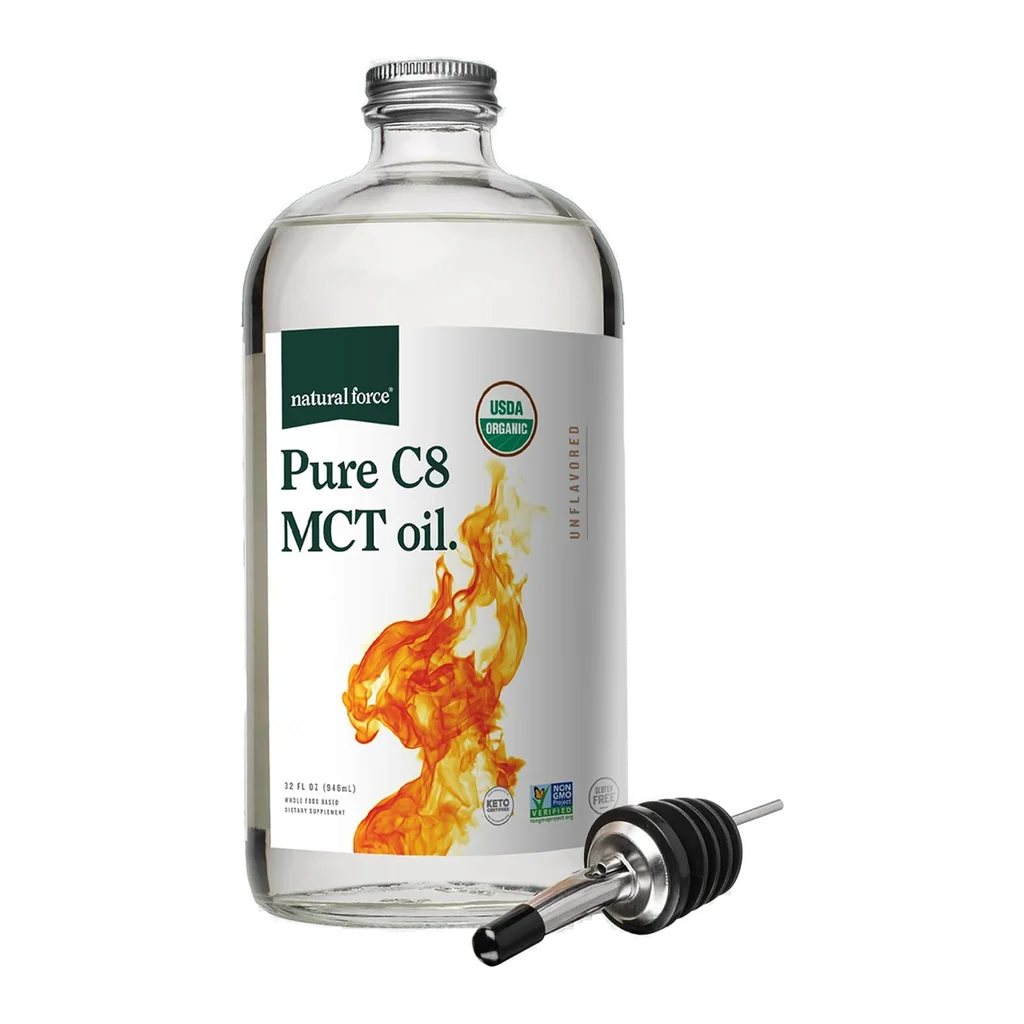
The current bottle in a rotation that goes back more than a decade, and one I have bought twice. Pure C8 from coconut only, no palm, lab tested, glass. Pricey per ounce, fairer per gram of C8, and it does the one job I have ever asked of this product: morning coffee, flat hunger, on to lunch.
Purchase signal: Bought twice · latest stop in a decade long rotation
Price: Around $62 to $65 for 32 oz, roughly $2 an ounce.
Quick questions
Does MCT oil put you in ketosis?
It nudges ketone production more than other fats, which is measurable and mostly beside the point unless you are managing a ketogenic diet for real reasons. I do not chase numbers, I skip breakfast comfortably. That result I can vouch for.
MCT oil or just coconut oil?
Different products. Coconut oil is a nice food that is mostly C12. If you are buying for the fast fuel effect, the label needs to say C8/C10, otherwise save the money and buy the cooking oil you will actually cook with.
Is MCT oil made from palm oil?
Some of it is. Palm kernel oil is the cheaper raw material, so the bulk and store brand bottles often use it, or a coconut and palm blend, and the label may only say so in the ingredient line. The Natural Force bottle is coconut only, which is part of what I am paying for. If it matters to you, the ingredient line is where to look, not the front of the bottle.
What about the powder?
I use one, specifically an MCT and butter powder, when I want bulletproof coffee without the production. Real oil and real butter blended properly is better, and that is what I make when I have the time. The powder wins the mornings when I do not.
How much per day?
I settled at about a tablespoon in coffee, after starting at a teaspoon, and the ramp is not optional. Read the warning section, then read it again.
MCT oil is concentrated fat, not a supplement with a health claim attached. If you have gallbladder, pancreas, or fat absorption issues, or you are managing a medical ketogenic diet, dosing decisions belong with your doctor.
I earn a small commission if you purchase through these links, at no
additional cost to you. I only recommend products I’ve personally used or
researched thoroughly. This helps support the work behind Better Living
Every Day.