In This Article
This is not a list of gadgets I think you should own. It is the short list of kitchen things I have vouched for on this site, in one place, and the one kind of pan I will not buy.
Most of them already have a longer write-up on this site. This page is the map.
The blender I use constantly
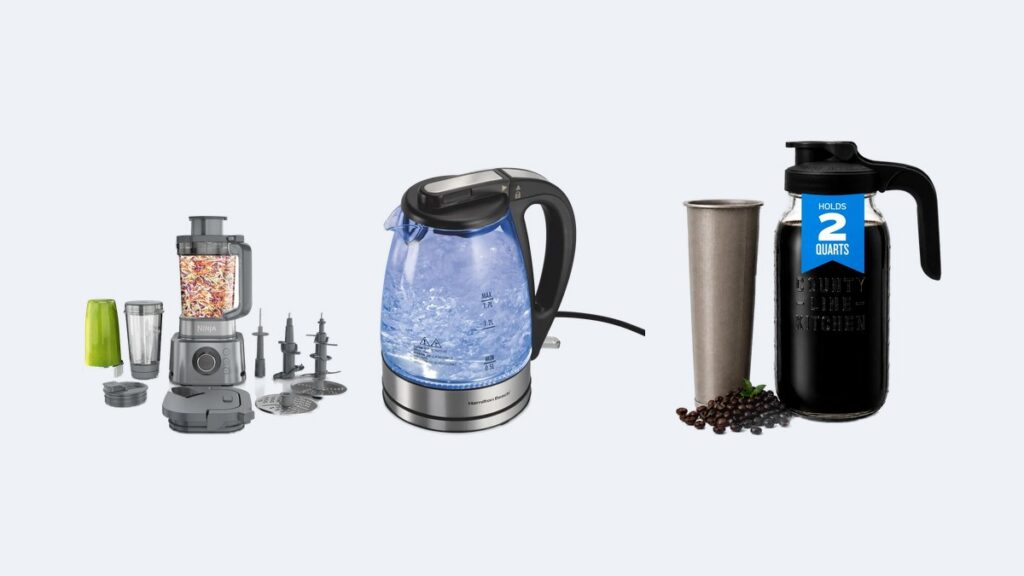
A Ninja Foodi blender and processor, the SS401. I bought it a couple of years ago, I use it constantly, and I would buy it again.
It is also expensive, and Ninja sells a cheaper model with ten times the reviews. I have not used that one, and I explain what the extra money buys, and when it is not worth it.
A stick blender for the small jobs
A big blender is the wrong tool for mayonnaise. Mayonnaise wants a narrow jar and a small blade, which is what a stick blender is.
Mine is a Cuisinart Smart Stick. It is green, I bought it many years ago, and it works excellently. The current model is silver and costs more than mine did. The mayonnaise method is about a minute of work once you have one.
A coffee machine and a steel filter cup
I usually buy whole beans and grind them, and buy preground when I am being lazy. The coffee goes into a Krups machine with a reusable stainless steel filter cup in place of paper, and the two work very well together. The machine also makes iced coffee, and it does it fast.
I have not pinned down which Krups model it is, so I am not linking one. What I can tell you is what I found when I checked the coffee itself against the research.
A glass kettle
A Hamilton Beach 1.7 litre glass kettle, bought in 2024. It handles tea, pourover and French press coffee. That is the whole job description and it does it.
A half gallon jar and a mesh infuser
This is the cheapest thing on the list. A two quart County Line mason jar with a steel filter, and a Fenshine mesh infuser. Hibiscus goes in once a week, the jar goes in the fridge, and honey goes in. It makes a cold half gallon at a time.
The batch has its own section in the post about winding down without melatonin.
The pans: cast iron, stainless, ceramic
What I cook in is cast iron, stainless steel and ceramic nonstick. What I avoid is Teflon, the PTFE coating on most nonstick pans. My reason, in my own words, is that coated pans that break down can put plastics and toxins into food.
Here is what the evidence says next to that, because it is more specific than the worry.
Scratched pans do shed plastic. In 2022 an Australian team used Raman imaging on scratched Teflon pans in a simulated cooking process. They estimated that a single surface scratch released about 9,100 PTFE particles, and that an area of broken coating could release up to about 2.3 million.1 That is a measurement of what comes off the pan. It is not evidence that eating those particles harms anyone, and PTFE itself is generally treated as chemically inert. Nobody has shown the harm. Nobody has ruled it out either.
Overheating is the clearer risk. PTFE starts to break down at around 260 °C, or 500 °F, and the fumes can cause what doctors call polymer fume fever, a short flu-like illness. An empty nonstick pan left on high heat can get there faster than people expect.
“PFOA-free” is mostly marketing now. PFOA was the chemical once used to make PTFE, and it is the one with the worrying health record. The eight major manufacturers agreed with the EPA to eliminate it from emissions and products by 2015, and the EPA says they all met that goal.2 A new pan that says PFOA-free is telling you the truth about something that is true of nearly every new pan.
Cast iron and stainless have no coating to scratch or overheat. Ceramic nonstick is not PTFE. I am not naming pan brands here, and I am not going to claim cast iron is a health food. It is a pan. The site’s post on cooking fats covers what goes in it.
Quick questions
Is a scratched nonstick pan dangerous?
It sheds more PTFE particles than an intact one. Whether that harms you is not established. If the coating is visibly scratched or flaking, replacing it is the cautious choice.
At what temperature does Teflon become a problem?
Around 260 °C, or 500 °F. An empty pan on a high burner can reach that.
Does PFOA-free mean nonstick is safe?
It means the pan was made without PFOA, which has been true of almost all new PTFE pans since 2015. It says nothing about scratching or overheating.
What is the best kitchen tool for healthier eating?
The one you will use. If I were starting from nothing, I would start with the cheapest thing on this list, the jar and the infuser.
The bottom line
Five tools I have vouched for, and one rule about pans. I skip PTFE for my own reason: I do not want plastics and toxins from a worn coating in my food. The evidence says scratched pans shed particles and overheated pans give off fumes. It does not yet say what the particles do to you.
References
- Luo Y, Gibson CT, Chuah C, et al. Raman imaging for the identification of Teflon microplastics and nanoplastics released from non-stick cookware. Sci Total Environ. 2022 Dec 1;851(Pt 2):158293. PubMed
- U.S. Environmental Protection Agency. Risk management for per- and polyfluoroalkyl substances (PFAS) under TSCA: the 2010/2015 PFOA Stewardship Program. EPA
there is nothing for me to earn on it. Other posts on this site do contain Amazon
affiliate links, and they are disclosed as such where they appear.