In This Article
Our rice cooker has one switch. You push it down, and when the rice is done it pops back up. There is no screen and no menu. It is a Zojirushi NHS-06, and it is the best purchase we have made in a long time.
We add rice, water and a little olive oil, and about 20 minutes later it is done and the rice is perfect. That is the whole review, really. The rest of this post is the two things worth knowing before you buy one, and one thing no rice cooker can do.
What you get
The listing describes it in four lines: a single switch control, a see through glass lid with a knob that stays cool, handles that stay cool, and a nonstick inner pan. That is all there is to it.
The size takes a moment to understand. It is called a 3 cup cooker, but the cup is the small plastic one in the box. Zojirushi says that cup holds 6 ounces, about three quarters of a US measuring cup. The 3 cups are uncooked rice, and each one makes two to three of the same small cups cooked.
So a full pot is around five or six US cups of cooked rice. That is dinner for two to four people, or enough left over for fried rice the next day.
It comes with a plastic spatula, so you do not scratch the pan getting the rice out. The pan is hand wash only.
What it cost us, and what it costs now
We bought ours many years ago, at Walmart I think, for somewhere between $20 and $30. That is my memory of it and I would not swear to the number.
It is $59.99 on Amazon today, and the same at Walmart. So it has about doubled. At sixty dollars it is no longer an impulse buy. I would still call it a fair price for something we are using many years on.
Zojirushi sells the same one switch design in two bigger sizes. The 6 cup was $64.99 and the 10 cup $84.99 when I looked. I have not used either, and I am going on the fact that they are the same machine with a bigger pot.
The nonstick pan
This is the part to know about. The inner pan has a nonstick coating, and the listing does not say what kind.
I stay away from Teflon pans, so this is a fair thing to raise against my own purchase. It is true of ours. The plastic spatula is there because the coating can be scratched, and a scratched coating is the kind I would replace.
Here is how I would weigh it. Rice cooks at the boiling point of water and no higher, because once the water is gone the switch pops. That is a long way below the temperatures a frying pan reaches. I do not have a study on rice cooker pans to show you, so take that as reasoning and not as proof.
If any coating is a firm no for you, this is the wrong cooker. Rice cookers with stainless steel or ceramic pots exist. I have not used one, so I am not going to point you at one.
Zojirushi NHS-06 3 Cup Rice Cooker (the one we have)
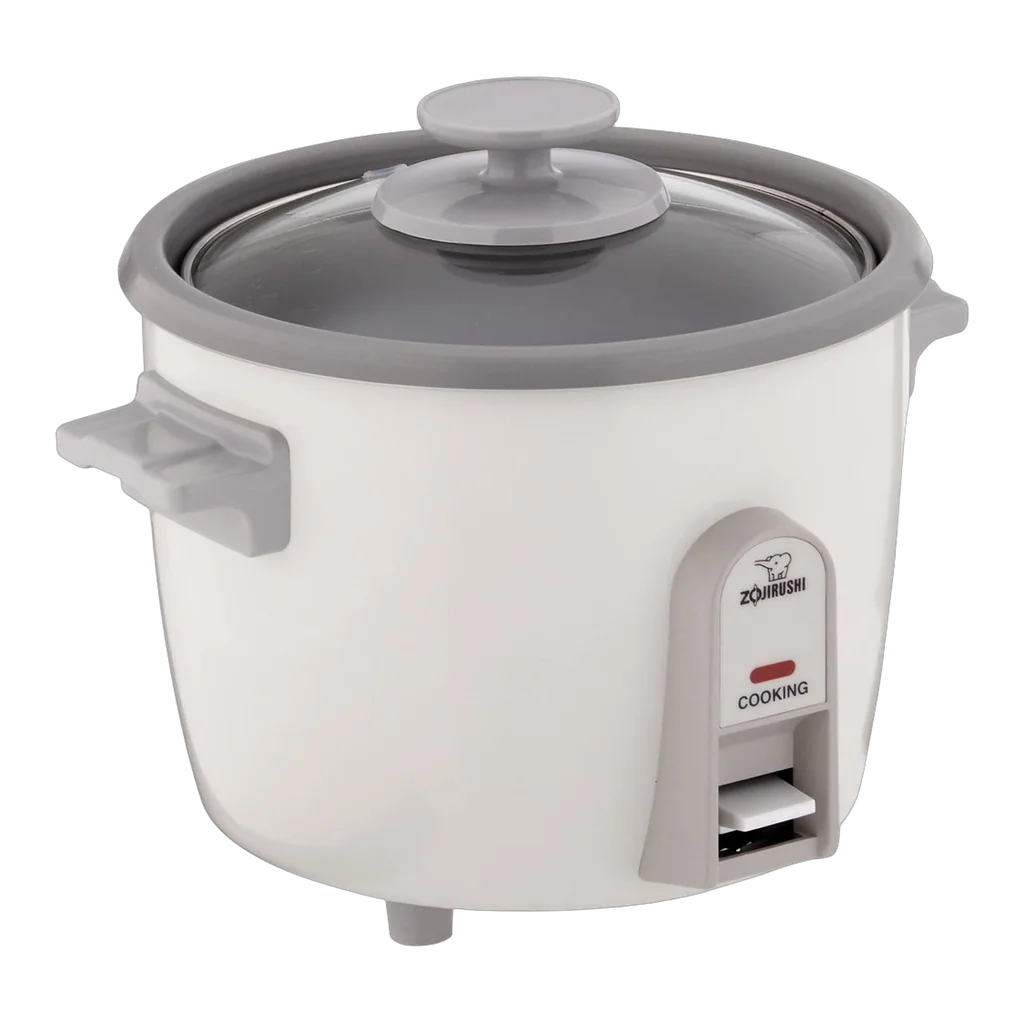
The measuring cup in the box is smaller than a US cup, so use it and the lines inside the pan together. The inner pan is nonstick coated and has to be washed by hand.
Purchase signal: Ours, bought many years ago, at Walmart I think, for somewhere between $20 and $30. The best purchase we have made in a long time.
Price: $59.99 on Amazon on October 10, 2026, with 12,332 ratings averaging 4.5 stars.
The arsenic question
Rice has an arsenic problem that other grains mostly do not. The FDA puts it plainly: rice “tends to absorb arsenic more readily than other crops”.1 The same page says rice can still be eaten as part of a balanced diet.
The FDA also describes a cooking method that lowers it. You cook rice the way you cook pasta, in 6 to 10 parts water to 1 part rice, and pour the extra water away. That “can reduce 40 to 60 percent of the inorganic arsenic content”.
A rice cooker does the opposite. It uses just enough water for the rice to soak up, and nothing is poured away. My reading is that whatever was in the rice and the water at the start is in the bowl at the end. The FDA page does not mention rice cookers, so that is my inference from how the machine works.
The pasta method has a cost as well. White rice sold in the United States is usually enriched, and the FDA says cooking in extra water lowers its folate, iron, niacin and thiamine by 50 to 70 percent. You pour vitamins down the sink with the arsenic.
Rinsing does not solve it either. The FDA says rinsing “has a minimal effect on the arsenic content of the cooked grain”, and that it washes the same added vitamins off white rice.
So there is no free fix, and a rice cooker is not one. For infants and toddlers, the advice the FDA passes on is a variety of grains, with rice as one of them. That seems like sound advice for the rest of the table too.
After it pops
Cooked rice is one of the foods that should not sit out. The USDA’s rule for leftovers is two hours at room temperature and no more, then into the fridge.2 Spread it shallow so it cools fast.
That is also how you get the cold, day old rice that fried rice needs. Rice that goes straight from the cooker into a wok turns to paste.
Quick questions
Is the Zojirushi NHS-06 worth it?
We have had ours for many years and I would call it the best purchase we have made in a long time. It costs about $60 now, roughly double what we paid.
How much rice does a 3 cup rice cooker make?
About five to six US cups cooked. The 3 cups are measured with the small 6 ounce cup in the box.
Does the Zojirushi NHS-06 have a nonstick pan?
Yes. The listing calls it a nonstick inner cooking pan and does not name the coating.
Does a rice cooker remove arsenic from rice?
No. The FDA’s method needs extra water that is poured away, and a rice cooker pours none away.
How long does it take?
About 20 minutes for the amount we make.
The bottom line
It is a simple machine and it has earned its place on our counter. Know that the pan is nonstick, be gentle with it, and do not expect it to do anything about arsenic. For the rest of the kitchen, the cookware guide covers the pans I do and do not use.
This is one household’s experience plus public guidance, not medical advice.
References
- U.S. Food and Drug Administration. What you can do to limit exposure to arsenic. Content current as of April 27, 2022. FDA
- USDA Food Safety and Inspection Service. Leftovers and food safety. USDA FSIS
I earn a small commission if you purchase through these links, at no
additional cost to you. I only recommend products I’ve personally used or
researched thoroughly. This helps support the work behind Better Living
Every Day.