In This Article
This site runs on a record of the health and wellness products I have bought on Amazon, swept out of my order history. Supplements, filters, kitchen fats, bathroom swaps, recovery gear. Every line has a note on whether I bought the thing once or came back for more.
Most of the time it is a lookup table. Read as data, it says something less flattering than a product list, and more useful.
The count
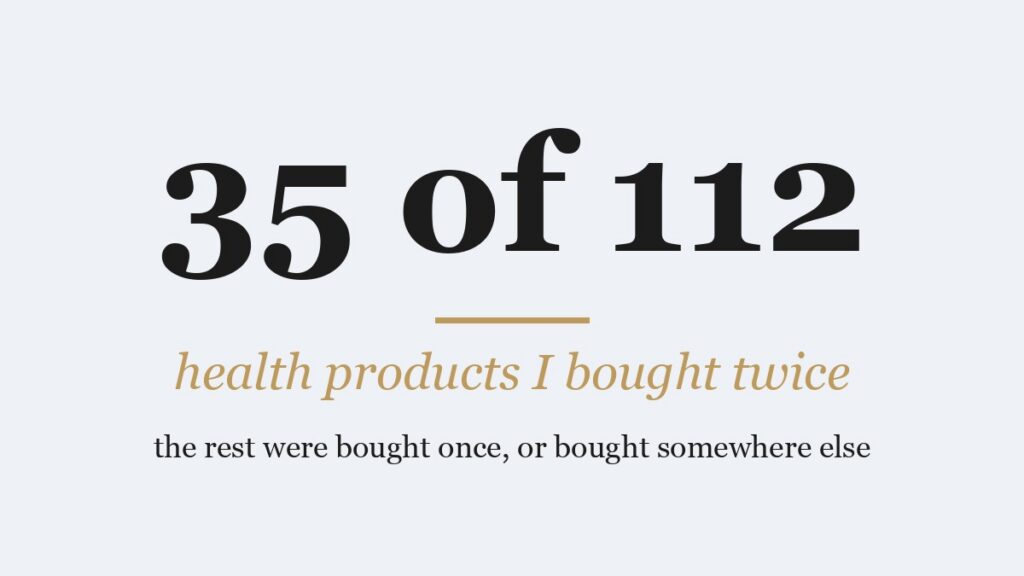
There are 112 entries with a purchase signal on them. Thirty-five say repeat buy. Fifty say once. The remaining twenty-seven are messier: bought across a couple of years, bought a few times without a clean pattern, or bought somewhere that was not Amazon and so recorded from memory rather than a receipt.
Round it however you like. Somewhere around a third of the health products I have bought earned a second purchase. Most of what I have owned, I owned once.
Why the reorder matters more than the review
Almost everything you read about a health product is written in the first week of owning it, which is the week the product is best at selling itself. You are curious, you have just spent money, and the placebo of a new routine is at full strength. Nobody writes the six-month follow-up, because by then it is boring and there is no reason to publish.
A reorder is the follow-up. It is a decision made months later, with the novelty gone, by someone who has to spend money again. Nobody reorders to be polite. It is the only review I know of that cannot be faked by enthusiasm.
That is why this site leans on repeat buys, and why the purchase signal is printed on every product card here rather than tucked away.
Three reasons this is not a scoreboard
Before reading anything into the fifty, some honesty about what that column is and is not.
Some of it is just recent. Twelve of the fifty one-time buys are from 2025 and 2026. A jar bought in March cannot have become a repeat buy by September, so a chunk of that column is not a verdict, it is a calendar.
Some things are not supposed to be rebought. A yoga mat, a pill organiser, a blender, an air purifier. Buying one of those twice would usually mean something had gone wrong. The reorder test is a good test for consumables and a meaningless one for objects. At least one of the one-time buys was not even for me: a DNA kit, bought for a family member.
And not rebuying is not the same as rejecting. A single purchase can mean the product failed. It can also mean the bottle ran out and life moved on, or nothing much at all. The record shows what I bought, not what I concluded.
What the survivors have in common
The thirty-five that came back are duller than the fifty that did not.
They tend to be cheap and consumable. They tend to do one specific, recurring job rather than promise a general improvement. Filter cartridges. A toothpaste. A liquid magnesium. A cooking fat. Deodorant. Nothing on that list is exciting.
The one-time column reads differently. It has more single ingredients with an interesting mechanism attached: turmeric with black pepper, boswellia, glutamine, astaxanthin, oregano oil. All perfectly reasonable purchases, and none of them came back. The record does not say why.
I am not saying those products do not work. I have no idea, and the record cannot tell you either, which is exactly my point. The most one person’s order history can show is a pattern: the things that handle a specific recurring job tend to repeat, and the bottles with a mechanism on the label tend to stop at one.
The 2023 spike
The strangest thing in the data is a year.
Eighteen of the fifty one-time buys happened in 2023. That is nearly double the next busiest year, 2025, with ten. The record does not say what was going on, and I am not going to invent a story for it here.
It is a familiar shape, though, and not only with supplements. People do the same thing with running shoes, courses and apps: there is a mode where you are buying the idea of becoming a person who does the thing, and the arrival of the box is the part that actually delivers. Whether that is what 2023 was, the data cannot say.
What to do with a count like this
Two rules come out of it, and neither is very clever.
Buy for a problem you can name in one sentence, not for a mechanism you find interesting. “My scalp flakes in winter” leads somewhere. “This molecule activates a pathway in yeast” does not.
And treat the first bottle as the trial rather than the verdict. The question is not whether it worked in week one. The question is whether, when it runs out, you notice.
The honest limit of all this
The record only sees Amazon. Anything bought in a shop, or direct from a company, is invisible to it. I know of at least four confirmed cases where the file was simply wrong about what I own because the purchase happened somewhere else.
So the real reorder rate is not exactly one in three, and my shelf is not exactly this list. But the shape holds, and the shape is the part worth having: most things get bought once, the survivors are boring, and the survivors are the ones worth writing about.
Quick questions
Is a one-time purchase a bad review?
No, and treating it as one is the main mistake I want to avoid here. It can mean the product failed, or that it was recent, or that it was never a consumable, or that it was bought for someone else. The record does not distinguish.
Why does this site keep printing a purchase signal on every product?
Because it is the piece of information a review normally leaves out, and it is the one I would want.
Does a repeat buy prove something works?
It proves I chose to spend money on it again, which is a behavioural fact rather than a clinical one. For most of what is written about in this category, it is the strongest honest signal available.
How many products are on the list?
112 with a purchase signal, across fifteen categories, from vitamins to water filters.
The bottom line
A decade of buying health products produced 35 things I bought again and 50 I bought once, and the difference between the two columns does not look like quality. It looks more like whether the thing does a job that keeps coming back. Curiosity is a fine reason to try something, and a poor predictor of what anyone will still be using next year.
there is nothing for me to earn on it. Other posts on this site do contain Amazon
affiliate links, and they are disclosed as such where they appear.