In This Article
My order record has one bottle of olive oil in it that cost real money. Georgia Olive Farms, extra virgin, bought in 2023.
It is the oil I pour when I want mayonnaise to taste of something. That is the whole of what the record and I can tell you about it.
What I can tell you is why a bottle like that costs about forty dollars and a bottle sitting next to it on the shelf costs six. Most of the answer is printed on the label. Some of it is printed there to be misread.
The words that do almost nothing
Start with the front. Most of it is decoration.
“Packed in Italy” or “Imported from Italy” says where the oil was bottled. It does not say where the olives grew. Oil from several countries can be blended, shipped to Italy, bottled there and sold with a name that sounds Italian. In the United States that sentence is still true.
“Product of” a list of countries is more honest, not less. At least it admits the blend.
“Pure” and “light” catch a lot of people. Both usually mean refined olive oil with a little virgin oil mixed back in for taste. Light is about flavour and colour. The calories are the same as any other oil.
“First cold pressed” is mostly nostalgia. Most modern mills do not press at all, they spin the paste in a centrifuge, and there is no second pressing of the same fruit to compare it with. It is not false. It just does not separate one bottle from another.
“Extra virgin” is the one that should mean something, and in the United States it means less than you would hope. The USDA has had grade standards for olive oil since October 2010, with a real chemical and sensory definition of extra virgin.1 They are voluntary. A bottle can say extra virgin without ever being graded, unless it carries the USDA grade mark itself.
What the 2010 UC Davis tests found
In 2010 the UC Davis Olive Center bought olive oil off ordinary shelves in three parts of California and sent it to accredited panels. Fourteen imported brands, three bottles each. Five California brands, two bottles each.2
Sixty-nine percent of the imported samples labelled extra virgin failed the international sensory standard for extra virgin. Ten percent of the California samples did too.
That number gets misquoted a lot. Failing the sensory test means trained tasters found defects. It does not mean the bottle was fake. The report named three causes: oil that had oxidised from heat, light or age; oil cut with cheaper refined olive oil; and oil made from poor fruit or badly handled. Only the second one is fraud in the way people mean it.
Two more things you should know about that report. It was paid for by the California industry: Corto Olive, California Olive Ranch and the California Olive Oil Council. And the International Olive Council pushed back on it publicly. Neither of those makes the tasting wrong. Both are reasons not to treat one study as the last word.
The date that matters, and the one that pretends to
Olive oil is a fruit juice. It is at its best soon after pressing and declines from there.
A harvest date is not required on an American label. When a producer prints one anyway, they are showing you the number that could embarrass them. I would read that as a good sign and buy from the most recent harvest I can find.
A best-by date on its own tells you the bottle is not ancient. That is about all.
The bottle is part of the label
Light and heat are what age olive oil fastest, and the packaging decides how much of either it gets.
A Tunisian group stored the same extra virgin oil for six months in clear glass, dark glass, plastic and tin, under light at room temperature. The clear glass and the plastic lost significant amounts of their carotenes, chlorophylls and phenols. Tin and dark glass held up best.4
A group in Chile did something closer to a kitchen. They kept Arbequina extra virgin, the same variety Georgia Olive Farms grows, for a year at different temperatures. The warm samples, at 30 and 40 °C, broke down faster, and a compound the authors use as an early marker of declining quality climbed steadily with time.5
So a clear bottle in a bright shop window, or a nice glass cruet next to the stove, is working against you. Dark glass or a tin, kept in a cupboard away from the oven, is the whole trick.
Seals worth something
Two seals on American oil involve real testing, and they are easy to confuse.
OOCC seal (Olive Oil Commission of California). A state body. Since 2014, California producers handling 5,000 gallons or more a year have had to sample, test and grade every lot.7
Neither applies to oil grown anywhere else, including Georgia. Nothing wrong with oil from other states because of that. You just have one less thing to lean on.
One more thing on labels, and it is the only health wording you will see here. In Europe an olive oil can carry the claim that its polyphenols help protect blood lipids from oxidative stress, but only if it contains at least 5 mg of hydroxytyrosol and related compounds per 20 g of oil, and the label has to say the effect comes with 20 g a day.8 A number on the bottle is a test result. The words “high polyphenol” on their own are marketing.
So what is in the Georgia bottle
Georgia Olive Farms started in 2009, when five farmers near Lakeland, in south Georgia, planted olive trees. In 2011 they brought in what they describe as the first commercial olive harvest east of the Mississippi since the 1800s.9 They say every olive is grown in Georgia and goes from field to their own mill in under 24 hours.
Put that bottle through everything above and it answers the first question on the front: where the olives grew. One state, one company growing and milling. What I cannot tell you is whether my bottle had a harvest date on the back. The record does not say, and I am not going to guess.
It is also expensive. About $2.35 an ounce at the time of writing.
The pick
Georgia Olive Farms Extra Virgin Olive Oil, Chef’s Blend, 16.9 fl oz
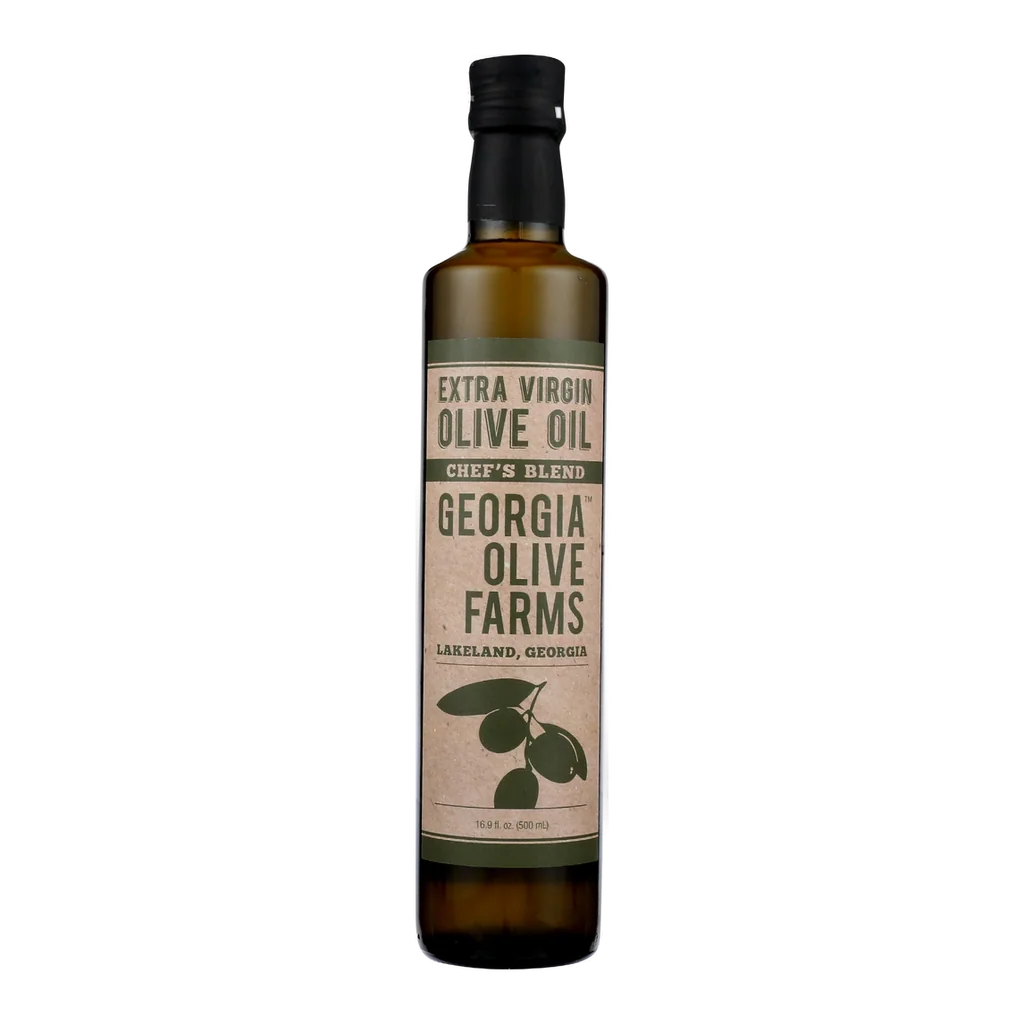
Grown and milled in south Georgia by the people who planted the trees. The oil I pour when I want mayonnaise to taste of something.
Purchase signal: Once · 2023
Price: Around $39.79 for 16.9 fl oz.
Quick questions
Does “Packed in Italy” mean Italian olives?
No. It means bottled in Italy. Look for the countries where the olives were grown, or a single named estate.
How fresh should olive oil be?
Buy the most recent harvest you can find, and once it is open, use it within a couple of months rather than a couple of years.
Is dark glass really better than clear?
In storage tests, yes. Dark glass and tins protect the oil. Clear glass and plastic let it degrade faster under light.
Is extra virgin always tested in the US?
No. The USDA grades are voluntary. Seals like COOC or OOCC, or a USDA grade mark, tell you someone actually tested it.
Is American olive oil better?
Not automatically. It usually has a shorter trip and an easier label to read. That is an advantage, not a guarantee.
The bottom line
Turn the bottle round. A harvest date, a named place where the olives grew, a dark bottle and a seal that involves real testing are the four things a label can prove. Everything on the front is there to sell it. One bottle in my record, a $40 Georgia oil, answers the origin question on its face, and a California bottle for less than half the price answers the same questions if you read the back.
References
- U.S. Department of Agriculture, Agricultural Marketing Service. United States Standards for Grades of Olive Oil and Olive-Pomace Oil. Federal Register. 2010 Apr 28;75(81). Federal Register
- Frankel EN, Mailer RJ, Shoemaker CF, Wang SC, Flynn JD. Tests indicate that imported “extra virgin” olive oil often fails international and USDA standards. UC Davis Olive Center; 2010 Jul. UC Davis Olive Center
- North American Olive Oil Association. Olive oil harvest date vs best by date. aboutoliveoil.org
- Gargouri B, Zribi A, Bouaziz M. Effect of containers on the quality of Chemlali olive oil during storage. J Food Sci Technol. 2015 Apr;52(4):1948-59. PubMed
- Caipo L, Sandoval A, Sepúlveda B, et al. Effect of storage conditions on the quality of Arbequina extra virgin olive oil and the impact on the composition of flavor-related compounds (phenols and volatiles). Foods. 2021 Sep 13;10(9):2161. PubMed
- California Olive Oil Council. About the seal. cooc.com
- Olive Oil Commission of California. Grade and labeling standards for olive oil, refined-olive oil and olive-pomace oil. California Department of Food and Agriculture; 2014. Report
- European Commission. Commission Regulation (EU) No 432/2012 establishing a list of permitted health claims made on foods. Off J Eur Union. 2012 May 25;L136:1-40. EUR-Lex
- Georgia Olive Farms. About us. georgiaolivefarms.com
I earn a small commission if you purchase through these links, at no
additional cost to you. I only recommend products I’ve personally used or
researched thoroughly. This helps support the work behind Better Living
Every Day.