In This Article
- The FDA does not require a date at all
- What “best by” means for a supplement
- What goes off first
- The bathroom cabinet and the shelf above the stove
- Keep the desiccant and keep the bottle
- Do weekly pill organisers hurt?
- Signs it is time to bin a bottle
- Refrigeration, and when it backfires
- How to get rid of the old ones
- Quick questions
- The bottom line
- References
Five of the supplements in my order history are ones I take every day. That is five bottles opened every day, and a reason to care how long a bottle keeps once it is open.
The date printed on a supplement is not what most people think it is. It is not even required. What it does mean, and what goes off before it, is below.
The FDA does not require a date at all
Prescription drugs must carry an expiration date backed by stability testing. Dietary supplements do not.
The rule that governs how supplements are made in the United States is 21 CFR Part 111. The FDA’s own compliance guide to that rule asks the question directly: does the rule require an expiration date, a shelf date or a best-if-used-by date? The answer is one word, no. The guide goes on to say that if a company prints a date anyway, it should have data to support it.1
So the date is voluntary. A bottle with no date is legal. A bottle with a date is making a claim the company is supposed to be able to back up, which is a better sign than no date, but nobody checks that data before it goes on the shelf.
What “best by” means for a supplement
For a drug, the expiration date is the last day the maker promises full potency. For a supplement, a best-by date is the maker’s estimate of how long the bottle still contains what the label says, stored the way the label directs.
So the day after the date is not a cliff. Potency drifts down over months. And a bottle kept somewhere hot and damp can be well below label long before the date arrives.
What goes off first
Not every supplement ages at the same speed. A rough order, fastest first.
Fish oil and other liquid oils. Omega-3 fats oxidise on contact with air, light and heat. That is what the fishy smell is. A New Zealand group tested 32 fish oil supplements off the shelf and found 83 percent over the recommended peroxide limit, with only 8 percent meeting all three oxidation markers. The best-before date, the price and the country of origin were all poor guides to which ones were fresh.3 A larger North American survey of 171 products found half over the voluntary limits and another 18 percent heading there with one to three years still left on the date.4 That second study also found unflavoured capsules held up better than bulk oils and flavoured products, which is worth knowing if you buy a liquid.
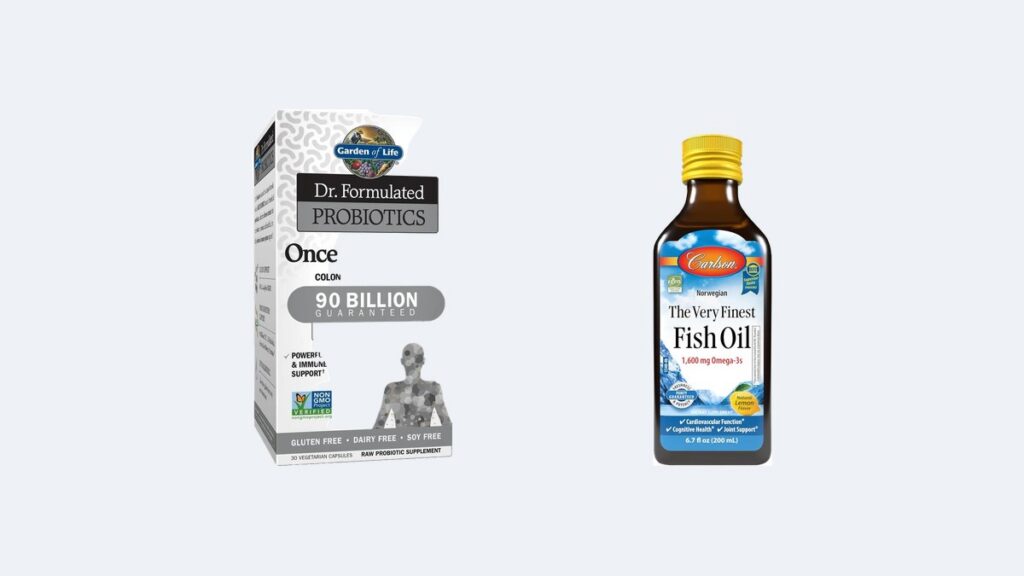
The Carlson in my record is a liquid, lemon flavoured, bought once in 2025. That is the whole of what the record says about it. On the studies above, a liquid oil is the bottle in the house that most needs a cool, dark place and a lid screwed on tight.
Carlson The Very Finest Fish Oil, lemon, 6.7 fl oz

A liquid rather than softgels, 1,600 mg of omega-3s a serving, in a small bottle. Small is the right size for a liquid oil, because it is used up before it has time to turn.
Purchase signal: Once, in 2025.
Price: About $29.67 for the 6.7 oz bottle, checked October 1, 2026.
Probiotics. These are live organisms, and they die over time. The count on the label is in CFU, colony forming units, and whether that number is promised at manufacture or at the end of shelf life depends on the brand. When a DuPont team plated out 52 commercial probiotic supplements, 17 of them, a third, were already below their label count before their expiration dates.5 Heat speeds this up. A probiotic that spent a summer in a hot car is a different product from the one that was packed.
Garden of Life Dr. Formulated Once Daily Probiotics, 30 capsules

One capsule a day, 30 to a bottle, so a bottle is finished in a month and never sits around long enough to lose much. Read the storage line on your own bottle and do what it says.
Purchase signal: Repeat buy, 2022.
Price: $39.89 on October 1, 2026, which works out to about $1.33 a capsule.
Vitamin C and the B vitamins. These are water soluble crystals, and the enemy is humidity rather than air. More on this in the next section, because it is the one most people get wrong.
Liquid drops. Vitamin D drops, liquid minerals, tinctures. Once opened they get a fresh dose of air every time the dropper goes in. If the label gives a window for an opened bottle, follow it.
Softgels versus tablets. A softgel seals its contents from air, which is good, but the shell softens in heat and the capsules stick together, and a stuck softgel is usually a split one. A pressed tablet shrugs off heat better and pulls in damp instead.
The bathroom cabinet and the shelf above the stove
Lisa Mauer’s group at Purdue stored thiamin, B6 and sodium ascorbate, alone and in blends, at humidities from 43 to 98 percent for twelve weeks. Above a certain humidity each crystal reaches what chemists call its deliquescence point: it pulls enough water from the air to start dissolving. Once that happens the thiamin and the vitamin C break down fast. B6 was the tough one. And blends deliquesce at a lower humidity than any single ingredient, with the vitamin C making the thiamin degrade faster still.6
The numbers matter because they are reachable in a house. Pure sodium ascorbate deliquesces at 86 percent humidity, which a bathroom hits every time someone showers. Some blends started at 30 percent, which is a dry living room. Mauer put it plainly: in some products that have deliquesced you can lose all of the vitamin C within a week. And a sealed lid does not save you, because opening and closing the bottle changes the air inside it.7
Keep the desiccant and keep the bottle
That little packet or canister in the bottle is there for the humidity problem above. Leave it in until the bottle is empty.
The same goes for the bottle. Opaque plastic or amber glass blocks light, the cap seals against damp, and the label carries the lot number you will want if anything goes wrong. Decanting a month of capsules into a clear jar on the counter undoes all of that.
Do weekly pill organisers hurt?
A little. The lid of a pill organiser is not airtight, and most of them are clear, so for seven days the pills sit in whatever air and light the room has. For most tablets and capsules that is a small cost and the convenience is worth it. The exceptions are the fragile ones, which means probiotics, and anything with vitamin C if the room is humid, and softgels if it is warm. Fill the organiser for a week, not a month, and leave the fragile things in their own bottles.
The one organiser in my order history is a StarPlus2 bottle bag, bought once in 2023. It holds whole bottles rather than loose pills. I am not linking it, because the record does not say which size I bought and StarPlus2 sells several.
Signs it is time to bin a bottle
The date gets you so far. After that you use your nose and your eyes.
Fish oil that smells like fish has oxidised. Fresh fish oil smells of very little, so a strong fishy smell, or one like paint, is the oil telling you. Softgels that taste off or repeat on you are the same story in a shell.
Clumping is the other big one. Powder that has caked, tablets that have fused, softgels stuck together in a lump. That is moisture or heat, and whatever is inside has been exposed to it.
Then colour. Tablets gone spotty or darker than they were, capsules whose contents have browned. And a cracked seal or a burst desiccant on a bottle that has sat a long time.
None of this makes a supplement dangerous the way spoiled food is. It makes it weaker than the label, and the label is what you paid for.
Refrigeration, and when it backfires
The fridge slows oxidation and slows the die off in a probiotic. Use it for liquid fish oil once opened, and for anything whose label says to.
It backfires with powders and tablets. A cold bottle opened in a warm kitchen pulls condensation onto the contents, and for vitamin C and the B vitamins moisture is the whole problem. Keep those at room temperature somewhere dry. Whatever you do refrigerate, open it briefly and put it straight back.
How to get rid of the old ones
Do not flush them. The FDA’s disposal guidance for medicines is to use a take-back location or mail-back envelope first, and failing that to mix the pills with something unappealing such as used coffee grounds or cat litter, seal the mix in a bag, and put it in the household rubbish, scratching your details off the label.8 That page is about medicines and does not mention supplements, but the same steps work. Some take-back programmes accept vitamins and some do not, so ask before you drop them in.
Quick questions
Is it safe to take expired vitamins?
In almost every case the risk is that they are weaker than labelled, not that they have turned harmful. Fish oil is the one to be stricter about. Smell it.
Why does my bottle have no date on it?
Because the FDA does not require one on a dietary supplement. A date is a voluntary claim the maker should be able to support with data.
How long after the best-by date is a supplement still good?
There is no general answer. A dry tablet kept cool and dark may be close to label for a long time. A probiotic or a liquid oil may be below label before the date arrives.
Should I keep supplements in the fridge?
Only the ones whose label says so, plus opened liquid fish oil. Tablets and powders do worse in the fridge because of condensation.
The bottom line
The date on a supplement is a voluntary estimate, not a legal promise, and the FDA’s own guide says the rule does not require one. What the bottle has been through matters more than what it says. Fish oil wants cold and a tight lid. Probiotics want cool. Vitamin C and the B vitamins want dry, which rules out the bathroom, and nothing wants the cupboard over the stove. Leave the desiccant in. And when a bottle smells of fish or the pills have stuck together, it has expired, whatever the label says.
References
- U.S. Food and Drug Administration. Small entity compliance guide: current good manufacturing practice in manufacturing, packaging, labeling, or holding operations for dietary supplements. Subpart E, requirements to establish specifications. FDA
- Lyon RC, Taylor JS, Porter DA, et al. Stability profiles of drug products extended beyond labeled expiration dates. J Pharm Sci. 2006 Jul;95(7):1549-60. PubMed
- Albert BB, Derraik JG, Cameron-Smith D, et al. Fish oil supplements in New Zealand are highly oxidised and do not meet label content of n-3 PUFA. Sci Rep. 2015 Jan 21;5:7928. PubMed
- Jackowski SA, Alvi AZ, Mirajkar A, et al. Oxidation levels of North American over-the-counter n-3 (omega-3) supplements and the influence of supplement formulation and delivery form on evaluating oxidative safety. J Nutr Sci. 2015 Nov 4;4:e30. PubMed
- Morovic W, Hibberd AA, Zabel B, et al. Genotyping by PCR and high-throughput sequencing of commercial probiotic products reveals composition biases. Front Microbiol. 2016 Nov 3;7:1747. PubMed
- Hiatt AN, Ferruzzi MG, Taylor LS, Mauer LJ. Impact of deliquescence on the chemical stability of vitamins B1, B6, and C in powder blends. J Agric Food Chem. 2008 Aug 13;56(15):6471-9. PubMed
- Purdue University. Vitamins stored in bathrooms, kitchens may become less effective. Press release via EurekAlert, 2010 Mar 2. EurekAlert
- U.S. Food and Drug Administration. Disposal of unused medicines: what you should know. FDA
I earn a small commission if you purchase through these links, at no
additional cost to you. I only recommend products I’ve personally used or
researched thoroughly. This helps support the work behind Better Living
Every Day.