In This Article
Over the last few weeks this site has gone through the research on a lot of things people buy for their health. Supplements with eighty-eight of a hundred and ten outcomes graded very low certainty. A device costing sixteen hundred dollars with three small trials behind it. Recovery boots whose pooled effect the authors describe as trivial to small.
Compression socks came back with a Cochrane review and the words high-certainty evidence in it.
That almost never happens. It certainly does not happen for something that comes in a multipack.
I bought some, for what that is worth. My purchase record has a multipack of compression socks from 2024 or 2025. I picked whichever brand Amazon was recommending at a decent price, and I could not tell you now which one it was. Hold on to that, because it turns out to matter.
What the review found
Twelve randomised trials, all on flights lasting more than five hours, pooled by Cochrane and updated in 2021.1
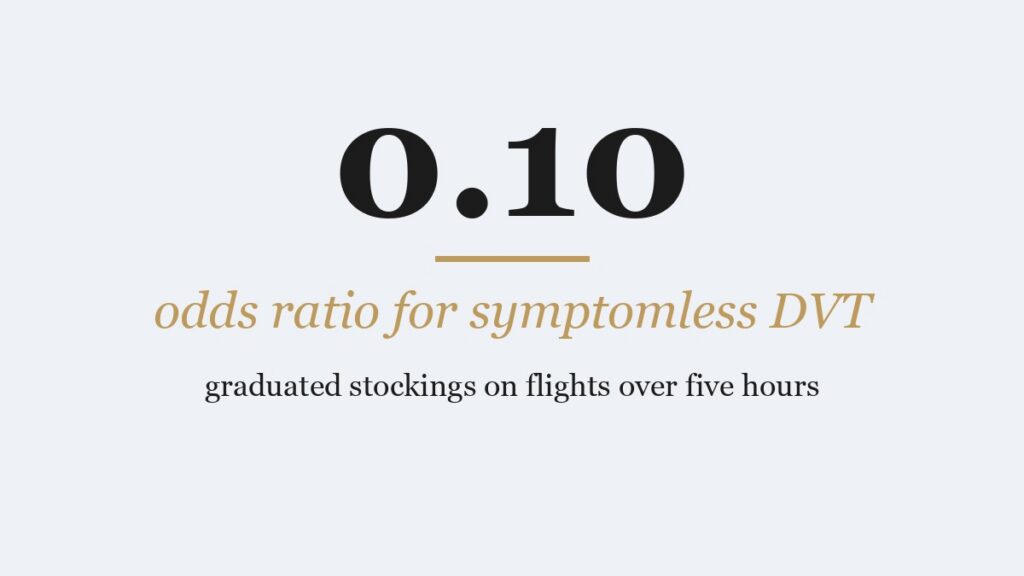
Across the trials that put stockings on both legs, 2,637 people had usable follow-up. Fifty of them turned out to have a deep vein thrombosis. Three were wearing compression stockings. Forty-seven were not.
They also found reduced swelling in the legs, at low certainty because the trials measured swelling in inconsistent ways. Superficial vein thrombosis went the same direction but did not reach significance. No meaningful side effects were reported.
Here is the catch, and it is a big one
Every one of those fifty clots was symptomless.
They were found because the researchers went looking with ultrasound, not because anybody felt anything. And the review is explicit about what follows from that: across all twelve trials, there were no deaths, no pulmonary emboli, and no symptomatic DVTs at all. Not in the stocking group, not in the control group. None.
Which means the review cannot tell you whether wearing these prevents the thing you are actually frightened of. The authors say so directly, and add that a trial capable of answering it would need an enormous number of people, because the event is so rare in ordinary travellers.
So the honest summary is uncomfortable and worth sitting with. There is excellent evidence that compression stockings prevent a finding on a scan. There is no evidence either way about whether they prevent a clot that hurts you, because nobody in these trials had one.
The word that does the work is “graduated”
This is the practical part, and it is where most of the market fails you.
The trials used graduated compression stockings. Graduated means the pressure is engineered: tightest at the ankle, easing as it goes up the leg, so it pushes blood upward rather than just squeezing evenly. That gradient is the mechanism. A sock that is uniformly snug is not doing the same job.
You can tell the difference from the packet, and it is the only spec worth checking. Graduated stockings state a pressure range in millimetres of mercury, usually 15 to 20 mmHg for travel or 20 to 30 for stronger medical use. A great many socks sold as “compression” state no number anywhere, which usually means nobody engineered one.
If there is no mmHg range on the packaging, you are buying an athletic sock. It may be comfortable. It is not the thing that was tested.
Which brings me back to my own multipack. I do not know whether that packet printed an mmHg range. So I genuinely cannot tell you whether what I bought was the product these trials tested or an athletic sock with the right word on the label, and that is exactly the question the packet would have answered in two seconds.
The spec turns out to be free
You might expect the graduated ones to carry a medical markup, on the usual pattern where a number on the box doubles the price.
They do not. On Amazon in September 2026, socks with a printed 15 to 20 mmHg range started around eight dollars for a three-pack and ran to about forty-five for merino or alpaca. The gradient is not what you are paying for. You are paying for the fibre and the brand, the same as with any other sock.
Which removes the last reason to get this wrong. If the pair that matches the trials costs the same as the unmarked pair next to it, there is no argument for buying the one nobody tested.
Who should be careful
Compression is a real intervention and it has real exclusions, which is easy to forget about something sold in a three-pack.
Significant peripheral arterial disease is the important one: if the arterial supply to your leg is already compromised, squeezing it is the wrong move. Anyone who has been told by a clinician not to wear compression should not overrule them because of a Cochrane review.
And if you have had a clot, have a family history of them, are pregnant, are recently post-surgical, or are on hormonal contraception, you are in a different risk bracket than the low and medium risk travellers who made up most of these trials. That is a conversation with a doctor, and the answer may well be more than socks.
What the evidence actually supports
Fly more than five hours, wear graduated stockings with a printed mmHg range, and get up and walk occasionally regardless, because none of the trials tested socks against moving and neither should you.
Below five hours, the evidence simply does not speak to it. Nobody has tested it, so nobody can tell you it helps.
Quick questions
Do compression socks prevent DVT on flights?
They substantially reduce symptomless DVT, on high-certainty evidence. Whether they prevent symptomatic clots is unknown, because no trial participant had one.
What strength should I buy?
The travel trials generally used the lighter end, around 15 to 20 mmHg. The number matters more than the brand, and its absence from the packet tells you something.
Are athletic compression socks the same thing?
Usually not. If the packaging states no pressure gradient, assume it does not have one.
How long a flight before it is worth it?
Every trial in the review used flights over five hours. Under that, the honest answer is that nobody has tested it.
Is there a downside?
The review found no significant adverse effects. The exclusions above are the real caution, along with the fact that badly fitted stockings that roll or bunch can dig in and are worse than nothing.
The bottom line
After a month of research on this site, the best evidenced thing turns out to be a pair of socks. The finding is genuinely strong and genuinely narrow: high-certainty evidence, on long flights, for graduated stockings, against a clot you would never have noticed. Buy the ones with a number printed on the packet, which is the one thing I cannot vouch for about my own, and do not confuse a very good result on a marker with insurance against an emergency.
References
- Clarke MJ, Broderick C, Hopewell S, Juszczak E, Eisinga A. Compression stockings for preventing deep vein thrombosis in airline passengers. Cochrane Database Syst Rev. 2021 Apr 20;4(4):CD004002. PubMed
Not medical advice. If you have peripheral arterial disease, a history of clots, or have been advised against compression, this is a question for your doctor rather than a shopping decision.
there is nothing for me to earn on it. Other posts on this site do contain Amazon
affiliate links, and they are disclosed as such where they appear.