In This Article
- What is actually in the capsule
- The trials look extremely good
- Then look at what it improved
- The part nobody puts on the bottle
- Very low certainty is not the same as debunked
- If you take it anyway, the details that matter
- The oil on skin is a separate question
- What my record shows, and what it does not
- Quick questions
- The bottom line
- References
I bought black seed oil softgels on and off through 2023 and into 2024, across a few different brands, and I could not tell you now which ones. The softgels were the easy way to take it. I also keep the liquid oil around, and I rub that into skin when I need it. My order history shows no softgels after 2024, and it does not say why.
What is odd is the research. When I finally went and read it properly, black seed did not look like a dud. It looked like one of the most promising things I have bought. And the more of it I read, the less I trusted it.
What is actually in the capsule
Black seed is Nigella sativa, a small flowering plant whose seeds have been pressed for oil across the Middle East and South Asia for a very long time. The compound everyone points at is thymoquinone. It has a reputation in traditional medicine that borders on absurd, the kind of reputation that gets printed on the bottle, and I am going to set that aside rather than treat it as evidence. Plenty of things with long histories do nothing.
The interesting part is that unlike most folk remedies, this one has actually been run through trials. A lot of them.
The trials look extremely good
Start with blood pressure. A 2016 meta-analysis in the Journal of Hypertension pooled 11 randomised trials covering 860 people and found black seed lowered both numbers.1
Then the metabolic side. A 2025 meta-analysis of 16 trials in people with type 2 diabetes reported fasting blood glucose down by about 21 mg/dL, HbA1c down by 0.44 points, total cholesterol down about 19 mg/dL and LDL down about 20.2 Those are not trivial numbers. An HbA1c drop of 0.44 is in the neighbourhood of what a real medication does.
And then the big one. A 2025 review in Pharmacological Research pulled together 82 trials, 5,026 participants, doses from 200 to 4,600 mg a day, durations from one week to just under a year.3 The authors concluded black seed could be a promising adjunct for cardiovascular risk factors.
If you stopped reading there you would order a bottle.
Then look at what it improved
Here is the list of things that 82-trial review found black seed significantly improved. Body fat percentage. BMI. Skeletal muscle mass. Waist circumference. Weight. Waist to hip ratio. Systolic pressure, diastolic pressure and mean arterial pressure. Fasting blood sugar, HbA1c, post-meal glucose and insulin sensitivity. CRP and high sensitivity CRP. ICAM-1, IL-6, TNF-alpha and VCAM-1. Atherogenic index, HDL, LDL, total cholesterol, the cholesterol to HDL ratio, triglycerides and VLDL. Alkaline phosphatase, ALT, AST, creatinine and urea. Catalase, malondialdehyde, superoxide dismutase and total antioxidant capacity.
Read that list twice. One pressed seed oil improved essentially every marker anybody thought to measure, including ones that usually move in opposite directions.
There are two ways to explain that. Either black seed is the most broadly effective natural compound ever tested on a human being, or the underlying trials are small, short, heterogeneous and reported by people who wanted a result. I know which one I would bet on, and so, it turns out, do the people who grade this stuff for a living.
The part nobody puts on the bottle
In 2023 a team published an overview whose entire job was to assess the quality of the black seed literature rather than its conclusions. They collected 20 meta-analyses published between 2013 and 2021 and ran them through the standard checklists.4
The methodological quality of those 20 reviews: one moderate, four low, fifteen critically low.
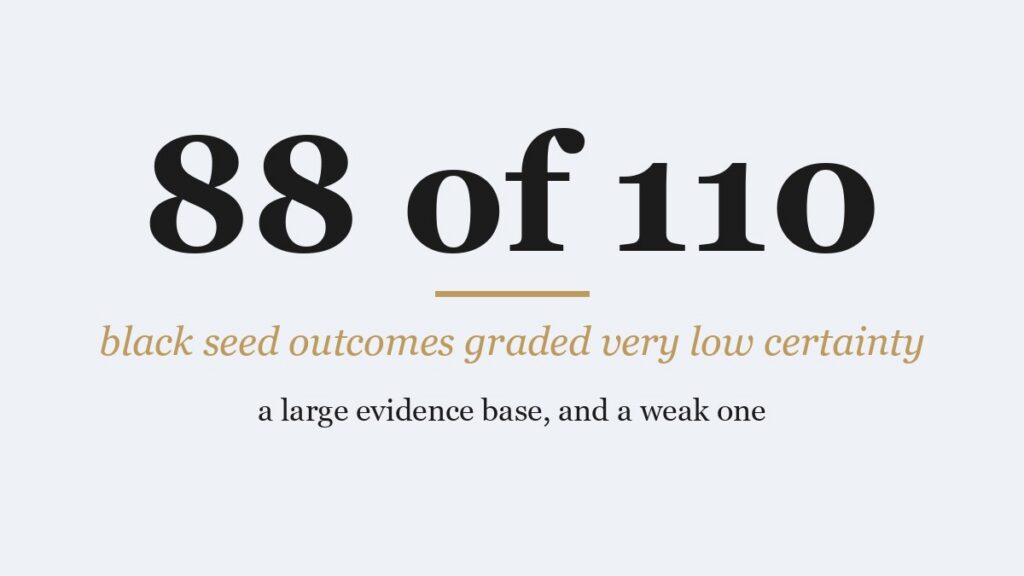
Then they graded the actual findings. Across 110 outcome measures, five came out as moderate certainty evidence. Seventeen were low. Eighty-eight were very low. The reasons for the downgrades were risk of bias, inconsistency between trials, and imprecision.
That is the honest state of black seed oil in 2026. Not “it does not work.” Something more frustrating.
Very low certainty is not the same as debunked
I want to be careful here, because the internet only has two settings for supplements and both of them are wrong.
Very low certainty evidence does not mean black seed was tested and failed. It means the tests were not good enough to tell us much. The effect could be real and roughly the size those meta-analyses report. It could be half that. It could be nothing. The research so far cannot separate those possibilities, and the reviewers said so plainly.
The difference matters for your money. A supplement with strong evidence of a small effect is a reasonable purchase. A supplement with weak evidence of a large effect is a lottery ticket. Black seed is the second one. Some lottery tickets pay.
If you take it anyway, the details that matter
I would not try to talk anyone out of this. It is inexpensive, it has been eaten for centuries, and the safety signal in the trials is unremarkable. A few things I would want to know first.
The oil seems to beat the powder. The subgroup analyses in both the diabetes and blood pressure work point the same way, and the doses that moved numbers were generally above a gram a day.
Thymoquinone content is the actual active question, and most labels do not answer it. Two bottles both saying “black seed oil” can differ several fold in the compound the research is about. Nobody is required to tell you.
So since I cannot name the brands I bought, I would choose the next bottle on two things a label can actually state: a thymoquinone figure somewhere between 1% and 5%, and cold pressed extraction. ORZAX Black Seed Oil softgels meet both on paper. They are 1,000 mg softgels, about $18 for 90 when I checked, and both the Amazon listing and ORZAX’s own product page say cold pressed and standardised to 2% thymoquinone. I have not used this bottle. I picked it on the label spec, and a percentage on a label is still the company’s claim, not a lab result I have seen.
ORZAX Black Seed Oil Softgels (the on-paper pick)
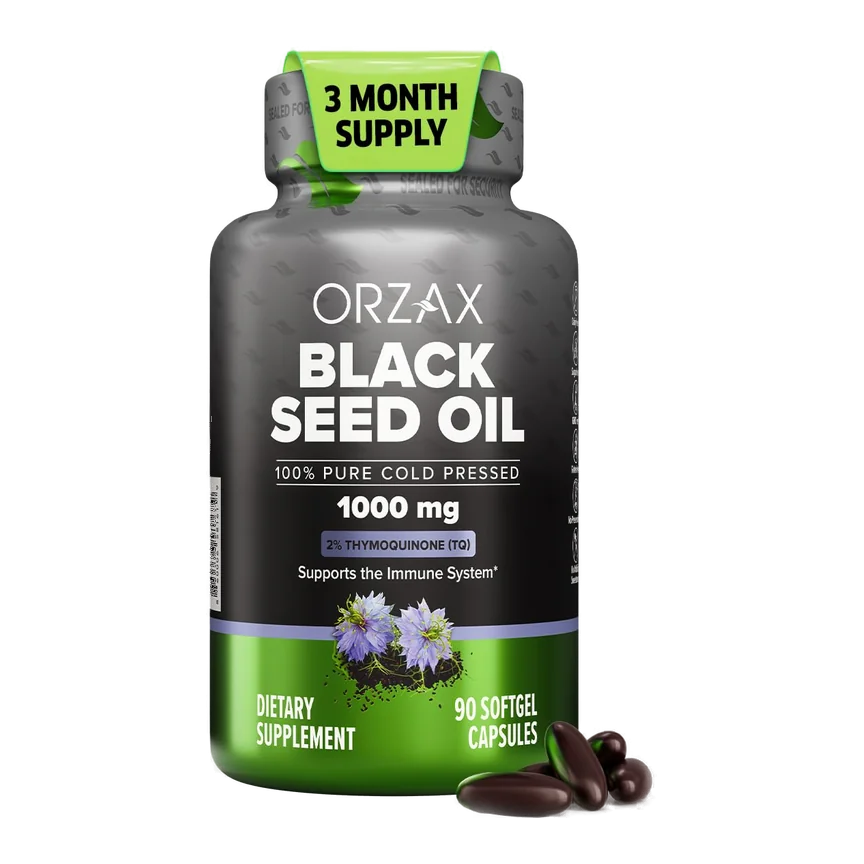
1,000 mg softgels with the thymoquinone figure printed on the label, which most bottles leave off.
Picked for: It states the two things I would check: thymoquinone content and cold pressing. Not one of the bottles in my record.
Price: $14.32 when I looked on September 26, lower than my earlier check.
The oil on skin is a separate question
Rubbing the liquid oil into skin is a different use from swallowing capsules, and it has its own, much smaller evidence base.
A 2022 systematic review found 14 randomised trial records on Nigella for skin conditions, covering 732 people with problems ranging across eczema, psoriasis, acne, vitiligo and warts.5 Pooled, the odds ratio favoured Nigella at 4.59, with a confidence interval running from 2.02 to 10.39. The authors still said more research was needed before calling it validated.
Two of the individual trials show what that pile is made of. In hand eczema, 60 people were randomised to a Nigella ointment, a betamethasone steroid cream or plain Eucerin for four weeks, and the Nigella group did about as well as the steroid group, both better than Eucerin.6 In acne, 60 people used either a Nigella hydrogel standardised on thymoquinone or a placebo gel for 60 days, and the treated group’s severity score fell 78% against 3.3% on placebo.7
Look at what was tested, though. Formulated ointments and gels, small groups, a few weeks. That is not the same thing as oil poured from a bottle, and it is nowhere near enough to call black seed a skin treatment.
The same oil can also cause the reaction you were trying to calm. A French case series described three people hospitalised with severe contact dermatitis after putting Nigella oil on their skin, with the rash spreading well beyond where they applied it.8 A separate report identified thymoquinone itself as the allergen in a case of black seed oil contact dermatitis.9 Reactions like that are rare, but they are a good reason to try a small patch of skin first.
What my record shows, and what it does not
My order history shows black seed softgels bought across brands in 2023 and 2024, and nothing after that. It does not say why, and I am not going to invent a reason for it.
I do get regular blood panels, which I go through with a nutritionist. A panel before and after is the only kind of self test that could tell you anything about a supplement like this, and nothing in my record ties a panel to the black seed months. So I am not claiming a result either way.
What the evidence grades settle is narrower than a personal verdict. The enormous, impressive, everything improves literature behind this supplement is mostly a pile of small trials that agree with each other about being uncertain. If a large, properly powered trial lands on black seed and holds up, I will say so here.
Quick questions
Is black seed oil safe?
Taken by mouth in the trials, unremarkably so. The reviews did not find meaningful effects on liver enzymes or kidney markers at the doses tested. The real safety issue is interaction with medication you may already take for blood pressure, blood sugar or clotting, and on skin, the chance of an allergic reaction.
How long would I need to take it to know?
The trials that moved fasting glucose generally ran longer than eight weeks. A couple of weeks of noticing nothing tells you nothing.
Is the oil better than the seeds or the powder?
The subgroup data leans toward the oil. Nobody has run the head to head trial that would settle it.
Softgels or liquid?
Softgels are easier to handle and dose. The liquid is the one you can also put on skin, with the patch test caveat above.
Which bottle would you buy?
I cannot tell you which brands I bought, so I would pick on the label: a stated thymoquinone percentage between 1% and 5%, and cold pressed. The ORZAX softgels above meet that on paper. I have not used them.
The bottom line
Black seed oil has one of the largest and one of the weakest evidence bases of anything I have bought. Eighty-eight of 110 graded outcomes sit at very low certainty. If that reads as a reason to try it, fine, it is cheap and it is probably harmless if you are not on the medications above. It reads to me as a reason not to pretend anyone knows yet what it is doing.
References
The claims about black seed above come from peer-reviewed research. The papers that matter most:
- Sahebkar A, Soranna D, Liu X, Thomopoulos C, et al. A systematic review and meta-analysis of randomized controlled trials investigating the effects of supplementation with Nigella sativa (black seed) on blood pressure. J Hypertens. 2016 Nov;34(11):2127-35. PubMed
- Karimi M, Pirzad S, Pourfaraji SMA, Sedgi FM, et al. Effects of black seed (Nigella sativa L.) on cardiometabolic indices in type 2 diabetic patients: a systematic review and meta-analysis of RCTs. Complement Ther Med. 2025 Jun;90:103174. PubMed
- Jafari A, Mardani H, Faghfouri AH, Fashtali ZM, et al. Does Nigella sativa supplementation improve cardiovascular disease risk factors? A comprehensive GRADE-assessed systematic review and dose-response meta-analysis of 82 randomized controlled trials. Pharmacol Res. 2025 Sep;219:107882. PubMed
- Li Z, Wang Y, Xu Q, Ma J, et al. Nigella sativa and health outcomes: an overview of systematic reviews and meta-analyses. Front Nutr. 2023 Mar 28;10:1107750. PubMed
- Nasiri N, Ilaghi Nezhad M, Sharififar F, Khazaneha M, et al. The therapeutic effects of Nigella sativa on skin disease: a systematic review and meta-analysis of randomized controlled trials. Evid Based Complement Alternat Med. 2022 Dec 5;2022:7993579. PubMed
- Yousefi M, Barikbin B, Kamalinejad M, Abolhasani E, et al. Comparison of therapeutic effect of topical Nigella with Betamethasone and Eucerin in hand eczema. J Eur Acad Dermatol Venereol. 2013 Dec;27(12):1498-504. PubMed
- Soleymani S, Zargaran A, Farzaei MH, Iranpanah A, et al. The effect of a hydrogel made by Nigella sativa L. on acne vulgaris: a randomized double-blind clinical trial. Phytother Res. 2020 Nov;34(11):3052-3062. PubMed
- Gaudin O, Toukal F, Hua C, Ortonne N, et al. Association between severe acute contact dermatitis due to Nigella sativa oil and epidermal apoptosis. JAMA Dermatol. 2018 Sep 1;154(9):1062-1065. PubMed
- Kurihara F, Soria A, Lepoittevin JP, Chasset F, et al. Thymoquinone as a causative allergen in Nigella sativa oil contact dermatitis with cross-reactivity to tert-butylhydroquinone. Contact Dermatitis. 2020 Aug;83(2):132-134. PubMed
This is a supplement, not medicine, and none of the above is medical advice. Black seed interacts with blood thinners, diabetes medication and blood pressure medication. Talk to whoever prescribes those before adding it, and patch test the oil before putting it on skin.
I earn a small commission if you purchase through these links, at no
additional cost to you. I only recommend products I’ve personally used or
researched thoroughly. This helps support the work behind Better Living
Every Day.