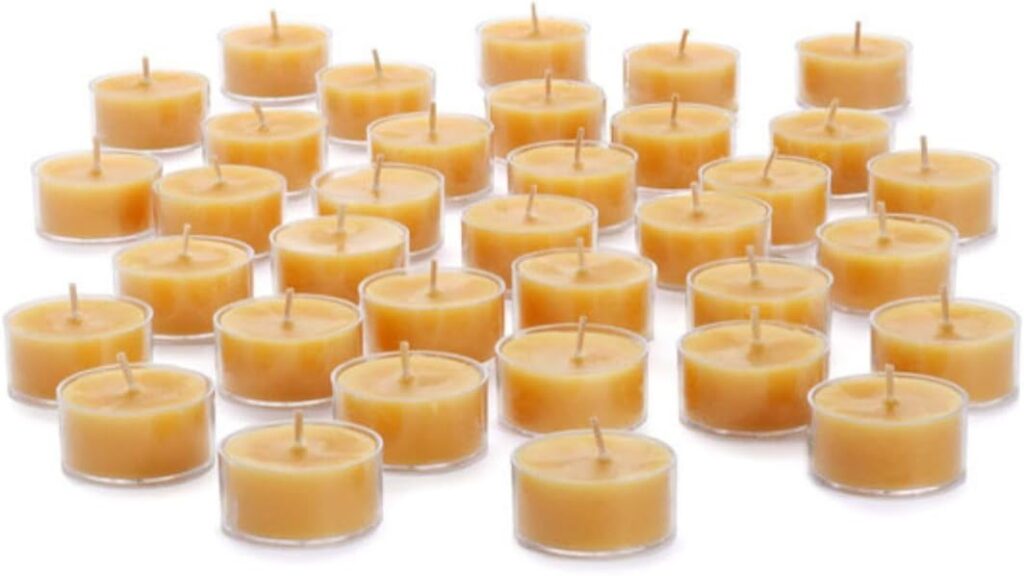
I used to burn three or four scented candles every night. Fall in particular. Pumpkin, fir, vanilla, the whole catalog. It made the house feel warm in a way I genuinely missed when I stopped.
The thing that broke the habit was an air quality monitor a friend lent me last year. I figured I’d play with it for a weekend. Lit a $30 fall scented candle from one of the big mall brands. Watched the PM2.5 number on the monitor climb from eight to one hundred forty-two in maybe fifteen minutes. For context, anything above thirty-five is the EPA’s “unhealthy” threshold. I was triple that, in my own living room, voluntarily. The VOC reading was climbing too, and even after I snuffed the wick, it took hours for either number to come down.
Nearly the entire candle aisle is paraffin dosed with synthetic scent. Soy and beeswax fight over the last sliver of shelf. And paraffin is, not to put too fine a point on it, a petroleum leftover. Burn it with a fragrance load on top and you’re releasing a little formaldehyde, a little benzene, some toluene. Some imported ones even sneak in a lead-core wick, which we supposedly banned back in 2003. Honestly the nicest thing I can say about a typical mall candle is that the pretty jar it came in probably isn’t poisoning you.
That weekend basically ended the paraffin era in our house. Beeswax burns clean, smells mildly of honey on its own, doesn’t move the monitor, doesn’t streak the wall. It runs me about three times what the mall candle did, which I’ve made my peace with. The four brands I actually keep buying are below.
What’s actually in a typical drugstore candle
Here’s the part that surprised me: the label tells you basically nothing. The FDA doesn’t require candle makers to list ingredients, and most don’t bother. So you walk into a store, pick up a $25 candle off the seasonal display, and the box just says the brand name and maybe the scent. Could be anything inside.
What’s inside is almost always paraffin. Which sounds like nothing until you find out paraffin is basically the sludge left at the bottom of the barrel after they make gasoline. They bleach it, deodorize it, melt it, pour it into a jar, and sell it to you as coziness. Because it melts at a low temperature the wick never fully burns the scent oils, so you get soot. You’ve seen it: that grey smear climbing the wall above where a candle sat for a few weeks. That smear is on your ceiling and, I’d assume, in your lungs.
Then there’s the smell itself, which is its own rabbit hole. “Fragrance” (or “parfum”) is almost always synthetic, and the FDA lets companies keep the recipe secret as a trade secret, so you genuinely can’t find out what’s in it. When the EWG tested a batch of these formulas back in 2018, over half had phthalates in them. Phthalates are the endocrine-disrupting ones people worry about for fertility and development, and the evidence there is not thin. We’ve already pulled them out of kids’ toys. Candles, apparently, are fine.
Dyes mostly just add to the soot. Cotton or hemp wicks should be standard, but lead-core wicks (banned domestically in 2003) still occasionally show up on imports because enforcement is spotty. Quick way to check: if the wick stays standing upright on its own in a melted wax pool instead of curling over, there’s metal in it. Snip off the end and look at the cross-section.
Put it all together and you’re quietly inhaling the same short list of nasties (formaldehyde, benzene, that family) plus a solid dose of fine particulate. Here’s the comparison that stuck with me: searing a steak with the hood off throws off about the same PM2.5. But the steak is ten minutes and you’ve got the window open. The candle burns three hours while you sit two feet away watching a movie.
Why beeswax is different
Beeswax is what bees make to build honeycomb. It’s harder and denser than paraffin and melts at a much higher temperature, around 64°C compared to paraffin’s 50°C. Sounds like a tiny difference, but it changes the entire burn. A hotter flame combusts cleaner. So almost no soot, no streaks on the wall, no acrid smell. The wax itself has a soft honey scent when warm, more “warm room in an old farmhouse” than “perfume aisle.” Add essential oils if you want a stronger smell, but you don’t need to.
You’ll also run into the claim that beeswax flames throw off negative ions and clean your air. The negative-ion part is technically true; the “purifies your air” part is wishful marketing, so ignore it. What actually holds up in side-by-side tests is boring but real: same conditions, beeswax puts far fewer particles into the room than paraffin. That’s the number that matters. The other thing I like, honestly, is that the wax comes from beekeeping instead of an oil refinery. Feels less like industrial waste with a candle costume on.
And then the thing nobody likes to bring up: it’s expensive. Real beeswax costs three to five times what the equivalent paraffin candle does. Brands get around that by cutting it with cheaper wax (palm, soy, sometimes paraffin itself) and still stamping “beeswax” on the front in big letters, conveniently skipping the percentage. Your defense is the ingredient list. You want the literal words “100% pure beeswax.” If all it says is “beeswax candle” or “beeswax blend” with no number attached, you’re mostly buying cheap wax wearing a beeswax label.
People always ask about soy, so: soy sits in the middle, cleaner than paraffin and dirtier than beeswax. It burns cool, which lets makers pack in extra scent oil without cooking it off, and that’s why a soy candle can smell like it’s screaming at you across the room. The catch you rarely hear is that most “soy” candles on the shelf are actually soy cut with paraffin unless the label swears otherwise, and industrial soy has its own environmental baggage. Beeswax still wins the cleanliness contest.
The 4 products I burn now
Bluecorn 3×4 Beeswax Pillar (the centerpiece pillar)
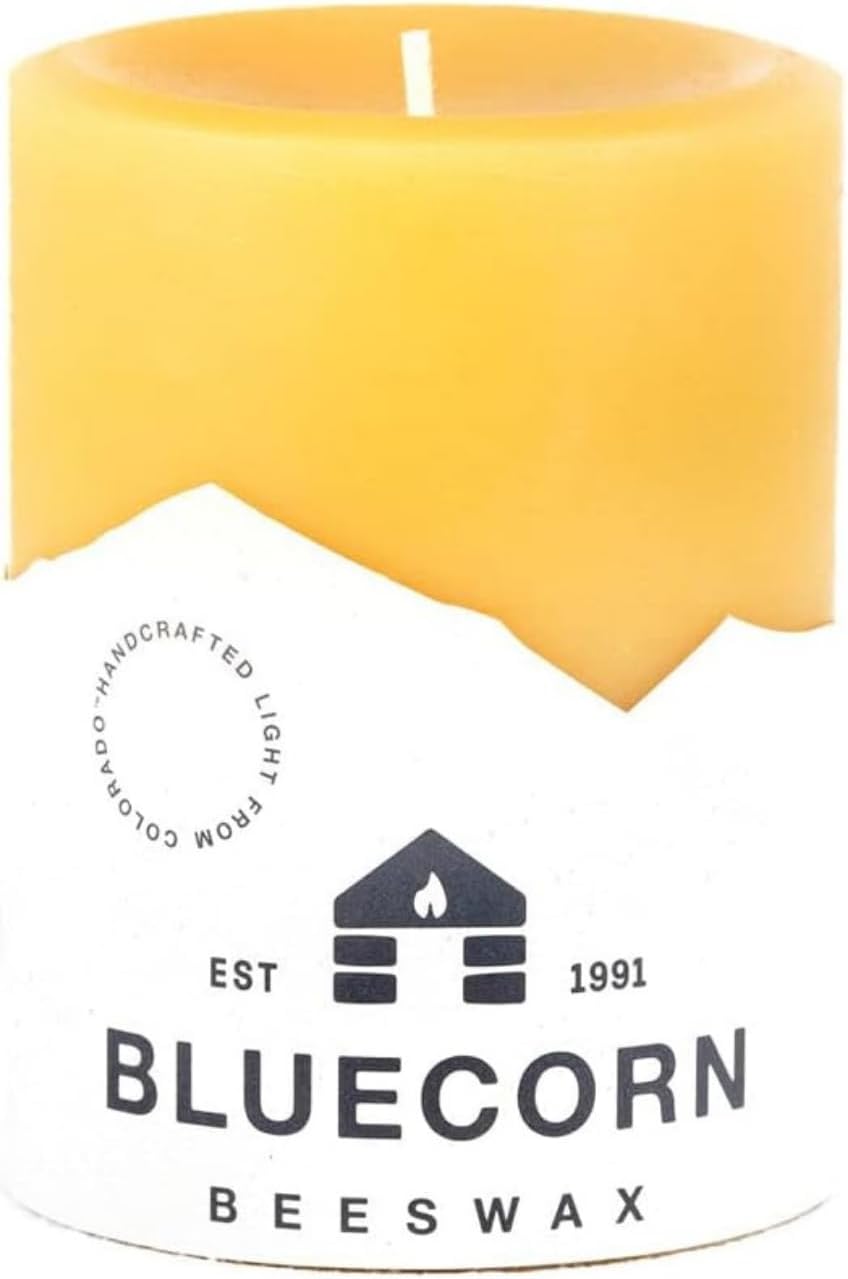
Bluecorn has been pouring these in Colorado since 1991, and the 3×4 pillar is the one that lives on our dining table. Pure beeswax, cotton wick, nothing sprayed on. They don’t bleach the wax, so it’s that natural warm gold, which means it looks like something even when it’s unlit. And it lasts: I get 80-ish, sometimes 90 hours out of a single pillar. A paraffin pillar that size would be long gone.
Ingredients: 100% pure beeswax, cotton wick. Nothing else.
Size: 3″ diameter x 4″ tall (also available in 3×6, 3×9).
Price: Around $24.
My take: This is the one I’d give someone who’s never tried beeswax before. That soft honey smell is the whole pitch, and it kills the “but I want a scented candle” itch better than I expected it to.
Big Dipper Beeswax Tealights, 48-pack (the everyday workhorse)
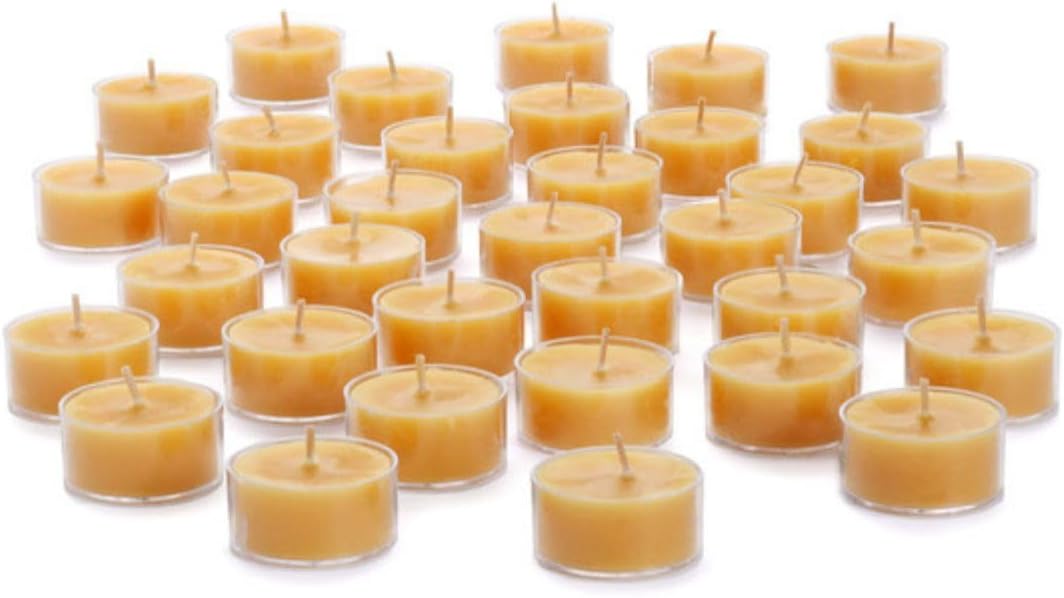
Big Dipper is a Seattle co-op, also candle-making since the ’90s, and their tealights are the ones I scatter into little votives all over the place. Bathroom, kitchen sill, nightstand. We go through the 48-pack in roughly three months, which drops the per-candle cost well below buying twelve at a time and running out constantly. Each one burns four, maybe five hours.
Ingredients: 100% pure beeswax, cotton wick, polycarbonate cup.
Pack size: 48 tealights.
Price: Around $80 for the 48-pack.
My take: My reach-for-it-without-thinking candle. Grab the big box, shove it in a drawer, forget about it for a season. Nothing fancy, just reliable.
Big Dipper Hand-Dipped Beeswax Tapers (the dinner-table candle)

These come out when there’s an actual sit-down dinner happening. Twelve-inch tapers, two to a pack, hand-dipped, and they barely drip. Because a person dipped them instead of a machine pouring them, each one is a little imperfect, which somehow reads as nicer than the dead-straight ones. Eight to ten hours of burn apiece.
Ingredients: 100% pure beeswax, cotton wick.
Size: 12″ tall, 2 per pack.
Price: Around $22 for a pair.
My take: If you own taper holders and they’re sitting empty, fix that with these. They beat the chalky white drugstore tapers on looks and don’t leave wax puddles on the tablecloth.
Big Dipper Beeswax Apothecary Jar Candle (the room candle)
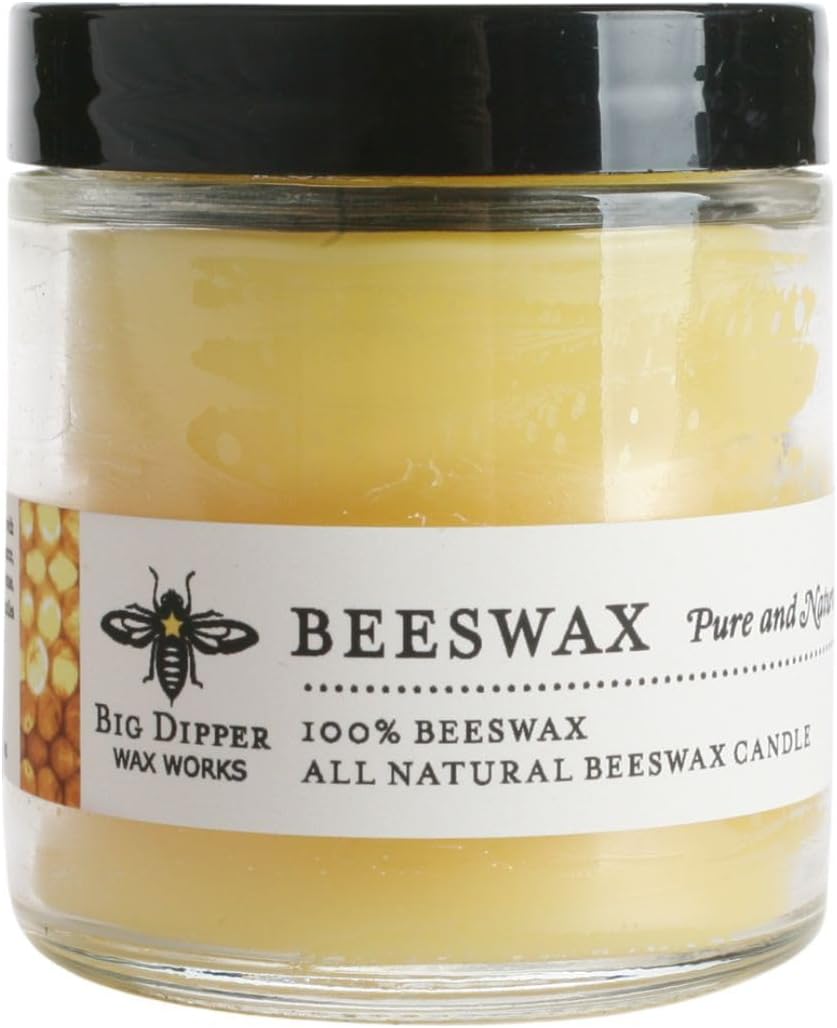
This is the beeswax answer to wherever a Yankee Candle would normally go. It’s 3.2 ounces of pure wax in a glass apothecary jar with a metal lid, and that lid earns its keep: keeps dust off, and slide it over the flame and it snuffs out clean, no smoke trail. No added scent, just the faint honey thing. Call it 25 to 30 hours.
Ingredients: 100% pure beeswax, cotton wick, glass jar.
Size: 3.2 oz.
Price: Around $18.
My take: What I keep on the coffee table. The apothecary jar format is the closest beeswax equivalent to a Diptyque or Yankee setup, just without the chemical load. The lid makes it easier to live with. You can blow it out, slide the lid on, no smoke trail through the house.
How to read a candle label
Standing in the store holding some brand I’ve never heard of, here’s the ten-second gut check I run.
First I hunt for the exact words “100% pure beeswax.” Everything short of that is a dodge. “Beeswax candle” could legally be five percent beeswax. “Natural wax” is usually code for soy plus paraffin. If they won’t print the percentage, I assume the worst.
Then the wick, which should just be cotton or hemp. “Natural wick” with nothing after it tells me nothing, and that phrase can hide anything up to a zinc-core, so back on the shelf it goes.
Scent is where a lot of “clean” candles fall apart. Spot “fragrance” or “parfum” in the ingredients and I’m out. If it’s scented, I want a named oil (lavender essential oil, that kind of thing), or nothing at all, which is fine too.
And the color tips you off before you even read anything. Real beeswax is warm gold. If it’s bright snow-white, it’s been bleached, and bleaching strips the pollen bits that were half the point of buying beeswax to begin with. Miss any one of these and I put it down. It really is that quick once you’ve done it a couple times.
How to use them well
A handful of things I picked up the hard way that nobody bothers to mention.
Trim the wick. Every time, before the match, down to about a quarter inch. A long wick means a tall flame, a tall flame doesn’t burn clean, and even beeswax will start sooting on you if you let the wick get away. Scissors are fine; a little five-dollar wick trimmer is fine too and weirdly more fun to use. Just don’t skip it.
The very first burn is the one that matters most, which nobody tells you. The first time you light a new candle, leave it going until the whole top has melted flat, wall to wall. Cut it short and you’ve taught it to “tunnel,” where it burns straight down the middle in a skinny column and the outer wall never melts at all. You end up with a wax tube wrapped around a hole and half the candle wasted. So light a fresh one when you’ve actually got a couple hours.
Give it a reset every few hours. Somewhere around the four-hour mark the wick “mushrooms,” this little carbon knob on the tip, and the soot creeps up. Blow it out, let it cool for ten, snip the knob off, relight. You can keep that going all night.
And crack a window if you’ve got two or three going at once. Even the clean stuff still sheds some particulate, and it stacks up in a sealed room. The window barely has to be open, just enough to keep the air moving.
FAQ
Are soy candles fine?
Better than paraffin, not as clean as beeswax. The bigger issue with soy is mislabeling. Most “soy” candles in US retail are a soy and paraffin blend. If you find a brand that’s verifiably 100% soy with cotton wicks and essential-oil scenting, it’s a fine pick. Beeswax just burns cleaner.
Are beeswax candles vegan?
No. They’re made from bees, which makes them animal-derived by definition. If you’re vegan and want a clean candle, the two paths are verified 100% soy or coconut wax. Both exist on Amazon. Read the ingredient list carefully because most “soy” candles in retail are actually blended with paraffin.
Do beeswax candles smell like honey?
Lightly, yes, but it’s subtler than the name suggests. Most people who try one for the first time describe it as “warm” rather than honey-specific. If you want something more pronounced, look for the ones scented with real essential oils, not “natural fragrance,” which is sometimes a polite name for the same synthetic chemistry you’re trying to avoid.
How long do beeswax candles last?
A lot longer than paraffin or soy at the same physical size. Beeswax melts at a higher temperature, so the wax disappears slower. A 4-inch pillar that gives me about thirty hours of burn time in paraffin runs sixty to eighty in beeswax. Which means the cost per burn hour gap between paraffin and beeswax is way smaller than the sticker price gap.
Are candles scented with essential oils safe?
Mostly yes, with one watch-out. Real essential oils are fine. The catch is that some brands use “natural fragrance” as a label, which can be the same synthetic stuff you’d find in a drugstore candle. If the ingredients name a specific oil (lavender essential oil, eucalyptus essential oil) you’re good. One caveat: candle-flame heat degrades some of the therapeutic compounds in essential oils, so don’t expect aromatherapy benefits. You’re just getting a nice-smelling room. Lavender, citrus, and conifer scents are my regular picks.
What about palm wax?
Skip it. Palm plantations are responsible for some of the worst tropical deforestation on the planet, and the wax combustion chemistry is iffy on top of that. Same answer I give for cooking with palm oil. Just don’t.