In This Article
The word on the front of the bottle is aminos. The protein line on the back of the same bottle says zero grams. Amino acids are what protein is made of, so I went and read both labels properly, the coconut aminos and an ordinary bottle of soy sauce, to see what else did not line up.
Most of it does line up. The sodium claim is real and the arithmetic checks out. There is also some sugar the front label skips, and an allergen rule that changed in 2025. Coconut Secret is the bottle I have bought again and again since 2023, so this is me checking my own cupboard.
What is in each bottle
Coconut aminos is the sap of the coconut palm flower, fermented, with sea salt added. The Coconut Secret label lists two ingredients: organic coconut tree sap and sea salt.1 There is no coconut meat or coconut water in it. The Amazon listing makes a point of saying it is made from the sap “and not coconuts”.
Brewed soy sauce has four. Kikkoman’s regular bottle lists water, soybeans, wheat and salt.2 People miss the wheat. Soy sauce is a wheat product as much as a soy one.
If the bottle in the store says Nutiva where you expected Coconut Secret, it is the same sauce. Coconut Secret became part of Nutiva in 2021, and the maker says the products are moving to the Nutiva name with the recipes unchanged.3
Liquid aminos is a third thing with a similar name. It is made from soybeans, so it is no help if soy is what you are avoiding.
The sodium math
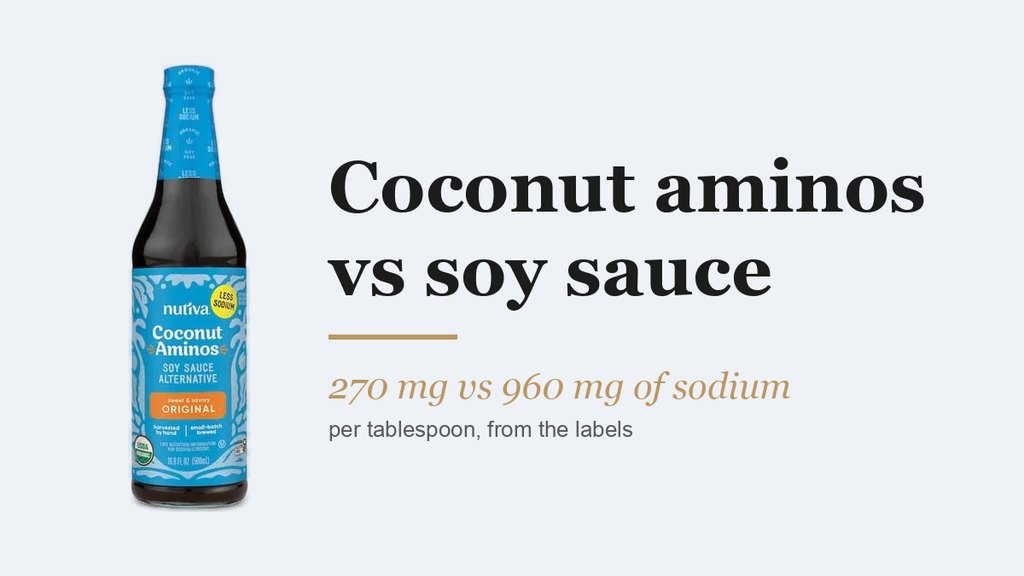
A tablespoon of Coconut Secret has 270 mg of sodium. A tablespoon of regular Kikkoman has 960 mg. Kikkoman’s less sodium bottle has 590 mg.4
So coconut aminos carries 28 percent of the sodium of regular soy sauce. That is the “72% less sodium” on the bottle, and the maker’s footnote names the same 960 mg figure, so I can see what it was measured against. Next to the less sodium soy sauce it comes to a little under half.
The FDA sets the Daily Value for sodium at less than 2,300 mg, about a teaspoon of table salt, and says Americans average about 3,400 mg a day.5 One tablespoon of regular soy sauce is 42 percent of that Daily Value. One tablespoon of coconut aminos is 12 percent.
The catch is the pour. Coconut aminos tastes less salty, so it is tempting to use more. Double it and you are at 540 mg by my arithmetic, which is still under the less sodium soy sauce by a little. Triple it and you have gone past. The saving only holds if the spoon stays the same size.
The sugar on the other side of the label
The Kikkoman panel shows 1 gram of carbohydrate in a tablespoon, and 10 calories. Whatever sugar is in there has to fit inside that gram.
Coconut aminos starts as a sweet sap, and it shows. A tablespoon has 4 grams of carbohydrate, 3 of them sugar, and 15 calories. None of it counts as added sugar, because nobody added any. It came out of the tree that way. Nutiva’s own page says the sauce is “a bit sweeter” than soy sauce.
Three grams is small. A teaspoon of table sugar is about four. Marinades use more than a tablespoon, though. A quarter cup of coconut aminos is four tablespoons, so 12 grams of sugar goes into the bowl with it. If you count carbohydrates closely, count that.
The Amazon listing also says the sap is “very low glycemic (GI of only 35)”. That is a statement about the raw sap. The panel on the finished sauce still reads 3 grams of sugar, and I would go by the panel.
What the word aminos is worth
The Amazon listing for Coconut Secret says the sauce “contains 17 amino acids”, and further down that it has “14 times the amino acid content” of soy sauces. Nutiva’s current product page does not mention amino acids at all.
Protein on the coconut aminos panel is 0 grams per tablespoon. On the Kikkoman panel it is 2 grams.
Federal labeling rules say protein is stated to the nearest gram, and that a serving with less than half a gram may be shown as zero.6 The same rule lets a maker work out protein from the nitrogen in the food, and loose amino acids carry nitrogen too, so they are counted in that line. My reading of the two panels, then: a tablespoon of coconut aminos has under half a gram of protein and amino acids together, and a tablespoon of soy sauce has at least a gram and a half.
On those numbers soy sauce has at least three times as much, and I cannot make fourteen times in the other direction fit. The sap may well contain 17 different amino acids. That is a count of kinds, and it says nothing about how much.
Nobody eats either sauce for protein, so dinner is unaffected. I only bring it up because “aminos” sounds like nutrition. The reasons to buy this bottle are on the ingredient list and the sodium line.
The no MSG line
The listing says coconut aminos has no MSG. Nobody adds MSG to brewed soy sauce either. Water, soybeans, wheat and salt is the whole list.
What brewed soy sauce does have is glutamate that fermentation frees from the soy and wheat protein. That is where the savory taste comes from. The FDA says glutamate released from protein “is chemically the same as the glutamate in MSG”, and puts the average adult’s intake from ordinary food protein at about 13 grams a day, against roughly half a gram from added MSG.7
The coconut aminos label cannot tell you how much free glutamate is in it. With under half a gram of protein in a tablespoon, there is not much there to free. If you avoid added MSG and its relatives, the words to watch for on a sauce label are hydrolyzed protein.
The soy sauce shortcut
Brewing soy sauce takes months. The faster way is to break soy protein down with hydrochloric acid and heat. The FDA calls the result acid hydrolyzed protein and notes that it is often added to soybeans and other ingredients “to produce soy sauce that does not undergo a traditional fermentation process”.8
The acid can react with leftover fat and form a chemical called 3-MCPD. In the FDA’s words, 3-MCPD “has been shown to cause cancer in long-term studies with animals”. The agency’s guidance level for it in these sauces is 1 part per million. FDA uses that figure to decide when to act, and the document says outright that it binds nobody. The cancer finding is from animals.
The label usually settles it. A brewed soy sauce lists soybeans, wheat, salt and water. A shortcut one lists hydrolyzed soy protein or hydrolyzed vegetable protein. The FDA document does warn that some makers add the acid straight to the soybeans, and then nothing on the label gives it away. Coconut aminos is fermented sap, so the acid step does not come into it.
Soy, wheat and the coconut rule that changed
Soy and wheat are both major allergens under federal law, and the Kikkoman label says so in plain words: “Contains: Soy, Wheat”. Coconut aminos has neither, and the Coconut Secret bottle is certified gluten free. Tamari is the usual soy sauce for people avoiding wheat, though it is still soy and some brands add a little wheat, so read that label too.
Coconut is the one that changed. For years the FDA counted coconut as a tree nut for labeling, so a product with coconut in it carried a tree nut warning. In January 2025 the agency issued the fifth edition of its allergen labeling guidance, and coconut came off the tree nut list along with several others.9
Coconut still has to appear in the ingredient list. It no longer has to appear in the “Contains” line. The Academy of Nutrition and Dietetics puts the practical advice simply for anyone with a coconut allergy: “Look for information within the ingredient statement.”10
Whether sap from the flower is a problem for someone who reacts to coconut is a question for an allergist. I am not going to guess at it.
The labels side by side
| Per tablespoon | Coconut aminos | Regular soy sauce | Less sodium soy sauce |
|---|---|---|---|
| Sodium | 270 mg | 960 mg | 590 mg |
| Share of the sodium Daily Value | 12% | 42% | about 26% |
| Sugar | 3 g | not listed (1 g carbohydrate) | not checked |
| Protein | 0 g | 2 g | not checked |
| Soy | No | Yes | Yes |
| Wheat | No | Yes | Yes |
| Ingredients | Coconut tree sap, sea salt | Water, soybeans, wheat, salt | The same four, plus lactic acid and a preservative |
The 26 percent is my arithmetic from 590 mg and the 2,300 mg Daily Value.
The bottle I keep buying
Coconut Secret Coconut Aminos, 16.9 oz (the original, now under Nutiva)
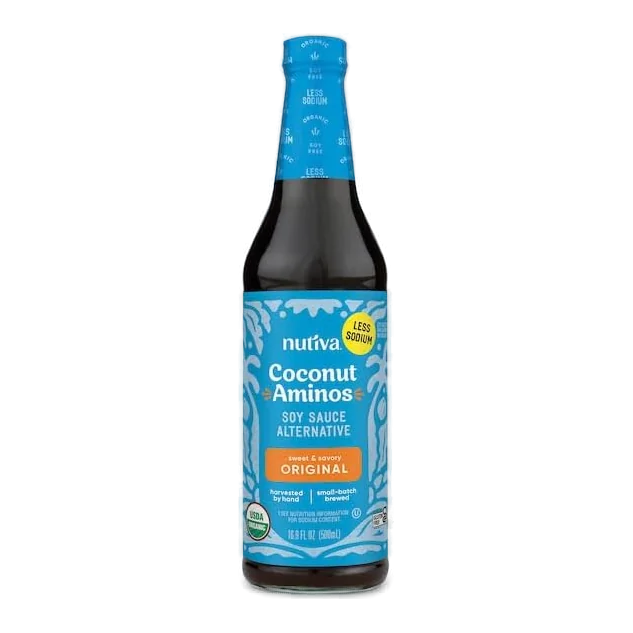
Organic and certified gluten free, with 33 tablespoons to the bottle. The listing says to refrigerate it after opening.
Purchase signal: A repeat buy, 2023 through 2025.
Price: $12.99 on October 10, 2026, which is 77 cents a fluid ounce, or about 39 cents a tablespoon.
The price is the argument against it. If soy, wheat and sodium are no concern in your house, a brewed soy sauce with four ingredients is a perfectly good thing to own.
Quick questions
Is coconut aminos healthier than soy sauce?
It has 72 percent less sodium per tablespoon and no soy or wheat. It also has 3 grams of sugar, where the soy sauce panel shows 1 gram of carbohydrate in total. Which of those matters depends on what you are avoiding.
How much sodium is in coconut aminos?
The Coconut Secret label says 270 mg per tablespoon, which is 90 mg per teaspoon. Regular Kikkoman soy sauce has 960 mg per tablespoon.
Does coconut aminos have sugar?
Yes, 3 grams per tablespoon on the label, all of it from the sap. None is added.
Is coconut aminos a good source of amino acids?
No. The label shows 0 grams of protein per tablespoon, which under the labeling rules means less than half a gram.
Is coconut a tree nut allergen?
Not for FDA labeling since January 2025. Coconut must still be named in the ingredient list.
Can I swap coconut aminos for soy sauce one for one?
The maker says to use it the same way. It is sweeter and less salty, so the dish will taste a little different, and pouring extra gives back the sodium you saved.
The bottom line
Coconut aminos earns its place on the ingredient list, which has no soy or wheat in it, and on the sodium line, at 270 mg where soy sauce has 960. The 3 grams of sugar is what you pay for that. As for the amino acids in the name, I could not find them on the panel. For more of the cupboard, the pantry swaps post has the other four, and the ketchup post does the same label reading on a different bottle.
This is label reading, not medical advice. If you are on a sodium restriction or managing an allergy, go by your doctor and the label in your hand.
References
- Coconut Secret Organic Coconut Aminos, 16.9 oz. Nutrition facts and ingredients: 1 Tbsp, sodium 270 mg, total sugars 3 g; organic coconut tree sap, sea salt. Accessed 2026-10-10. Giant Food Stores
- Kikkoman Soy Sauce, 15 oz. Nutrition facts and ingredients: 1 Tbsp, sodium 960 mg, protein 2 g; water, soybeans, wheat, salt. Accessed 2026-10-10. Food Lion
- Nutiva. Organic Original Coconut Aminos, product page and FAQ. Accessed 2026-10-10. Nutiva
- Kikkoman USA. Less Sodium Soy Sauce: 590 mg sodium per 1 Tbsp, 38% less sodium than Kikkoman Soy Sauce. Kikkoman
- U.S. Food and Drug Administration. Sodium in your diet. Content current as of March 5, 2024. FDA
- Code of Federal Regulations. 21 CFR 101.9(c)(7), Nutrition labeling of food: protein. eCFR
- U.S. Food and Drug Administration. Questions and answers on monosodium glutamate (MSG). Content current as of July 17, 2026. FDA
- U.S. Food and Drug Administration. CPG Sec. 500.500: Guidance levels for 3-MCPD (3-chloro-1,2-propanediol) in acid-hydrolyzed protein and Asian-style sauces. Issued March 14, 2008. FDA
- U.S. Food and Drug Administration. Guidance for industry: Questions and answers regarding food allergen labeling (Edition 5). January 2025. FDA
- Baldry M. Coconut is no longer a tree nut allergen. Academy of Nutrition and Dietetics, May 26, 2026. eatright.org
I earn a small commission if you purchase through these links, at no
additional cost to you. I only recommend products I’ve personally used or
researched thoroughly. This helps support the work behind Better Living
Every Day.