In This Article
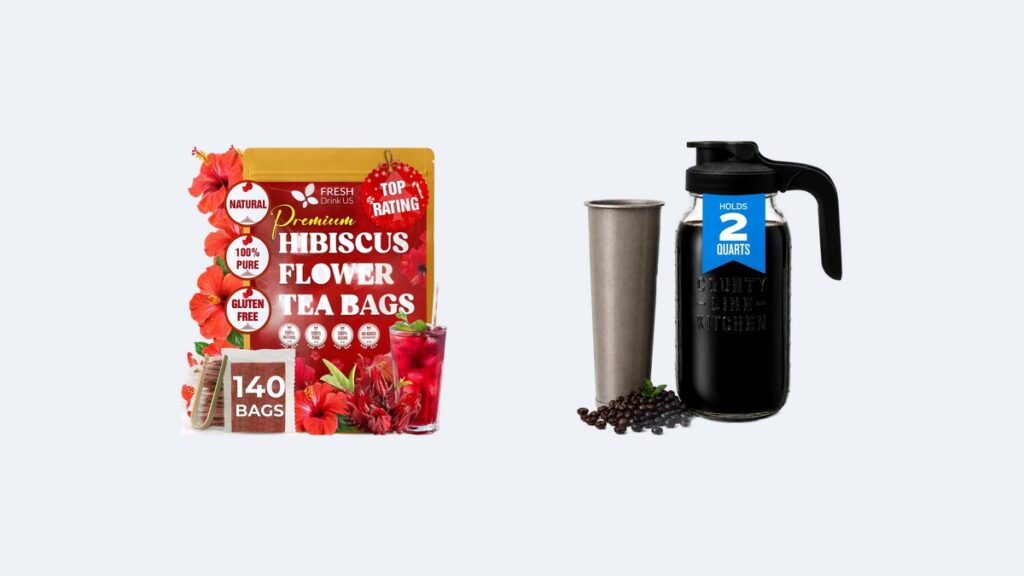
My order record has one box of hibiscus in it. FreshDrinkUS, 140 bags, September 2025.
The jar is older. A County Line Kitchen two quart cold brew mason jar, bought in February 2019, and a Fenshine mesh infuser from May 2021. Once a week it makes a cold half gallon, it lives in the fridge, and honey goes in.
That is the whole of what the record says about the batch. What it does not say is how many bags go in, how long it steeps or how much honey. So the method below is a general one, and the blood pressure section is what the trials found, not what the jar has done for me.
What hibiscus tea is
The tea is not the flower you are picturing. It is the dried calyx of Hibiscus sabdariffa, the red cup that holds the seed pod, sold as roselle, sorrel, karkade, agua de Jamaica or sour tea depending on where you grew up. Steeped in water it turns a deep ruby and tastes sharp, closer to cranberry than to anything you would call a tea.
It has no caffeine, which is why it is the evening glass on the evening shelf post. It is also acidic, which comes up again below under teeth.
A bag of plain hibiscus should list one ingredient. The box in the record does. If a box says “hibiscus blend” or “natural flavors”, you are buying something else.
FreshDrinkUS Hibiscus Flowers Tea (140 bags)

Single ingredient bags, no caffeine, no sugar. At a typical cold brew ratio one box covers somewhere around four months of weekly batches.
Purchase signal: Once, September 2025, the 140 bag box.
Price: $12.74 for 140 bags, checked October 1, 2026.
A half gallon cold brew method
Hibiscus gives up its colour and its acid easily, so it does not need hot water. Cold steeping pulls a smoother, less astringent glass, and it means you never pour boiling water into a glass jar.
A common ratio is one bag per cup of water. For a two quart jar that is eight bags to 64 ounces. Some people go to ten or twelve for a stronger glass, and loose calyces work the same way at about half a cup per half gallon.
Honey goes in the jar in the record. How much is not written down, so start with a tablespoon or two per half gallon and taste. Honey dissolves slowly in cold water. Stir it into a cup of the brew first, or add it with the bags at the start.
The steel mesh filter in the jar does most of the work. The Fenshine infuser is there for loose calyces or for when the filter is in the dishwasher.
County Line Kitchen 64 oz Cold Brew Mason Jar

A wide mouth two quart mason jar, a stainless steel filter basket that hangs from the lid, and a flip cap spout that pours without the basket coming out. Sold as a coffee maker; it does not know the difference.
Purchase signal: Bought in February 2019, in weekly service.
Price: on sale at $23.42 from a $29.99 list price the day I looked, October 1, 2026.
The jar is also on the plastic free kitchen tools list, where it is the cheapest thing on the page.
What the blood pressure trial found
The study everyone quotes is from Tufts, published in 2010. Sixty five adults with blood pressure in the prehypertensive or mildly high range, none of them on blood pressure medication, drank three 240 ml cups of brewed hibiscus tea a day for six weeks, or a placebo drink that looked the part.1
At six weeks systolic pressure had fallen 7.2 mmHg on the tea against 1.3 on placebo. Diastolic fell 3.1 against 0.5, and that difference did not reach significance. People who started higher dropped more.1
Read the details before the headline. Sixty five people. Six weeks. Hot brewed tea, three cups a day, about 24 ounces, and nobody on medication. A seven point systolic drop is real. It is also modest.
A half gallon is 64 ounces. Spread across a week that is nine ounces a day, under half of what the trial poured. The record does not say what the jar has done to my blood pressure, and I am not going to guess.
What the reviews say when you add the trials up
Three groups have pooled the trials, and they do not agree with each other, which is the honest state of the evidence.
A 2015 meta-analysis in the Journal of Hypertension found five randomized trials, 390 people in all. Pooled, hibiscus lowered systolic pressure by 7.6 mmHg and diastolic by 3.5. The authors said the effect was larger in people who started higher, and that better trials were still needed.2
A 2022 review in Nutrition Reviews found seventeen trials. The systolic result was about the same, 7.1 mmHg lower than placebo, but the confidence interval ran from 13 points to barely one, and the trials disagreed with each other so much that the heterogeneity figure was 95 percent. The same review found LDL cholesterol about 7 mg/dL lower.3 That is a wide spread, and it comes from trials that used teas, extracts and capsules at different doses in different people.
Then there is Cochrane. Their 2021 update applied stricter rules, wanted trials in people with diagnosed hypertension against placebo or nothing, and found exactly one that qualified: 60 people with type 2 diabetes taking an extract in capsules for eight weeks. On that trial the pressure did not move, and Cochrane rated the evidence very low certainty and called it insufficient to say whether hibiscus lowers blood pressure in people with hypertension.4
Where does that leave you? A modest systolic effect shows up in most of the small trials, the trials disagree about its size, and the strictest reviewers say they cannot tell. Almost all of it is hot brewed tea or standardized extract. Nobody has run the trial on a cold brew jar.
The proposed mechanism is a mild diuretic effect plus some inhibition of the ACE enzyme, the same enzyme a lisinopril tablet blocks. A Mexican trial ran a standardized extract against 10 mg of lisinopril for four weeks. The extract lowered pressure and lowered plasma ACE activity, and it did less of both than the drug.5
Why it is not a treatment
That lisinopril comparison is where a tea habit can go wrong. Four cautions, each with its source.
If you take blood pressure medication, ask before you add this. The Tufts trial excluded people on medication, so the one clean human trial says nothing about stacking the two. Hibiscus pushes the same way the pills do, and in rats and rabbits an extract increased urine output and slowed the clearance of hydrochlorothiazide, so more of the drug stayed in the blood for longer.6 Animal data, but not comforting. Feeling light headed when you stand up is the sign to watch for.
It can change how other drugs are absorbed. In healthy men in Sudan, a 600 mg dose of chloroquine taken with karkade reached less than a third of the blood level it reached with water, and the authors expected the antimalarial effect to fall with it.7 In Nigerian volunteers, 300 ml of hibiscus drink a day for three days reduced how much diclofenac came out in the urine.8 Neither study is large. Both are reason enough not to wash a prescription down with the jar.
Pregnant or nursing, the safe default is to skip it. There is no human trial. In rats, hibiscus extract given through pregnancy or lactation was linked to faster weight gain and delayed puberty in the female pups.9 Rats are not people and the doses were extract in the drinking water. It is still why most references list hibiscus as one to avoid, and a clinician is the person to ask.
It is acid, and acid wears enamel. A Bristol dental lab tested a range of herbal teas and found pH values down to 3.1, with many of them stripping more enamel in an hour than orange juice did.10 In Khartoum, where the hibiscus drink is an everyday thing, a survey of 12 to 14 year olds found erosion on two thirds of them, strongly tied to fizzy drinks and the hibiscus drink.11 Drink the glass rather than sipping it all afternoon, and wait half an hour before you brush.
The jar is a food with a measurable effect, and that is the whole reason to be careful with it. A doctor who knows what you take is the person to run it past. A home cuff is the only way you would ever know whether it did anything for you.
Quick questions
Do you need hot water to brew hibiscus?
No. It extracts well cold. Hot water pulls a stronger, more astringent glass faster; cold water in the fridge overnight gets you a smoother one.
How many bags for a half gallon?
A common ratio is one bag per cup, so eight for 64 ounces. Go to ten or twelve if you like it sharper.
How long does cold brew hibiscus keep?
About a week in the fridge with the lid on. The colour fades before it goes off.
Does hibiscus tea lower blood pressure?
In small trials of hot tea or extract, systolic pressure fell by about seven points in people who started high. The trials disagree on the size and Cochrane is unconvinced. It is not a replacement for medication, and if you take any, ask first.
Can you drink it every day?
Most people can. The exceptions are above: blood pressure drugs, medication it might interfere with, pregnancy, nursing, or enamel that is already worn.
The bottom line
A two quart jar, eight to ten bags, cold water, the fridge, and honey if you want it. That gets you a weekly half gallon of something tart and red with no caffeine in it, which is reason enough to make it. The blood pressure story is real but small: short trials of hot tea and extracts, a systolic drop in the single digits, and the strictest review saying it cannot tell. If you are hoping the jar will move your numbers, buy a cuff, tell your doctor, and measure.
References
The claims about hibiscus and blood pressure are drawn from peer-reviewed research, opened on PubMed on October 1, 2026. The studies most directly relevant:
- McKay DL, Chen CY, Saltzman E, Blumberg JB. Hibiscus sabdariffa L. tea (tisane) lowers blood pressure in prehypertensive and mildly hypertensive adults. J Nutr. 2010 Feb;140(2):298-303. PubMed
- Serban C, Sahebkar A, Ursoniu S, Andrica F, Banach M. Effect of sour tea (Hibiscus sabdariffa L.) on arterial hypertension: a systematic review and meta-analysis of randomized controlled trials. J Hypertens. 2015 Jun;33(6):1119-27. PubMed
- Ellis LR, Zulfiqar S, Holmes M, et al. A systematic review and meta-analysis of the effects of Hibiscus sabdariffa on blood pressure and cardiometabolic markers. Nutr Rev. 2022 May;80(6):1723-1737. PubMed
- Pattanittum P, Ngamjarus C, Buttramee F, Somboonporn C. Roselle for hypertension in adults. Cochrane Database Syst Rev. 2021 Nov;11(11):CD007894. PubMed
- Herrera-Arellano A, Miranda-Sánchez J, Avila-Castro P, et al. Clinical effects produced by a standardized herbal medicinal product of Hibiscus sabdariffa on patients with hypertension. A randomized, double-blind, lisinopril-controlled clinical trial. Planta Med. 2007 Jan;73(1):6-12. PubMed
- Ndu OO, Nworu CS, Ehiemere CO, Ndukwe NC, Ochiogu IS. Herb-drug interaction between the extract of Hibiscus sabdariffa L. and hydrochlorothiazide in experimental animals. J Med Food. 2011 Jun;14(6):640-4. PubMed
- Mahmoud BM, Ali HM, Homeida MM, Bennett JL. Significant reduction in chloroquine bioavailability following coadministration with the Sudanese beverages Aradaib, Karkadi and Lemon. J Antimicrob Chemother. 1994 May;33(5):1005-9. PubMed
- Fakeye TO, Adegoke AO, Omoyeni OC, Famakinde AA. Effects of water extract of Hibiscus sabdariffa, Linn (Malvaceae) ‘Roselle’ on excretion of a diclofenac formulation. Phytother Res. 2007 Jan;21(1):96-8. PubMed
- Iyare EE, Adegoke OA. Mechanism of the delayed puberty onset in offspring of rats that consumed aqueous extract of Hibiscus sabdariffa during pregnancy. Niger J Physiol Sci. 2008 Jun-Dec;23(1-2):71-7. PubMed
- Phelan J, Rees J. The erosive potential of some herbal teas. J Dent. 2003 May;31(4):241-6. PubMed
- El Karim IA, Sanhouri NM, Hashim NT, Ziada HM. Dental erosion among 12-14 year old school children in Khartoum: a pilot study. Community Dent Health. 2007 Sep;24(3):176-80. PubMed
I earn a small commission if you purchase through these links, at no
additional cost to you. I only recommend products I’ve personally used or
researched thoroughly. This helps support the work behind Better Living
Every Day.