In This Article
My purchase record has a set of TENS electrode pads in it from 2014, which means there was a TENS unit for them to go on. I do not remember the brand. What I do know is that these units are inexpensive, and they may be even cheaper on Alibaba-type sites than on Amazon.
The research behind them is a lot better than the price suggests.
The number
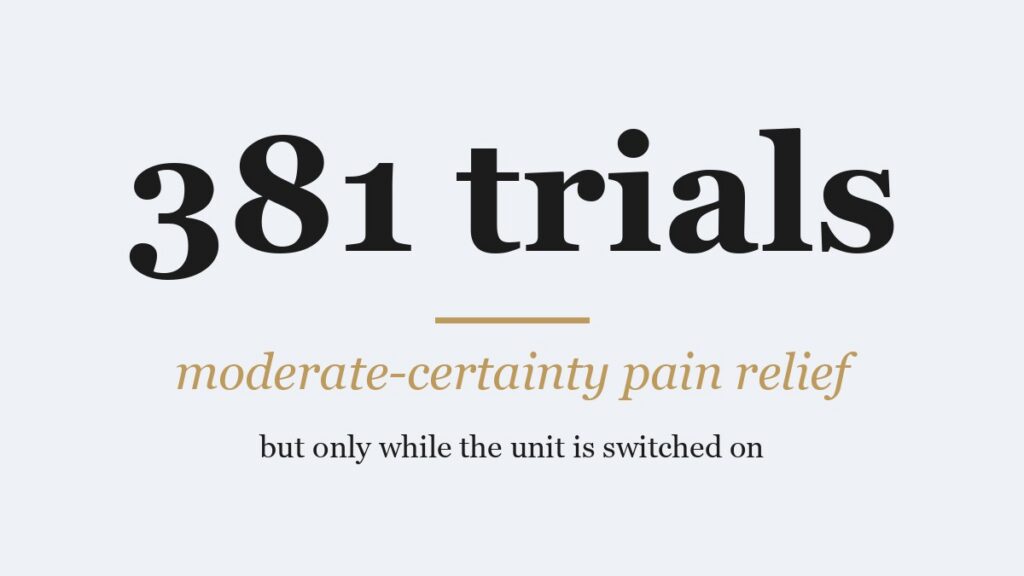
In 2022 a team at Leeds Beckett published what is, as far as I can tell, the largest review of transcutaneous electrical nerve stimulation ever assembled. They call it the meta-TENS study. It covers 381 randomised controlled trials and 24,532 participants.1
Against placebo, pooling 91 trials and 4,841 people, pain intensity was lower with TENS. The standardised mean difference was -0.96, with a confidence interval running from -1.14 to -0.78, and the authors graded it moderate-certainty evidence.
Against actual standard care, including drugs, TENS still came out ahead across 61 trials and 3,155 people, at -0.72, though the authors graded that one low-certainty because the trials were small.
That is not where most people would file a little box that buzzes.
Now the sentence that keeps it honest
The outcome those trials measured was pain intensity during or immediately after the stimulation.
That is the entire scope of the finding, and it changes what you are buying. TENS turns pain down while it is running. It is not treating whatever is causing the pain, it is not building anything, and the evidence does not say the relief persists after you take the pads off.
Which is fine, as long as you know it. A thing that reliably makes the next forty minutes better is genuinely useful. A thing you expect to fix your back is going to disappoint you.
Why it seems to work at all
The usual explanation is gate control. Firing a lot of harmless sensory nerve traffic up the same pathways that carry pain signals appears to crowd the pain signal out at the level of the spinal cord. Your nervous system has limited bandwidth and TENS floods it with something boring.
That is a simplification of a forty year old theory, and the mechanism is less settled than the effect. Which is an unusual and rather nice position for a wellness device to be in: we can see it works better than we can explain why.
Two things about that review you should know
First, the safety line. The reviewers reported that adverse events were poorly reported across the literature, generally mild, and not different from comparators. That is not the same as a clean safety record. It means most trials did not chase it properly, and I would rather say that than round it up.
Second, and I think a site like this should mention it: the paper’s own competing-interests statement discloses that the senior author has received funding and payments from GlaxoSmithKline and from TENS device manufacturers, among others.
That does not make the review wrong. It is a large, pre-registered, GRADE-assessed piece of work and the effect held across trial quality and pain type. But if you are about to spend money because of a number I quoted, you should know who is standing near the number.
Who should not use one
This is where a cheap device deserves the same care as an expensive one.
Anyone with a pacemaker or another implanted electronic device should not use TENS without medical clearance. Not over the front of the neck, because of the carotid sinus. Not on broken skin. Not in pregnancy without advice.
And the one people skip: not on pain you have not had looked at. A device whose entire function is turning down a warning signal is the wrong first move when nobody has established what the signal is for.
Cheap is fine. Uncleared is not.
I am not going to tell you which one to buy. I do not remember the brand of mine, and I am not going to pick one off a search page and imply otherwise.
The units at the cheap end all do the same basic job: adjustable intensity, a few programmes, a timer, and pads that go where it hurts. The consumable cost is the pads, which wear out and are the part you keep buying.
The thing worth checking, especially if you are shopping the cheapest overseas listings, is regulatory rather than technical. In the US a TENS unit for pain relief is a Class II medical device,2 and the over-the-counter version is not exempt from the FDA’s 510(k) premarket clearance.3 A unit sold here for pain relief should be able to point to that clearance, and the FDA’s 510(k) database is public. A listing that cannot show it is a reason to keep scrolling, however cheap it is.
If that reads as unhelpful on the brand question, it is the same reason this site is worth reading. When I know, I will say. When I do not, I would rather leave the slot empty.
Quick questions
Do TENS units actually work?
On pain intensity while they are running, the pooled evidence across 381 trials says yes, at moderate certainty against placebo. That is a stronger evidence base than most supplements have.
Does the relief last?
The reviewed outcome was during or immediately after stimulation. Nothing in that evidence promises anything afterwards.
Is TENS the same as EMS?
No, and the boxes look alike. TENS aims at pain perception. EMS contracts the muscle. Some units do both, and buying the wrong one is a common mistake.
Is a very cheap unit from an overseas site okay?
Price is not the issue. Whether the unit is FDA cleared for over-the-counter pain relief is, and that is something you can check before you buy.
Is it safe?
For most people, with the exclusions above, it is low risk. Be honest about what the review found on safety: adverse events were poorly reported rather than proven absent.
Why not just take a painkiller?
Some people would rather not, some cannot, and the review found TENS held up reasonably against drug and non-drug standard care. It is an option, not a replacement, and that is a conversation for whoever manages your pain.
The bottom line
A cheap plastic box has 381 randomised trials behind it and a moderate-certainty finding, which is more than almost anything else I have written about here. It also only works while it is switched on, and the biggest review of it was led by someone with money from the industry. All three of those things are true at once, and knowing all three is the difference between a useful purchase and a disappointed one.
References
- Johnson MI, Paley CA, Jones G, Mulvey MR, Wittkopf PG. Efficacy and safety of transcutaneous electrical nerve stimulation (TENS) for acute and chronic pain in adults: a systematic review and meta-analysis of 381 studies (the meta-TENS study). BMJ Open. 2022 Feb 10;12(2):e051073. PubMed
- U.S. Food and Drug Administration. Transcutaneous electrical nerve stimulator for pain relief. 21 CFR 882.5890. eCFR
- U.S. Food and Drug Administration. Product Classification: stimulator, nerve, transcutaneous, over-the-counter (product code NUH). FDA
Not medical advice. Do not use TENS with a pacemaker or implanted device, over the front of the neck, on broken skin, or on pain that has not been diagnosed.
there is nothing for me to earn on it. Other posts on this site do contain Amazon
affiliate links, and they are disclosed as such where they appear.