In This Article
Glutamine has one of the best reputations in the supplement aisle. It is the most abundant free amino acid in your blood, it is the preferred fuel of the cells lining your intestine, and it appears in more or less every gut protocol on the internet.
All of that is true. My order record shows one purchase of Optimum Nutrition glutamine, in 2023, and nothing after it. The record does not keep a reason, and I am not going to supply one after the fact.
What I can do is read the trials on the thing glutamine is most often sold for, which is your gut. The pooled answer came back as a number so close to zero that it is written as zero.
The result
A 2024 meta-analysis gathered the randomised placebo-controlled trials that measured gut permeability after glutamine supplementation. Ten studies, 352 people.1
A great deal of supplement research ends up inconclusive rather than negative. Wide intervals, small trials, effects that might be there. This one is unusual because the interval is narrow. It is not saying we could not tell. It is saying we looked, and there was nothing to find at these doses.
There was a subgroup at doses above thirty grams a day where the authors reported an effect. Worth knowing, and worth keeping in proportion: thirty grams is about six times the five gram scoop on the side of most tubs, and subgroup findings inside a null result are a hypothesis rather than a conclusion.
Where the reputation came from
The reputation is not invented. It came from somewhere real, and the somewhere is hospitals.
Glutamine genuinely becomes conditionally essential under severe physiological stress. In burns, in major trauma, in short bowel syndrome, in critical illness, the body’s demand outruns what it can make, and clinical nutrition takes that seriously. Decades of research went into it.
What happened next is the pattern this whole industry runs on. A finding that is real in a hospital gets carried out of the hospital and sold to people who are fine. Your intestinal lining is not under the metabolic stress of a burns unit. The condition that made glutamine conditionally essential is not the condition you are in.
The trial that should end “it is only an amino acid”
This next part needs a careful introduction, because it is easy to misuse.
In 2013 the New England Journal published REDOXS, a large randomised trial giving high-dose glutamine to critically ill adults with multiple organ failure. It was designed to show benefit. It did the opposite.2
Twenty-eight day mortality was 32.4 percent in the glutamine group against 27.2 percent without it, an adjusted odds ratio of 1.28. In-hospital mortality and mortality at six months were both significantly higher in the group receiving glutamine.
What it does do is kill a specific piece of reasoning that gets used constantly to sell supplements. The reasoning goes: it is just an amino acid, your body already makes it, so at worst you are wasting your money. REDOXS is a demonstration that a substance your body already makes, given in the wrong quantity to the wrong person, can be associated with worse outcomes rather than none.
The floor is not automatically zero just because a compound sounds natural. That principle travels well beyond glutamine.
A mechanism is not an outcome
A tub of glutamine sold for gut health is sold on a mechanism.
The mechanism is genuinely elegant. Enterocytes really do prefer glutamine as fuel. It is exactly the kind of story that makes you feel like you have understood something. But a mechanism tells you what could happen, and a trial tells you what did, and when the two disagree the trial wins.
None of this makes the product a scandal. Glutamine is cheap and it dissolves in water. The pooled trials simply did not find the gut effect it gets sold on.
Optimum Nutrition L-Glutamine Powder (10.6 oz)
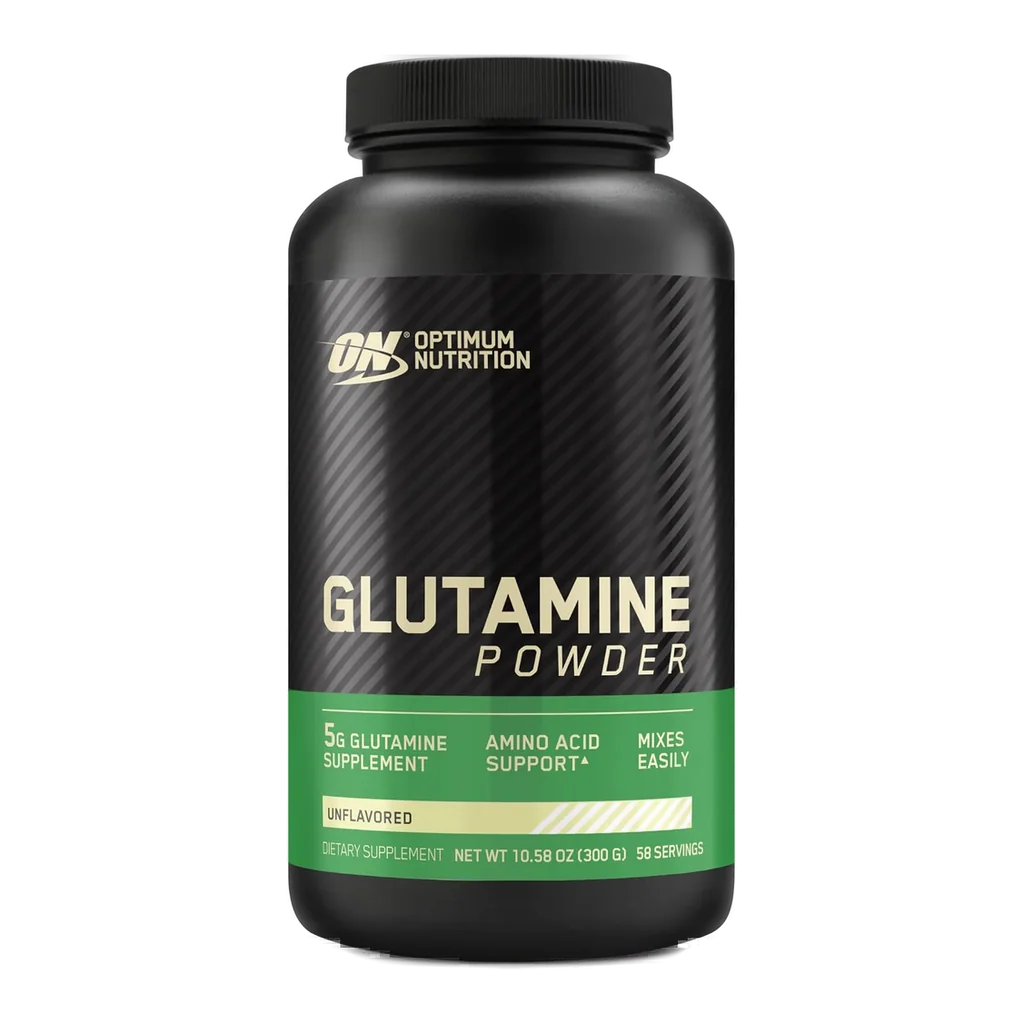
The brand in my 2023 order. The record names Optimum Nutrition and not the form, and they sell it as a powder and as capsules, so this card shows the 10.6 oz unflavoured powder rather than pretending to know. Nothing in this article is a knock on the product. The problem is the claim it gets bought for.
Purchase signal: Bought once, 2023. Not reordered.
Price: Around $23.74 for 10.6 oz.
Who this does not apply to
If you are being treated for a serious illness, recovering from major surgery or burns, living with short bowel syndrome, or under the care of an oncology team, none of the above is about you. Glutamine is used deliberately in some of those settings and avoided deliberately in others, and that is a decision for the clinician holding your chart.
Same if you have kidney or liver disease. Amino acid loads are handled differently when those organs are not working normally, and this is not the place to reason it out.
Quick questions
Does glutamine heal a leaky gut?
The pooled randomised evidence on intestinal permeability, ten trials and 352 people, found no effect at the doses studied. “Leaky gut” as it is used online is also a much broader claim than intestinal permeability as it is measured in a lab, so the popular version of the question is even less well supported than the technical one.
Is glutamine worth taking for muscle recovery?
It has been studied for that too and has not held up well outside clinical settings. If you are eating enough total protein, you are already taking in glutamine, because it is abundant in ordinary protein foods.
Is it safe?
For healthy adults at typical doses it is generally regarded as well tolerated, and I am not aware of evidence that a normal scoop causes harm. The reason this article raises the critical care trial is not to frighten anyone off a supplement, it is to retire the lazy argument that an amino acid cannot possibly have a downside.
So is there anything worth taking for gut health?
Fibre from actual food has the strongest evidence of anything in this area by a wide margin, and it is not close. That is a duller answer than a tub of powder, which is precisely why the tub sells.
References
- Abbasi F, Haghighat Lari MM, Khosravi GR, Mansouri E, Payandeh N, Milajerdi A. A systematic review and meta-analysis of clinical trials on the effects of glutamine supplementation on gut permeability in adults. Amino Acids. 2024;56(1):60. PMID 39397201
- Heyland D, Muscedere J, Wischmeyer PE, Cook D, Jones G, Albert M, et al. A randomized trial of glutamine and antioxidants in critically ill patients. New England Journal of Medicine. 2013;368(16):1489-97. PMID 23594003
Nothing here is medical advice. If you have kidney or liver disease, are undergoing cancer treatment, or are recovering from serious illness or surgery, talk to your clinician before taking glutamine rather than taking anything from this article as guidance.
I earn a small commission if you purchase through these links, at no
additional cost to you. I only recommend products I’ve personally used or
researched thoroughly. This helps support the work behind Better Living
Every Day.