In This Article
My order record has one line for folic acid. Vitamatic, bought once, in 2025. It does not say which strength, and that gap turns out to be the interesting part, because Vitamatic sells folic acid tablets at 400 micrograms, at 1,000 micrograms and at 5,000 micrograms.
At the time of writing, all three cost about ten dollars a bottle. They are not three sizes of the same idea. One of them sits exactly at the ceiling for a day, and one sits five times over it.
Two numbers, and the distance between them
The recommended intake for adult men and women is 400 micrograms a day, expressed as dietary folate equivalents.1
The tolerable upper intake level, the point above which the expert panel was no longer willing to say routine intake is safe, is 1,000 micrograms a day.
There is an important qualifier on that limit, and it cuts in the reassuring direction. The 1,000 microgram ceiling applies to synthetic folic acid from supplements and fortified food, and specifically excludes folate you get from actual food. You cannot overshoot it eating lentils and spinach. The limit exists because the synthetic form behaves differently in the body from the folate in a plant.
Why the ceiling is where it is
This is the part that makes the number make sense.
The upper limit on folic acid was not set because folate is toxic. It was set because high intakes of the synthetic form can correct the anaemia caused by vitamin B12 deficiency while leaving the neurological damage from that deficiency to carry on progressing underneath. The blood count looks better. The nerve problem does not stop.
That concern is the historical reason for the number. I am not telling you that one tablet does that to you. I am telling you that the limit is not arbitrary, and that “it is only a B vitamin” is not the right mental model for a compound that got a ceiling for a specific and fairly serious reason.
What folic acid is actually proven to do
The evidence for folic acid is genuinely strong. It is also genuinely narrow.
The US Preventive Services Task Force evidence review looked at supplementation for the prevention of neural tube defects. Across the newly identified cohort studies, taking folic acid before pregnancy was associated with roughly half the risk of a neural tube defect, and the review found no statistically significant harms from pregnancy-related exposure.2
That is one of the clearest wins in preventive nutrition. Whole countries fortify their flour on the strength of it.
The MTHFR detour
If you have gone looking into folate online, you have met MTHFR. It is a gene, common variants slow the enzyme it codes for, and an enormous amount of supplement marketing rests on the idea that people with those variants cannot process ordinary folic acid and need methylfolate instead.
The American College of Medical Genetics looked at that and issued a practice guideline. Their position is that MTHFR polymorphism testing has minimal clinical utility and should not be ordered as part of routine evaluation, and they note that the meta-analyses undercut the association the testing was based on.3
That guideline is from 2013. The supplement market built on the idea has grown steadily since.
I want to be fair about this. Methylfolate is a real compound, it is not a scam, and there are clinical situations where a specific folate form is chosen deliberately. What the guideline undermines is the routine consumer version: get tested, discover you carry a common variant, conclude that ordinary folate is failing you, and buy the expensive form forever.
What the record can and cannot tell you
The record shows one Vitamatic purchase in 2025 and no second one. It does not say which of the three strengths it was, how much of the bottle got used, or why it went in the basket. I am not going to fill those gaps in.
What the numbers do give you is a way to read any folic acid label in about five seconds. Find the microgram figure and hold it up against two others: 400, where the pregnancy recommendation sits, and 1,000, the ceiling. If nobody has told you to take folic acid, a tablet that uses up the whole day’s limit on its own is a lot of vitamin for a general wellness gesture.
Vitamatic Folic Acid 1,000 mcg (240 tablets)
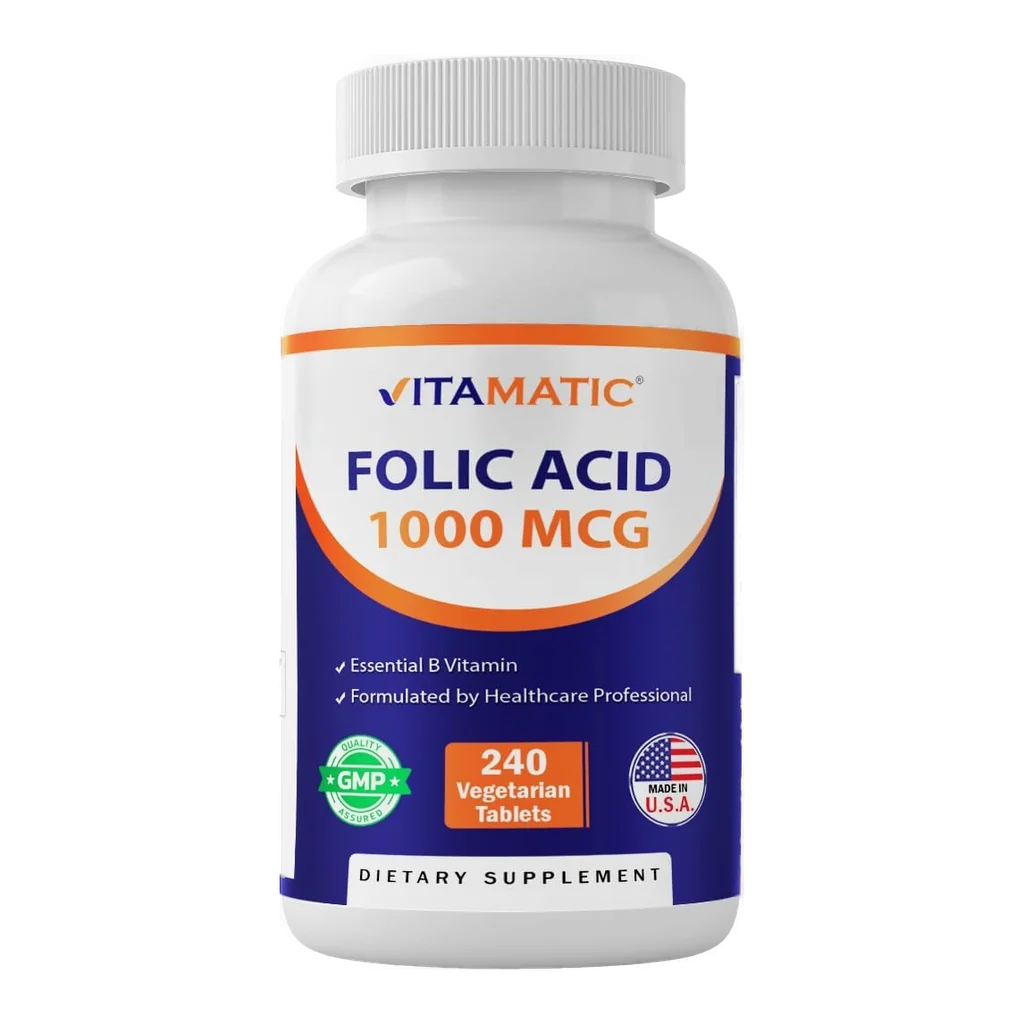
Vitamatic is the brand on my 2025 order, but the record does not give the strength, so treat this card as the bottle the article is about rather than a claim that it was mine. It is cheap and very well reviewed. The issue is the dose. If a clinician has told you to take 1 mg of folic acid, this is a sensible and inexpensive way to do it. If nobody has, the 400 mcg version from the same brand is the one that lines up with the recommendation.
Purchase signal: Bought once, 2025. Strength not recorded.
Price: Around $8.99 for 240 tablets.
Who should ignore everything above
If you are pregnant or might become pregnant, this article is not addressed to you and the advice you have already been given is better than anything here. The recommendation for you is 400 micrograms of folic acid daily, from a supplement or fortified food, alongside the folate in your diet, and 1 mg or higher doses are prescribed deliberately in some circumstances.
Same if you are on methotrexate, on certain anti-epileptic medicines, being treated for a folate deficiency, or have been told to take a specific dose for any reason. In those cases folic acid is functioning as a drug with a purpose, and a blog post is not the input you need.
Quick questions
Do men need a folic acid supplement?
Almost never, in the absence of a diagnosed deficiency or a doctor’s instruction. The recommended 400 micrograms a day is easily met from food, particularly in countries that fortify flour, and the proven benefit of supplementation is about preventing birth defects rather than general adult health.
Why is 1,000 mcg such a common strength then?
Largely convention and manufacturing habit rather than any recommendation. One milligram is a round pharmaceutical number and it is the dose used in several clinical contexts, so it became a default retail strength. It also happens to sit exactly on the upper intake limit, which is not something the label points out.
Is folate the same as folic acid?
Not quite, and the distinction matters here. Folate is the family of forms found naturally in food. Folic acid is the synthetic form used in supplements and fortification, which is more stable, absorbed more completely, and is the form the upper limit applies to.
Should I get tested for MTHFR before choosing a folate supplement?
The American College of Medical Genetics advises against ordering the test in routine practice, on the grounds that it has minimal clinical utility. If a clinician orders it for a specific reason, that is a different situation from ordering it yourself off the back of a supplement advert.
References
- Institute of Medicine (US) Standing Committee on the Scientific Evaluation of Dietary Reference Intakes and its Panel on Folate, Other B Vitamins, and Choline. Dietary Reference Intakes for Thiamin, Riboflavin, Niacin, Vitamin B6, Folate, Vitamin B12, Pantothenic Acid, Biotin, and Choline. Chapter 8: Folate. Washington (DC): National Academies Press; 1998. NCBI Bookshelf NBK114318
- Viswanathan M, Urrutia RP, Hudson KN, Middleton JC, Kahwati LC. Folic acid supplementation to prevent neural tube defects: updated evidence report and systematic review for the US Preventive Services Task Force. JAMA. 2023;330(5):460-466. PMID 37526714
- Hickey SE, Curry CJ, Toriello HV. ACMG practice guideline: lack of evidence for MTHFR polymorphism testing. Genetics in Medicine. 2013;15(2):153-6. PMID 23288205
Nothing here is medical advice. If you are pregnant, trying to conceive, taking methotrexate or anti-epileptic medication, or have been told to take folic acid by a clinician, follow that guidance rather than anything in this article.
I earn a small commission if you purchase through these links, at no
additional cost to you. I only recommend products I’ve personally used or
researched thoroughly. This helps support the work behind Better Living
Every Day.