In This Article
In 2018 I bought a turmeric capsule with ginger and BioPerine in it. My order record keeps the formulation and nothing else. No brand, no reason, no note on how long the bottle lasted or what it did. So that is the whole of what I can tell you about my bottle, and I would rather stop there than pad it.
The formulation is where the interesting part is anyway. BioPerine is a branded black pepper extract, and the active part of it is piperine. It is in there because curcumin, the compound everyone is actually after, barely gets into your blood on its own.
What the pepper is doing
The study everyone is quoting, whether they know it or not, is from 1998.
Researchers gave healthy volunteers two grams of curcumin. Blood levels came back either undetectable or very low. Then they gave the same dose with twenty milligrams of piperine alongside it, and the amount reaching the bloodstream rose by two thousand percent.1
So the pepper works. That is not the marketing overstating things. That is the finding.
The part worth slowing down on is how it works.
That distinction sounds like a technicality. It is not.
The exit that gets blocked is not curcumin’s exit alone
Glucuronidation is not a system that exists for curcumin. It is a general clearance pathway, and a long list of ordinary prescription drugs leaves your body through it.
Which means the ingredient added to your turmeric capsule to raise curcumin levels is, by the same mechanism, capable of raising the levels of other things you are taking. Nobody sells it that way. The bottle says “for enhanced absorption,” which is true and tells you almost nothing about what is happening.
I want to be careful here. Nothing in that mechanism says turmeric with pepper in it will hurt you. What it says is that the pepper is not a flavour note or a bit of filler. In a capsule like the one on my 2018 order, it is the ingredient doing the most pharmacology, and it gets the least explanation on the label.
The liver thing, stated precisely
In 2024, hepatologists at Michigan published an analysis of national survey data looking at six botanical products with known liver liability. Turmeric was one of the six. It was also the most commonly used of them.2
Scaling the survey to the population, they estimated that about 15.6 million US adults had taken at least one of those six in the previous thirty days. For comparison, they put that in the same range as the number of Americans taking NSAIDs or a common statin.
Now the honest part, because this number gets abused.
That study counted how many people are exposed. It did not count how many people were harmed. It is not a rate of liver injury and nobody should read it as one. The vast majority of people who take turmeric have no liver problem at all, and turmeric in food is not what anyone is talking about.
What it does establish is that a supplement most people file under “basically a spice” is being consumed at genuine pharmaceutical scale, with none of the pharmaceutical monitoring.
One more detail from the same survey. Compared with people who took no supplements at all, the people taking these botanicals were older and more than twice as likely to have arthritis. Which makes sense. The people buying turmeric are the people who hurt, and they are exactly who the pharmacist warning above is written for.
So does it work on joints
Some, in some formulations, with intervals wide enough to drive a bus through.
The most recent pooled analysis I could find brought together twenty randomised trials and 1,633 people, comparing turmeric, boswellia and combinations of the two for knee osteoarthritis.3
Modified curcumin formulations did beat placebo on pain. The effect size was large. The confidence interval ran from -5.30 to -0.33, which in plain terms means the true effect might be enormous or might be barely there, and twenty trials were not enough to tell the difference. Boswellia came out better on joint function and stiffness. Neither showed a difference in side effects against comparison groups.
That is a genuinely more encouraging picture than most supplements manage. It is also nothing like the certainty implied by the bottle.
The bottle I cannot link you to
I also bought a boswellia extract in 2023, a brand called Superior Labs, and there is no link to it here.
The brand does not come up on Amazon any more. Rather than send you to a different company’s boswellia and let you assume it is the one I bought, I would rather tell you that it appears to be gone and leave it there.
This happens more than the supplement internet admits. Brands vanish, listings get folded into other listings, and a few years on there is no exact thing left to point at. The honest move is a shrug, not a substitution.
The one with the fewest moving parts
Of the three bottles in this story, the least exciting one holds up best on paper.
Ginger has decent evidence behind it for nausea and reasonable evidence for joint pain, it is cheap, it does not need a pepper extract bolted on to get into your blood, and it was not one of the six botanicals in that liver survey.
Nature’s Way Ginger Root (1,100 mg per serving)
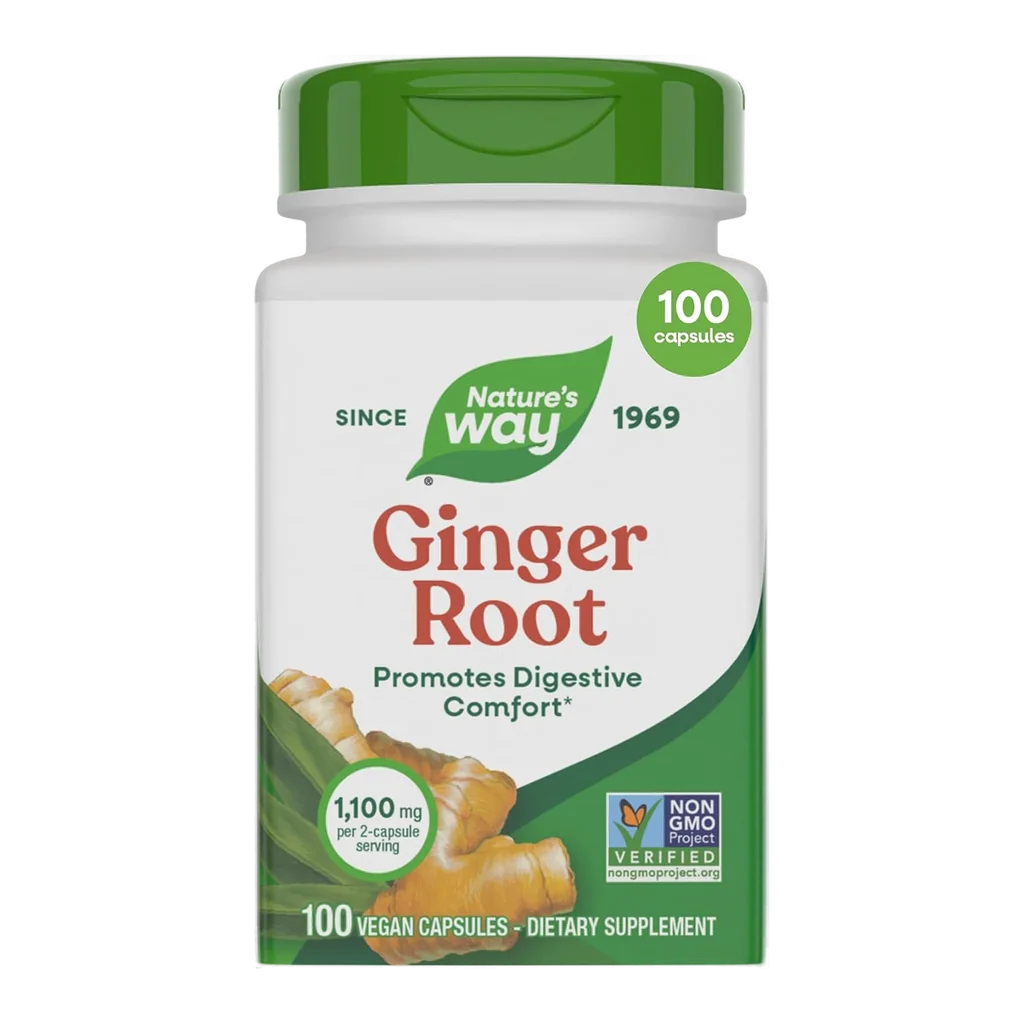
Plain ground ginger root in a capsule, with no absorption enhancer and no proprietary blend. My order record says Nature’s Way ginger root, once, in 2017. It does not say which size, so this card shows the current 100 capsule bottle, and it does not say whether the bottle earned a second look. On the evidence alone, it is the simplest of the three.
Purchase signal: Bought once, 2017. Not a repeat buy.
Price: Around $11.49 for 100 capsules.
What I would tell someone standing in the aisle
Read the other ingredients before you read the front of the label. If there is piperine or BioPerine in it, that is a pharmacologically active choice someone made on your behalf, and it deserves thirty seconds of your attention rather than none of it.
If you take prescription medication, ask your pharmacist first. If you do not, and you want to try turmeric for a sore knee, the evidence says you may get something out of it and probably will not be harmed by it, which is about as good as this category gets.
And if you want the version of this decision with the fewest moving parts, look at the plain ginger.
Quick questions
Is turmeric bad for your liver?
For most people, no. What the research supports is narrower and more useful than that: turmeric supplements are among the botanicals most often implicated in liver injury cases, and they are being taken at a scale comparable to common prescription drugs. That is a reason to treat a concentrated extract as a real substance rather than a kitchen spice, not a reason to be frightened of curry.
Should I buy turmeric without BioPerine then?
It is a genuine trade-off rather than an obvious answer. Without an absorption enhancer, very little curcumin reaches your blood, which is why the enhancer exists. With one, you get more curcumin and you also get a compound that slows a clearance pathway. If you take no medications, the calculation is simpler. If you do, ask someone who can see your list.
How much curcumin is in turmeric powder from the spice aisle?
Roughly three percent by weight, which is why supplements use concentrated extracts standardised to 95 percent curcuminoids. Cooking with turmeric is a pleasant thing to do and is not the same intervention as a capsule.
Does the ginger in these blends do anything?
Probably a little, for joints and more clearly for nausea. In a combination product you cannot tell which ingredient is responsible for anything you feel, which is the general problem with blends and a good argument for single ingredient products.
References
- Shoba G, Joy D, Joseph T, Majeed M, Rajendran R, Srinivas PS. Influence of piperine on the pharmacokinetics of curcumin in animals and human volunteers. Planta Medica. 1998;64(4):353-6. PMID 9619120
- Likhitsup A, Chen VL, Fontana RJ. Estimated exposure to 6 potentially hepatotoxic botanicals in US adults. JAMA Network Open. 2024;7(8):e2425822. PMID 39102266
- Inprasit C, Bunyamahote S, Boonpattharatthiti K, Thimkorn P, Intakhiao S, Dhippayom T. Evaluating the efficacy and safety of Curcuma longa, Boswellia serrata, and their mixed formulation in treating knee osteoarthritis: a systematic review and network meta-analysis. Complementary Therapies in Medicine. 2026;96:103256. PMID 41082950
Nothing here is medical advice. Turmeric extracts, boswellia and ginger can all interact with prescription medication, and concentrated supplements are not the same thing as the spice. If you take anything on prescription, are pregnant, or have liver or gallbladder problems, talk to a pharmacist or doctor before adding any of these.
I earn a small commission if you purchase through these links, at no
additional cost to you. I only recommend products I’ve personally used or
researched thoroughly. This helps support the work behind Better Living
Every Day.