In This Article
My purchase record has a fibre and resistant starch supplement in it, bought in 2017 and again in 2018, and nothing since. The record is not even sure of the brand. It lists Herbalife and Gut Garden side by side and leaves it there.
The evidence behind fibre turns out to be some of the strongest in nutrition. Almost none of it is about a supplement.
The evidence for fibre is enormous
In 2019 the Lancet published a series of systematic reviews and meta-analyses on carbohydrate quality, commissioned to inform WHO guidance.1 The scale of it is hard to take in: just under 135 million person-years of data, drawn from 185 prospective studies, plus 58 clinical trials covering 4,635 people.
Comparing the people eating the most fibre with those eating the least, the observational data showed a 15 to 30% lower rate of all-cause mortality, cardiovascular mortality, coronary heart disease, stroke, type 2 diabetes and colorectal cancer. The clinical trials, which are the harder test, showed lower body weight, lower systolic blood pressure and lower total cholesterol.
The certainty of the evidence for dietary fibre was graded moderate. In nutrition, where almost everything is graded low or very low, moderate is a rare and meaningful thing.
The authors describe the dose-response evidence as striking and say the relationships could be causal. That is careful language from people who chose it carefully, and I am going to leave it exactly as careful as they made it.
Which is not an argument for a tub of powder
This is where a supplement falls down.
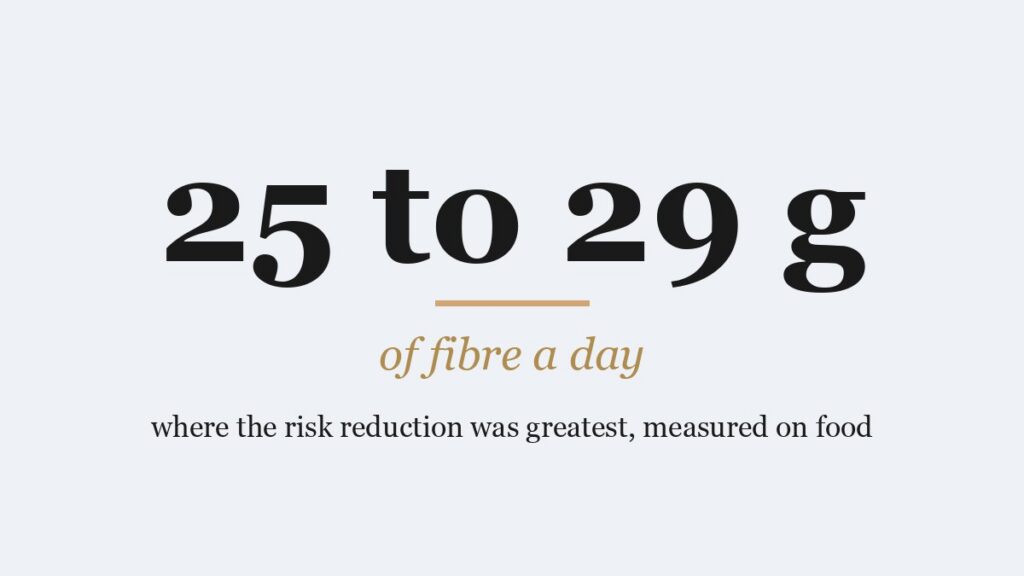
Everything above was measured on dietary fibre and whole grains. Food. The people in those cohorts were not taking a supplement, they were eating beans, oats, vegetables, fruit and whole grains, and arriving at 25 to 30 g a day as a by-product of eating that way.
You cannot assume the pill version inherits the result. It is the same mistake as the beta-carotene story, where the diets full of it looked protective and the supplement, when finally tested properly, did not reproduce the effect. Whole foods bring fibre attached to a lot of other things, and nobody has untangled which part is doing the work.
There is also the plainer problem, which is that a scoop of fibre powder does not change what is on your plate.
The mechanism people find exciting
Resistant starch is the interesting one, and it is worth understanding even if you never buy any.
Most starch is digested in the small intestine. Resistant starch is not: it arrives in the colon more or less intact, where the bacteria that live there ferment it and produce short-chain fatty acids, notably butyrate. Butyrate is the preferred fuel of the cells lining the colon, which is a genuinely elegant arrangement and the reason this topic gets so much attention.
Two things worth knowing about that. It is a mechanism under investigation rather than a proven pathway to any specific health outcome in humans. And you do not need a supplement to make it happen: cooked and then cooled potatoes, rice and pasta, along with beans, oats and slightly green bananas, all produce resistant starch without anybody selling you anything.
What actually moves the number
If 25 to 30 g a day is the target, the practical question is where the grams come from, and the answer is boring in a way that turns out to be the point.
Beans and lentils are the heavy lifters. A cup of cooked lentils gets you most of the way to half a day’s target on its own, which no scoop of powder will do. Oats, whole grains instead of refined ones, berries and pears, and leaving the skins on things. Nuts and seeds contribute. Vegetables contribute more when you eat more of them, which is the least helpful sentence in nutrition and also true.
So is a fibre supplement a waste
Not exactly, and it deserves a fair hearing.
A fibre supplement is a reasonable tool for a specific problem, mostly regularity, and it is used clinically for that. What it is not is a way to buy the outcomes in that Lancet paper, because those outcomes were attached to a way of eating rather than to a compound.
There is no shortcut around the diet here. That is a dull conclusion for an article to reach and it is the one the evidence supports, which is roughly how this goes with the well-studied stuff.
Quick questions
How much fibre should I eat a day?
The greatest risk reduction in the pooled data sat between 25 g and 29 g. Higher intakes appeared to confer further benefit for some outcomes.
Is a fibre supplement as good as food?
Nobody has shown that it is. The evidence above was collected on dietary fibre and whole grains, and the honest position is that the supplement has not been tested to the same standard for the same outcomes.
What is resistant starch?
Starch that survives the small intestine and gets fermented in the colon, producing short-chain fatty acids including butyrate. Cooked and cooled potatoes, rice and pasta are the easiest sources.
Why does more fibre make me bloated?
Because the bacteria fermenting it produce gas, and a sudden increase gives them a lot to work with at once. Ramp up slowly and drink more water.
Is this the same as a probiotic?
No. Probiotics are the organisms; fibre is what feeds the ones you already have. The two are complements, and the digestion post covers the other side of it.
The bottom line
Fibre has one of the strongest evidence bases in nutrition: 135 million person-years, 15 to 30% differences in serious outcomes, and a moderate certainty grade that most nutrients never reach. All of it was measured on food. A scoop of powder is easier than changing dinner, and easier than changing dinner is not a thing the research offers.
References
- Reynolds A, Mann J, Cummings J, Winter N, et al. Carbohydrate quality and human health: a series of systematic reviews and meta-analyses. Lancet. 2019 Feb 2;393(10170):434-445. PubMed
Not medical advice. If you have IBS, an inflammatory bowel condition, or any history of bowel obstruction, fibre advice needs to come from someone who knows your case.
there is nothing for me to earn on it. Other posts on this site do contain Amazon
affiliate links, and they are disclosed as such where they appear.