You swapped your cooking oils. You replaced the old nonstick pans. You started reading labels on groceries. But what about the stuff sitting next to the sink? I ignored dish soap for years. You rinse it off, right? Except you also use it with bare hands, sometimes three or four times a day, and that little detail bugged me once I started paying attention to everything else.
What I Mean by “Non-Toxic” Here
I need to call this out early because “non-toxic” on a label means almost nothing. There is no strict legal standard behind the term for cleaning products. Brands slap it on everything.
So here is what I actually mean when I use the phrase in this article. I am looking for dish soaps where the ingredient list is short enough to read without squinting, fragrance is either absent or actually explained (not hidden behind the word “fragrance”), the surfactants are on the milder side, and the preservative load is low. I am not saying conventional dish soap will poison you. I am saying these products are more transparent, and transparency matters to me.
Way more useful than trusting a green leaf on the label.
What Gives Me Pause in Conventional Dish Soap
1) Fragrance That Tells You Almost Nothing
“Fragrance” on a cleaning product label can represent dozens of individual scent chemicals bundled under one word. The brand is not required to break those out. If you have sensitive skin or you just like knowing what you are putting on your body, this is a problem. Not because every fragrance blend is harmful. Because you literally cannot evaluate it.
2) Harsh Surfactants
Sodium lauryl sulfate is a solid grease cutter. I will give it that. But it can also be rough on skin with repeated daily exposure, and if your hands feel tight and stripped after doing the dishes, SLS is a likely culprit. Not everyone reacts to it. Plenty of people do and just assume it is normal.
Once I swapped to better cookware and started cooking with actual cooking fats, looking at what was on my hands afterward felt like an obvious next step.
3) Preservatives That Can Bother Sensitive Skin
Methylisothiazolinone and benzisothiazolinone show up in a lot of dish soaps. They keep the product from growing mold and bacteria, which is a legitimate job. The catch is that both are well-documented contact allergens. The EU actually restricted methylisothiazolinone in leave-on cosmetics years ago because of skin sensitization complaints. Dish soap is rinse-off, so the exposure is different, but I still keep an eye on it.
4) Ethoxylated Ingredients and 1,4-Dioxane
Here is one that frustrates me. 1,4-dioxane is rarely added on purpose. It shows up as a manufacturing byproduct in certain ethoxylated ingredients, and the EPA has flagged it as “likely to be carcinogenic to humans.” Some brands now test for it. Others do not mention it at all. And the really annoying part? You cannot always tell from the label whether a finished product contains it, because the contamination depends on the manufacturing process, not just the ingredient list.
What I Look For Instead
My shortlist of ingredients I am comfortable with: decyl glucoside, coco-glucoside, and similar plant-derived surfactants. Citric acid as a pH adjuster. Clear labeling across the board. None of this guarantees a perfect product, but in my experience it usually gets you something gentler that still cleans well.
My Filter for Buying Dish Soap
Front labels are useless to me. “Natural,” “green,” “gentle” can go on anything. I flip the bottle and ask three questions: can I actually read and understand the ingredients? Is fragrance absent or clearly broken out? Are the surfactants and preservatives ones I am okay using every single day? If the answer to any of those is no, I put the bottle back. Same way I approach food labels.
Dish Soaps Worth Looking At
None of these are perfect. I am just presenting the ones that held up best once I started filtering for ingredient disclosure, how they feel on my hands, and whether the formula actually matches the marketing.

Branch Basics Concentrate
Full disclosure: this is not actually a dish soap. Branch Basics sells a multi-surface cleaning concentrate and you dilute it yourself at different ratios. Dishes get a stronger mix than countertops. The ingredient list is probably the shortest you will find anywhere, all plant- and mineral-based, zero fragrance.
The price tag is the sticking point. Last I checked it was around $55 for 33.8 oz. Sounds steep until you realize one bottle produces a ton of diluted product. I use it for dishes, counters, and general cleaning, so the math actually works out. The downside is you have to mix it every time, and it does not feel or smell like what most people expect from dish soap. If that bothers you, skip ahead. If you want the absolute simplest formula available, this is it.
What I don’t like: Premium price. Requires dilution for every use. Not a dedicated dish soap. No conventional soap feel or smell.
ECOS Dish Soap, Free & Clear
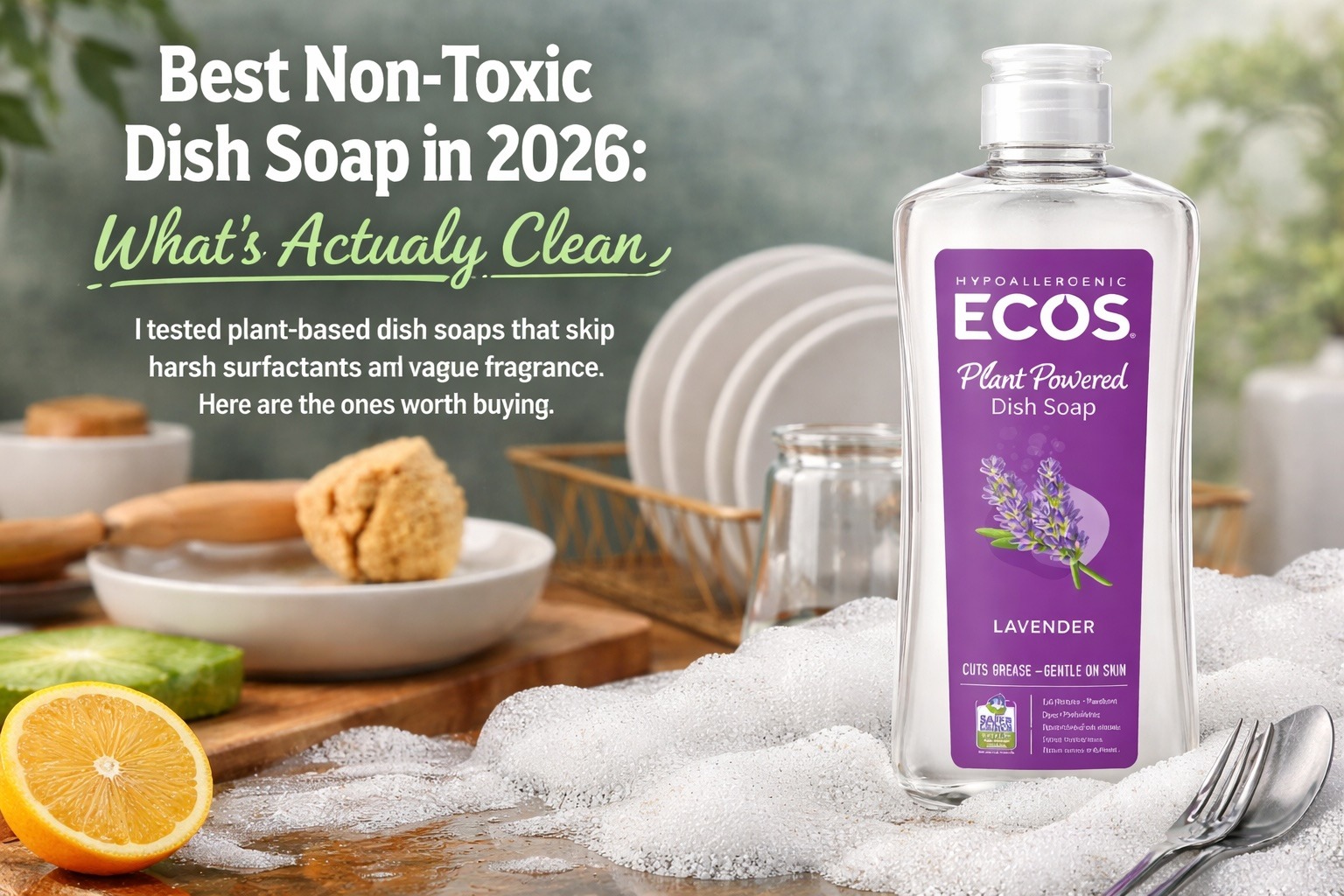
This is my daily driver, so I will start with the bias up front. ECOS markets the Free & Clear version as hypoallergenic and explicitly states it is made without dyes, phthalates, parabens, or 1,4-dioxane. For a product you can buy at a regular store or order online in two clicks, that disclosure is unusually good.
No mixing required, no dilution math, no concentrate bottle sitting on the counter. You just squirt and wash. I recommend this one first to anyone who asks me what to switch to because the barrier to entry is basically zero. The only knock is that “ECOS” covers a big product line and not every version is identical, so make sure you grab the Free & Clear specifically.
What I don’t like: Not as minimal as the simplest concentrate options. Ingredient simplicity depends on the exact version you buy.
Puracy Natural Dish Soap
Puracy occupies a nice spot between the minimalist concentrates and mainstream options. No SLS, no triclosan, plant-based surfactants. They call it “skin-softening,” which is marketing speak, but honestly? After about a week my hands did feel less stripped compared to whatever I had been using before. I noticed it most during winter when my skin was already dry.
The thing that sets Puracy apart for me is their ingredient page. They publish every ingredient with a plain-English explanation of what it does. Most brands do not bother. The Green Tea & Lime version smells light and pleasant without the vague “fragrance” catch-all, which I appreciate. Downside: they do not offer a truly fragrance-free dish soap option, and the bottle is on the smaller side for the price.
What I don’t like: Not fragrance-free (scented versions only for dish soap). Smaller bottle for the price compared to bulk options.

Attitude Dishwashing Liquid
If you just want something that works like normal dish soap from the grocery store but with a better ingredient profile, Attitude is worth a look. Canadian company, mostly naturally derived formulas, and some of their dish soap products carry EWG Verified certification (double-check the specific product page though, because it varies by version and scent).
They sit in a middle lane. Not as stripped-down as a castile soap or a DIY concentrate, but way more thoughtful than the average conventional bottle. Both scented and unscented options exist. Price is reasonable for what you get. My only gripe is that the ingredient list still has more going on than the true minimalist picks on this page.
What I don’t like: Not the cheapest option per ounce. Still more complex than the most minimal formulas.
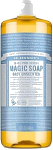
Dr. Bronner’s Pure Castile Soap
Everyone knows Dr. Bronner’s. The label is wild, the product is not. Saponified oils, short ingredient list, been around since the 1940s. It is concentrated, so a little goes a long way.
Here is my honest take though: I mostly use this for laundry. I mix it with washing soda and sometimes borax, and it works great for that at a solid price per load. For dishes? It can do the job, but it feels different from what most people expect. Hard water makes it worse because you can end up with a filmy residue on plates. If you already keep a bottle around the house for other cleaning tasks, sure, use it at the sink too. But I would not buy it specifically as a dish soap. Unscented version is available if the peppermint is not your thing.
What I don’t like: Not purpose-built for dishes. Can leave a film in hard water. Requires dilution and a bit of experimentation.
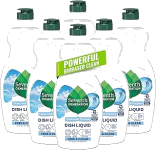
Seventh Generation Free & Clear
I almost left this one off the list. Most “clean living” roundups include Seventh Generation near the top without much scrutiny, and that bugs me. Yes, the Free & Clear version is fragrance-free. Yes, you can find it basically anywhere. Those are real advantages.
But pull up the actual ingredient list. Sodium lauryl sulfate is in there. So are benzisothiazolinone and methylisothiazolinone, the preservatives I flagged earlier. If you are specifically switching to avoid SLS or isothiazolinone-type preservatives, this product does not get you there. I see it more as a stepping stone for people coming from the really harsh conventional stuff, not as a final destination. Read the back of the bottle before you assume the branding tells the whole story.
What I don’t like: Contains sodium lauryl sulfate. Contains preservatives some sensitive users may prefer to avoid. Not as clean as the label implies.
What I Actually Use
Most days it is ECOS Free & Clear. When I feel like mixing up a batch of something, I pull out the Branch Basics concentrate. ECOS wins on convenience. Squirt, wash, done. My hands feel normal after, which sounds like a low bar but really is not once you have spent years using soap that leaves your skin feeling like parchment.
I used to think that tight, stripped feeling after doing dishes meant the soap was working. Took me a while to realize it just meant the formula was harsher than it needed to be. I did not have a comparison point until I tried something else, and then the difference was obvious.
What Matters Most If You Are Choosing Today
Want a dedicated dish soap you can buy at a normal store with good disclosure? Start with ECOS Free & Clear. Easiest swap on this list.
Want the absolute shortest ingredient list and you do not mind mixing a concentrate? Branch Basics.
Want good transparency and a light scent that actually smells nice? Puracy.
Coming from harsh conventional soap and just want something fragrance-free you can find anywhere? Seventh Generation Free & Clear is fine as a first step, but check the ingredients and understand it still has SLS and isothiazolinone preservatives.
Already have Dr. Bronner’s in the house? Go ahead and use it at the sink. It was not designed for dishes specifically, so temper your expectations.
The Bottom Line
Nobody needs to panic about dish soap. But if you have already cleaned up your condiments, your snacks, and your cooking oils, the stuff sitting next to your sink is a pretty easy next target. I am not chasing perfection here. I just want transparency, milder surfactants where I can get them, and fewer mystery ingredients. That filter alone eliminates most of what is on store shelves, and what is left tends to be better for your hands and easier to trust.
Frequently Asked Questions
Do plant-based dish soaps actually cut grease?
Yeah, they do. Surfactants like decyl glucoside and coco-glucoside use the same basic chemistry to break down grease as the synthetic versions. You might need a little more soap or hotter water for baked-on stuff, but for everyday dishes I have not noticed a meaningful difference in cleaning power.
Why does non-toxic dish soap smell like nothing?
Because nobody added synthetic fragrance engineered to linger on your skin for hours. Some of these use essential oils, which are subtler and fade fast. Others have no scent at all. Feels weird for about a week if you are used to the intense lemon or lavender blast from conventional soap. Then the old stuff starts smelling kind of aggressive by comparison.
Is this going to be more expensive?
Depends. Concentrates like Branch Basics look pricey up front but the per-use cost drops fast because one bottle makes a huge amount of diluted product. Ready-to-use picks like ECOS and Attitude land in the same price range as other mid-tier dish soaps. You are not doubling your grocery bill over this.
Will my hands be less dry?
Mine were, noticeably. It is also one of the first things other people mention when they switch away from SLS-based formulas. If your hands currently feel tight and papery after washing dishes, a milder surfactant base might fix that. Not a guarantee, but worth trying before you blame the weather or buy another tube of hand cream.
Can I use these in the dishwasher?
Absolutely not. Dishwasher detergent is a completely different chemistry. Squirt liquid dish soap in there and you will get a foam explosion and possibly damage the machine. If you want a non-toxic dishwasher option, look at dishwasher-specific tablets from ECOS or Seventh Generation.
Isn’t Seventh Generation supposed to be one of the “good” brands?
Better than a lot of what is out there? Sure. But “better” is relative. Their Free & Clear dish soap still contains SLS and isothiazolinone preservatives, which are exactly the ingredients some people are trying to move away from. The brand reputation has gotten ahead of the actual formula. Not terrible, just not as minimal as the name implies. Flip the bottle over and read for yourself.
What about “natural” dish soaps at the grocery store?
“Natural” on a cleaning product means whatever the brand wants it to mean. There is no regulatory standard for it in this category. Some of those products are legitimately simpler. Others are just a green bottle with a leaf on the label and the same old formula inside. Only way to tell the difference is to flip it over and read the actual ingredients. If “fragrance” shows up with zero further explanation, you already have your answer.
This article contains affiliate links. As an Amazon Associate, I earn from qualifying purchases. This doesn’t cost you anything extra. I only recommend products I’ve personally used or thoroughly researched.
